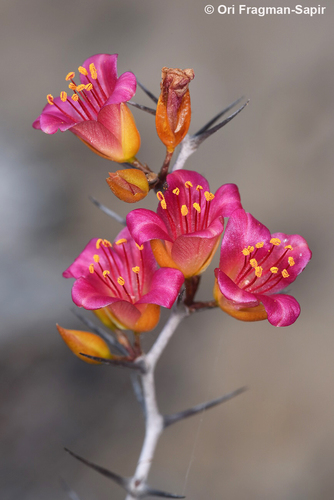
Portulacaceae
The Portulacaceae family, commonly known as the Purslane Family, belongs to the order Caryophyllales. Following major taxonomic revisions based on molecular data, the family is now defined very narrowly, containing only the single genus Portulaca. This genus includes approximately 40-120 species (depending on taxonomic opinion) of succulent annual or perennial herbs and subshrubs. Portulacaceae has a cosmopolitan distribution, particularly abundant in tropical and subtropical regions, often thriving in dry or disturbed habitats.
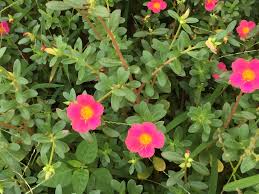
Overview
Portulacaceae, in its current strict sense (sensu stricto), is solely represented by the genus Portulaca. These plants are typically low-growing, fleshy succulents adapted to warm climates and often found in sunny, open, or disturbed sites. Common Purslane (Portulaca oleracea) is a familiar weedy species worldwide, known for its edible, slightly sour leaves rich in omega-3 fatty acids. Moss Rose (Portulaca grandiflora) is a popular garden annual cultivated for its showy, colorful flowers that open in bright sunlight.
Key characteristics of the family (and genus Portulaca) include succulent leaves and stems, flowers with only 2 sepals but typically 5 or more petals and numerous stamens, and a unique fruit type – a circumscissile capsule called a pyxis, which opens by a lid detaching horizontally. Many species also have noticeable hairs or scales in the leaf axils.
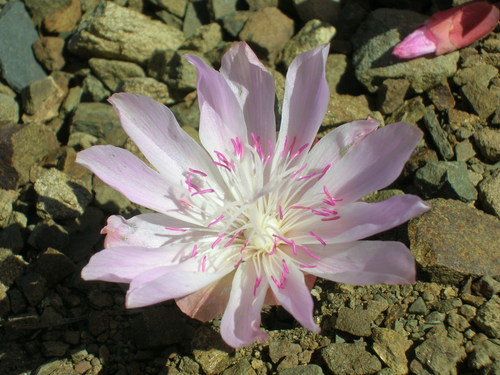
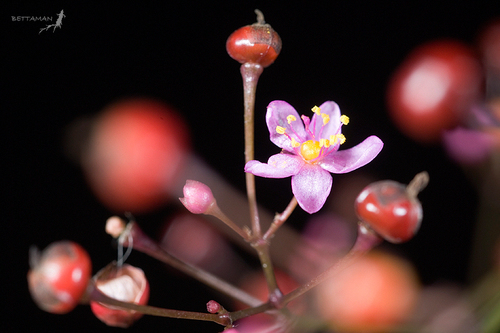
Historically, Portulacaceae was a much larger family, including genera like Claytonia (now Montiaceae), Talinum (now Talinaceae), Lewisia (now Montiaceae), and others. Molecular studies revealed that this broader group was not monophyletic, leading to the segregation of several distinct families and leaving Portulacaceae restricted to just Portulaca.
Quick Facts
- Scientific Name: Portulacaceae
- Common Name: Purslane Family
- Number of Genera: 1 (Portulaca)
- Number of Species: Approximately 40-120
- Distribution: Cosmopolitan, especially tropical and subtropical regions; often in dry or disturbed habitats.
- Evolutionary Group: Eudicots - Core Eudicots - Caryophyllales
Key Characteristics (Portulaca)
Growth Form and Habit
Annual or perennial succulent herbs or subshrubs. Stems are fleshy, often branched, and typically prostrate or ascending.
Leaves
Leaves are usually alternate or subopposite, sometimes appearing whorled beneath the flowers. They are simple with entire margins and are characteristically fleshy and succulent. Leaf shape varies from flattened (obovate, spatulate) to cylindrical (terete). Stipules are typically modified into inconspicuous hairs, scales, or bristles in the leaf axils, or sometimes absent.
Inflorescence
Flowers are borne solitary or, more commonly, in terminal clusters (cymose or head-like), often surrounded by an involucre of several leaves.
Flowers
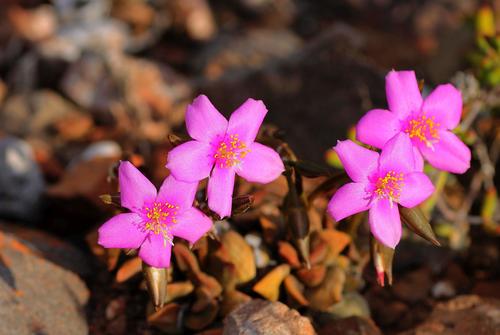
Flowers are actinomorphic (radially symmetrical), bisexual, often showy but typically ephemeral, opening only in bright sunlight for a few hours. Key features include:
- Calyx: Consists of only 2 sepals (rarely more), often fused at the base and sometimes partially fused to the base of the ovary (making the ovary appear half-inferior). Sepals are persistent or fall off after flowering.
- Corolla: Consists of (4-)5(-many) petals, which are free or slightly fused at the very base. They are often brightly colored (yellow, orange, red, pink, magenta, white) and wilt quickly after flowering.
- Androecium: Features (4-)7 to many stamens. Filaments are slender, free or slightly fused at the base.
- Gynoecium: Features a superior or half-inferior ovary composed of (2-)3-8 fused carpels. The ovary is unilocular (one chamber) with numerous ovules attached to a free-central placenta that arises from the ovary base. The style is simple, dividing above into 3-8 linear stigma branches.
Fruits and Seeds
The fruit is a highly characteristic circumscissile capsule (pyxis) – a dry capsule that dehisces horizontally, with the top part lifting off like a lid to release the seeds. The fruit contains numerous small seeds. Seeds are often kidney-shaped or rounded, typically black or gray, with a surface (testa) that can be smooth, granular, or tuberculate (warty).
Chemical Characteristics
Contains mucilage (contributing to succulence), oxalates, some alkaloids, and flavonoids. Characteristically possess betalain pigments (red and yellow nitrogen-containing pigments found in most core Caryophyllales except Caryophyllaceae and Molluginaceae) instead of anthocyanins. Portulaca oleracea is noted for high levels of omega-3 fatty acids. Some species utilize C4 or CAM photosynthesis pathways, adaptations to dry or hot environments.
Field Identification (Portulaca)
Identifying Portulacaceae (the genus Portulaca) relies on recognizing its succulent habit and unique floral and fruit characteristics:
Primary Identification Features
- Habit: Succulent herbs or subshrubs, often low-growing or prostrate.
- Leaves: Usually alternate or subopposite, fleshy/succulent, simple, entire.
- Stipules: Often present as hairs or scales in leaf axils.
- Flowers: Opening in sun, often showy, with only 2 sepals and usually 5 or more petals.
- Stamens: Usually numerous (7+).
- Ovary: Superior or half-inferior, with 3 or more stigma branches.
- Fruit: A circumscissile capsule (pyxis) that opens via a distinct horizontal lid.
Seasonal Identification Tips
- Flowers are often ephemeral, opening only for a few hours in bright sunlight.
- The pyxis fruit, which looks like a small pot with a lid, is highly diagnostic and can be found after flowering.
- The succulent leaves and stems are present throughout the growing season.
Common Confusion Points
Distinguishing Portulaca from other succulent families:
- Montiaceae (Miner's Lettuce Family): Closely related (formerly included), but typically have 2 styles/stigmas (vs. 3+ in Portulaca) and capsules that split vertically by valves (not a pyxis). Flowers often have 5 sepals (sometimes 2) and 5 petals.
- Aizoaceae (Ice Plant Family): Often have opposite leaves; flowers frequently have numerous petal-like staminodes; ovary is often inferior; fruit is usually a loculicidal capsule opening by valves, sometimes hygroscopic (opening when wet).
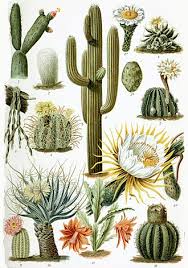
- Cactaceae (Cactus Family): Typically stem succulents (leaves usually absent or highly modified into spines) with spines borne in areoles; flowers have numerous tepals and an inferior ovary.
- Crassulaceae (Stonecrop Family): Often have opposite leaves; flowers usually have carpels that are free or nearly free (apocarpous or nearly so), often with distinct nectar scales at the base; fruit typically consists of separate follicles.
- The combination of 2 sepals, 5+ petals, numerous stamens, 3+ stigmas, and especially the pyxis fruit distinguishes Portulacaceae (Portulaca).
Field Guide Quick Reference (Portulacaceae / Portulaca)
Look For:
- Succulent herbs/subshrubs
- Leaves: Fleshy, usually alternate/subopposite
- Axillary hairs/scales often present
- Flowers: 2 sepals, 5+ petals (showy, open in sun)
- Stamens: Numerous (7+)
- Ovary: Superior/half-inferior
- Stigmas: 3+ branches
- Fruit: Pyxis (circumscissile capsule)
Key Distinctions:
- Pyxis fruit is diagnostic
- 2 sepals + 5 or more petals
- 3+ stigmas (vs. 2 in Montiaceae)
- Superior/half-inferior ovary (vs. inferior in Cactaceae, many Aizoaceae)
- Fused carpels (vs. free in Crassulaceae)
Notable Examples (Portulaca)
The family consists solely of the genus Portulaca, which includes well-known species:

Portulaca oleracea
Common Purslane
A widespread annual weed with prostrate, succulent stems, spatulate fleshy leaves, and small yellow flowers that open briefly in the morning. It is edible and known for its high nutritional value, including omega-3 fatty acids.

Portulaca grandiflora
Moss Rose, Eleven O'Clock
A popular annual garden ornamental native to South America. It has terete (cylindrical), succulent leaves and large, showy flowers in bright shades of pink, red, orange, yellow, and white that open in full sun. Numerous cultivars exist.

Other Portulaca spp.
(Various Purslanes)
The genus includes many other species native to various parts of the world, particularly tropical and subtropical regions. They vary in flower color, leaf shape (flattened vs. terete), and habit (annual vs. perennial, prostrate vs. erect), often adapted to dry, sunny conditions.
Phylogeny and Classification
Portulacaceae, in its current strict definition (sensu stricto), belongs to the order Caryophyllales within the Core Eudicots. The family's circumscription has been drastically reduced based on molecular phylogenetic studies, which showed the traditional Portulacaceae to be paraphyletic.
Now containing only the genus Portulaca, the family is part of the "portulacine" clade (or suborder Portulacineae) within Caryophyllales. This clade is characterized by succulent habits and includes other families segregated from the old Portulacaceae, such as Montiaceae, Talinaceae, Anacampserotaceae, and Didiereaceae, as well as the iconic Cactaceae (Cactus family). The relationships among these families are complex and subject to ongoing research, but Portulacaceae s.s. represents a distinct lineage within this succulent group.
Position in Plant Phylogeny
- Kingdom: Plantae
- Clade: Angiosperms (Flowering plants)
- Clade: Eudicots
- Clade: Core Eudicots
- Order: Caryophyllales
- Family: Portulacaceae (sensu stricto)
Evolutionary Significance
Portulacaceae sensu stricto (Portulaca) is significant for:
- Being a key example of how molecular phylogenetics led to major taxonomic realignments, drastically narrowing family boundaries.
- Representing a distinct lineage within the succulent clade (Portulacineae) of Caryophyllales, showcasing adaptations to arid and disturbed environments.
- Exhibiting physiological adaptations like C4 and CAM photosynthesis in various species, allowing survival in harsh conditions.
- Possessing the unique pyxis fruit (circumscissile capsule), a specialized type of dehiscence.
- Including globally distributed weeds (P. oleracea) and popular ornamentals (P. grandiflora), demonstrating ecological and horticultural success.