Didiereaceae
Didierea Family
Didiereaceae is a family of succulent shrubs and small trees adapted to arid environments, primarily known from Madagascar, with additional genera in mainland Africa. Often characterized by spiny stems and small, sometimes ephemeral leaves, these plants belong to the order Caryophyllales, which includes many other succulent lineages like cacti and purslanes.
Overview
The Didiereaceae family, in its modern circumscription (APG IV), includes 6 genera and about 16-20 species. The core group (subfamily Didiereoideae with 4 genera) is endemic to the unique spiny thickets of southern and southwestern Madagascar. The family was expanded to include Portulacaria and Calyptrotheca from mainland eastern and southern Africa, based on strong molecular evidence linking these previously separate families.
These plants are highly adapted to dry conditions, exhibiting succulence in stems and/or leaves, often possessing spines for defense and possibly reducing water loss, and frequently having small or seasonally deciduous leaves. Photosynthesis may occur primarily in the stems in some species. Flowers are generally small and unisexual (plants dioecious) in the Malagasy genera, while Portulacaria has bisexual flowers. Phylogenetically, Didiereaceae is nested within the Caryophyllales, an order renowned for its evolutionary diversification into arid environments and the repeated evolution of succulence.
Several species, particularly from the Malagasy genera and Portulacaria afra, are cultivated as curiosities by succulent collectors worldwide.
Quick Facts
- Scientific Name: Didiereaceae Radlk.
- Common Name: Didierea Family
- Number of Genera: Approximately 6
- Number of Species: Approximately 16-20
- Distribution: Disjunct: Madagascar and Eastern/Southern Africa.
- Evolutionary Group: Angiosperms - Eudicots - Core Eudicots - Caryophyllales
- Habit: Succulent shrubs or small trees, often spiny.
Key Characteristics
Growth Form and Habit
Plants are succulent shrubs or small trees adapted to arid conditions. Stems are often thick, woody or succulent, and frequently armed with formidable spines. Spines can be modified stipules or arise from short shoots (brachyblasts) that also bear the leaves. Some Malagasy species have distinctive columnar or octopus-like branching patterns. Portulacaria is typically a non-spiny succulent shrub or small tree.
Leaves
Leaves are usually alternate (spirally arranged), but opposite in Portulacaria. They are simple with entire margins. Leaves are often small, fleshy/succulent, sometimes cylindrical or scale-like, and can be deciduous during the dry season or short-lived (ephemeral), especially in the spiny Malagasy genera where stems are the primary photosynthetic organs. In Didiereoideae, leaves are often clustered on short shoots (brachyblasts) located in the axils of spines. Stipules may be present (sometimes modified into spines) or absent.
Inflorescence
Flowers are borne in axillary or terminal cymes or tight clusters (fascicles), sometimes appearing solitary.
Flowers
Flowers are generally small, radially symmetrical (actinomorphic), and can be unisexual or bisexual. Plants are often dioecious (especially Didiereoideae) or sometimes monoecious; Portulacaria typically has bisexual flowers.
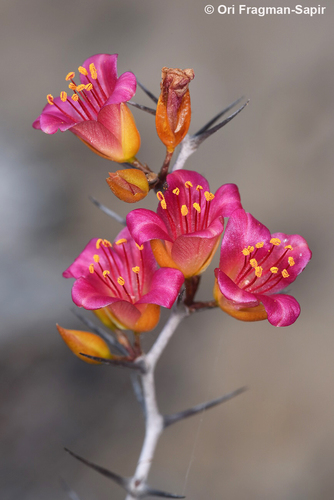
- Perianth: Distinctive structure usually consisting of only 2 outer, persistent, bract-like structures commonly interpreted as sepals, and (2-)4(-5) inner, often petaloid (petal-like) tepals which are typically free or slightly fused at the base. Tepals are often white, pink, yellowish, or greenish.
- Androecium (Male or Bisexual Flowers): Stamens usually number 8-10 (sometimes fewer or more), often arranged in two whorls. Filaments are free or slightly fused at the base. Anthers have two pollen sacs and open via longitudinal slits.
- Gynoecium (Female or Bisexual Flowers): Features a superior ovary composed of 2-4 (usually 3) fused carpels, forming a single chamber (unilocular). A single ovule is attached at the base of the locule (basal placentation). A single style is present, usually topped by 2-4 stigmatic lobes or branches.
Fruits and Seeds
The fruit is typically a small, dry, indehiscent, one-seeded unit, either a nutlet or a samara (winged nutlet). The fruit may be enclosed or subtended by the persistent bract-like sepals or tepals. The seed contains a curved embryo and nutritive tissue called perisperm (derived from the nucellus, typical of Caryophyllales).
Chemical Characteristics
Many species likely utilize CAM photosynthesis (Crassulacean Acid Metabolism) as an adaptation to conserve water in arid environments. The presence of betalain pigments (responsible for red/yellow colors, characteristic of many Caryophyllales) instead of anthocyanins is likely but needs confirmation across all genera. Mucilage cells may be present.
Field Identification
Identifying Didiereaceae involves recognizing their succulent, often spiny nature within their specific geographic ranges (Madagascar and mainland Africa):
Primary Identification Features
- Succulent shrub or tree habit: Plants adapted to dry conditions with fleshy stems and/or leaves.
- Spiny stems (common in Malagasy genera): Presence of sharp spines, often associated with clusters of small leaves on short shoots.
- Small, simple leaves: Often fleshy, sometimes ephemeral or deciduous, alternate or opposite (Portulacaria).
- Small flowers with distinctive perianth: Look for 2 outer bract-like sepals and 4-5 inner petaloid tepals.
- Superior, unilocular ovary: Ovary located above perianth attachment, with a single chamber and basal ovule.
- Geographic location: Found only in arid regions of Madagascar or Eastern/Southern Africa.
Secondary Identification Features
- Dioecious condition (common): Male and female flowers on separate plants.
- CAM photosynthesis indicators: Thick fleshy tissues.
- Fruit type: Small, dry nutlet or samara.
Seasonal Identification Tips
Stem and spine characteristics are useful year-round:
- Year-round: Succulent habit, stem structure, presence/arrangement of spines are constant features.
- Growing/Rainy Season: Leaves are most likely to be present.
- Flowering/Fruiting Season (Varies): Small flowers or dry fruits may be observed, confirming identification.
Common Confusion Points
Distinguishing Didiereaceae from other succulent/spiny groups:
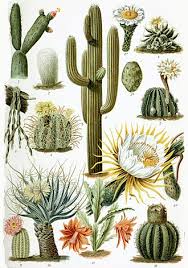
- Cactaceae (Cacti): Primarily New World (except Rhipsalis). Possess areoles (specialized pads from which spines, flowers, and branches arise). Flowers typically have numerous tepals and stamens, and an inferior ovary. Fruit is usually a berry.
- Euphorbiaceae (Succulent Euphorbias): Many African succulents resemble cacti but lack areoles, often produce milky latex when broken, and have highly specialized, reduced flowers arranged in cyathia. Fruit is typically a 3-parted capsule.
- Apocynaceae (Succulent Asclepiads/Stapeliads): Stem succulents often found in Africa, frequently lack spines or have softer emergences, often have milky latex, and possess complex 5-merous flowers often with a corona and specialized pollinia. Fruit typically paired follicles.
- Focus on the combination: Succulent Shrub/Tree (Madagascar/Africa) + Often Spiny + Small Leaves (often ephemeral/clustered) + Flowers with 2 Sepals & 4-5 Tepals + Superior Unilocular Ovary = Didiereaceae.
Field Guide Quick Reference
Look For:
- Succulent shrub or small tree
- Often spiny stems
- Leaves: Simple, small, often fleshy/deciduous
- Flowers: Small, unisexual or bisexual
- Perianth: 2 sepals + (2-)4(-5) tepals
- Stamens: 8-10
- Ovary: Superior, 1-locular, 1 basal ovule
- Fruit: Dry nutlet or samara
- Distribution: Madagascar or E/S Africa
Key Variations:
- Spines present/absent (Portulacaria)
- Leaves alternate/opposite (Portulacaria)
- Dioecious vs. bisexual flowers
- Growth form (columnar, branching shrub)
Notable Examples
The family includes iconic plants from Madagascar's spiny forests and a well-known succulent from Africa:

Didierea madagascariensis
Octopus Tree
Endemic to Madagascar. A small tree with thick, succulent, spiny stems that branch near the top like octopus arms. Leaves are small, linear, and deciduous, clustered on short shoots along the spiny stems.

Alluaudia procera
Madagascar Ocotillo
Endemic to Madagascar. Forms thickets of tall, columnar, sparsely branched stems covered in spines and small, rounded succulent leaves (often deciduous). A dominant species in the spiny forests.

Portulacaria afra
Spekboom / Elephant Bush / Dwarf Jade
Native to Southern Africa. A non-spiny succulent shrub or small tree with thick, reddish stems and small, opposite, fleshy, obovate leaves. Has small pink, bisexual flowers. Widely cultivated and important ecologically for carbon sequestration.
Phylogeny and Classification
Didiereaceae is firmly placed within the order Caryophyllales, a large and diverse order within the core eudicots. This order is particularly known for its high number of succulent plant families and adaptations to arid environments.
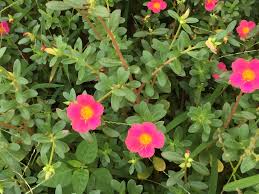
Within Caryophyllales, Didiereaceae belongs to the "succulent clade," which also includes families like Cactaceae (Cacti), Portulacaceae (Purslanes), Talinaceae, Anacampserotaceae, and Montiaceae. Molecular studies indicate a close relationship between Didiereaceae and these families, highlighting shared ancestry and likely convergent evolution of succulent traits. The inclusion of the African genera (Portulacaria, Calyptrotheca) with the Malagasy Didiereoideae into a single family reflects ancient biogeographic connections between Africa and Madagascar.
Position in Plant Phylogeny
- Kingdom: Plantae
- Clade: Angiosperms (Flowering plants)
- Clade: Eudicots
- Clade: Core Eudicots
- Order: Caryophyllales
- Family: Didiereaceae
Evolutionary Significance
Didiereaceae is significant for understanding:
- Adaptation to Aridity: Provides striking examples of convergent evolution of succulence, spines, and reduced leaves for survival in dry environments, similar to New World cacti but via a different evolutionary path.
- Biogeography: The disjunct distribution between Madagascar and mainland Africa offers insights into the geological and climatic history connecting these landmasses.
- Phylogeny within Caryophyllales: Helps resolve relationships within the major succulent clade of this diverse order.
- Madagascar's Unique Flora: The endemic Malagasy genera are iconic components of the unique spiny forest ecosystem, highlighting the island's importance as a center of endemism.