Talinaceae
Fameflower Family
Talinaceae is a relatively small family of herbaceous plants and subshrubs, often with succulent leaves or stems, belonging to the order Caryophyllales. They are known for their often brightly colored but short-lived (ephemeral) flowers, typically possessing 2 sepals and 5 petals.
Overview
Talinaceae is a family within the diverse order Caryophyllales, which includes well-known groups like cacti (Cactaceae), carnations (Caryophyllaceae), amaranths (Amaranthaceae), and Portulacaceae (purslanes). Talinaceae itself is relatively small, containing about 2 genera (primarily Talinum and Talinella) and around 28 species.
Members of the family are distributed mainly in the Americas and Africa, including Madagascar. They often inhabit seasonally dry or arid environments and exhibit adaptations such as succulence and tuberous roots. The family was segregated from the broader Portulacaceae based on molecular phylogenetic evidence.
Some species, like Talinum paniculatum (Jewels of Opar) are cultivated as ornamentals, while others, such as Talinum fruticosum (Waterleaf), are used as leafy vegetables in parts of Africa and Asia.
Quick Facts
- Scientific Name: Talinaceae
- Common Name: Fameflower family
- Number of Genera: Approximately 2 (Talinum, Talinella)
- Number of Species: Approximately 28
- Distribution: Americas, Africa, Madagascar
- Evolutionary Group: Eudicots - Core Eudicots - Caryophyllales
Key Characteristics
Growth Form and Habit
Plants in the Talinaceae family are typically perennial herbs or subshrubs. Many species exhibit succulence in their leaves and/or stems. They often possess thickened taproots, tuberous roots, or sometimes a caudex (a swollen stem base) for water and nutrient storage.
Leaves
Leaves are simple, usually entire (smooth margins), and arranged alternately or oppositely along the stem, sometimes clustered in basal rosettes. They are often fleshy or succulent. Stipules are generally absent or very small and scale-like.
Inflorescence
Flowers are borne in terminal or axillary inflorescences, typically cymes or panicles, though sometimes flowers are solitary. Inflorescences are often open and airy.
Flowers
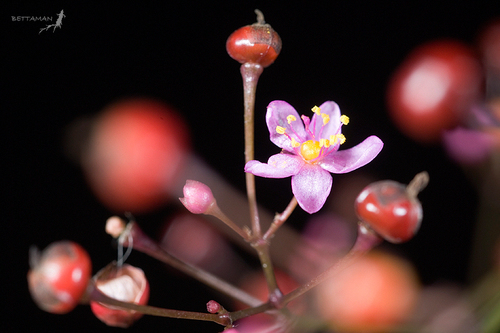
Flowers are usually bisexual and actinomorphic (radially symmetrical). A key characteristic is their ephemeral nature – they often open for only a few hours, typically around midday. Key floral characteristics include:
- Calyx: Composed of 2 distinct sepals, which are often caducous (falling off early as the flower opens or shortly after).
- Corolla: Composed of 5 distinct petals (rarely more), typically pink, purple, yellow, or white. Petals are usually delicate and short-lived.
- Androecium: Stamens number from 5 to many (often numerous), distinct.
- Gynoecium: A single superior ovary composed of 3 (rarely 2) fused carpels. It has a single locule with basal or free-central placentation and contains few to many ovules. The style is single with 3 stigmatic lobes.
Fruits and Seeds
The fruit is typically a capsule that dehisces (splits open) longitudinally by 3 valves to release the seeds. The seeds are small, often black, shiny, and sometimes patterned or textured.
Chemical Characteristics
Many species possess mucilage cells, contributing to their succulent texture. Some species exhibit CAM (Crassulacean acid metabolism) or C4 photosynthesis, adaptations common in plants from arid environments within Caryophyllales. Betalain pigments (red and yellow pigments found in Caryophyllales) are likely present, replacing anthocyanins.
Field Identification
Identifying Talinaceae relies on recognizing their succulent habit and distinctive floral structure, especially the number of sepals and petals, and the ephemeral nature of the flowers.
Primary Identification Features
- Succulent Habit: Plants are typically herbs or subshrubs with fleshy leaves and/or stems.
- Alternate or Opposite Simple Leaves: Leaves undivided, often succulent.
- Actinomorphic Flowers with 2 Sepals and 5 Petals: This combination is key. Sepals often fall early.
- Ephemeral Flowers: Flowers open for only a few hours, often around midday.
- Superior Ovary: Ovary positioned above sepals and petals, typically with 3 carpels/stigmas.
Secondary Identification Features
- Numerous Stamens: Often more than 5 stamens.
- Capsule Fruit: Dry fruit splitting open by 3 valves.
- Tuberous Roots or Caudex: Often present.
- Habitat: Often found in drier, sunny, or disturbed habitats.
Seasonal Identification Tips
Features vary seasonally:
- Flowering Season: Varies, often during warmer, wetter periods. Catching the flowers requires observation during their short opening window (usually midday). Note the 2 sepals / 5 petals structure.
- Fruiting Season: Capsules develop after flowering. Look for the 3-valved structure.
- All Seasons (Vegetative): The succulent leaves and stems, along with tuberous roots (if visible/excavated), are year-round clues.
Common Confusion Points
Talinaceae might be confused with other families in Caryophyllales, particularly those formerly included in Portulacaceae sensu lato:
- Portulacaceae (Purslane Family): Now restricted to Portulaca. Also has 2 sepals and often 5 petals, but has a half-inferior ovary and a circumscissile capsule (opening like a lid).
- Montiaceae (Miner's Lettuce Family): Diverse family, some succulent herbs with 2 sepals, but floral details (stamen number, ovary structure, placentation) and fruit types often differ.
- Cactaceae (Cactus Family): Highly succulent, but usually lack typical leaves (except Pereskia), possess areoles with spines, and have inferior ovaries with numerous tepals/stamens.
- Anacampserotaceae: Small family of succulent subshrubs, closely related, often with hairs in leaf axils, 2 sepals, 5 petals, but details of capsule and seed structure differ.
Field Guide Quick Reference
Look For:
- Succulent herbs or subshrubs
- Alternate/opposite simple leaves
- Flowers with 2 sepals (often falling early)
- Flowers with 5 petals (often pink/yellow/purple)
- Ephemeral flowers (open few hours)
- Superior ovary (3 carpels)
- Capsule fruit (3-valved)
Key Variations:
- Leaf shape (flat vs. cylindrical)
- Flower color
- Presence of tuberous roots/caudex
- Inflorescence structure (panicle, cyme)
Notable Examples
Examples primarily come from the genus Talinum.

Talinum paniculatum
Jewels of Opar / Fameflower
Native to much of the Americas, this species is often cultivated as an ornamental. It has somewhat fleshy leaves and produces tall, airy panicles of small, bright pink, ephemeral flowers, followed by jewel-like, globose, reddish or yellowish capsules.

Talinum fruticosum (syn. T. triangulare)
Waterleaf / Ceylon Spinach / Lagos Bologi
Originating in the Americas and Africa, this species is cultivated as a leafy vegetable in many tropical regions. It has succulent stems and leaves, and pink ephemeral flowers. It thrives in humid conditions.

Talinum calycinum
Rock Pink / Large-flowered Fameflower
Native to the central United States, this species grows in dry, rocky habitats like glades. It has succulent, linear leaves in a basal cluster and produces bright pink flowers on slender stalks that open in the afternoon. It has a tuberous root.
Phylogeny and Classification
Talinaceae belongs to the core Caryophyllales, a large and diverse order characterized by adaptations to stressful environments (succulence, CAM/C4 photosynthesis, salt tolerance) and the presence of betalain pigments in many families. Talinaceae was segregated from Portulacaceae based on molecular data.
Within the Caryophyllales, Talinaceae is part of the "portulacine clade," which includes other succulent families like Portulacaceae, Cactaceae, Montiaceae, Didiereaceae, and Anacampserotaceae. Its exact relationships within this clade are still being refined by ongoing research.
Position in Plant Phylogeny
- Kingdom: Plantae
- Clade: Angiosperms (Flowering plants)
- Clade: Eudicots
- Clade: Core Eudicots
- Order: Caryophyllales
- Family: Talinaceae
Evolutionary Significance
Talinaceae is significant for understanding:
- Evolution of Succulence: Contributes to understanding the repeated evolution of succulence and associated physiological adaptations (CAM/C4) within Caryophyllales.
- Relationships within Caryophyllales: Its phylogenetic position helps resolve the complex relationships among the succulent families in the order.
- Floral Evolution: The characteristic 2-sepal, 5-petal structure and ephemeral nature of the flowers represent specific evolutionary pathways.
- Biogeography: Distribution patterns across Africa and the Americas provide clues about historical connections and dispersal.