Anacampserotaceae
Anacampseros Family
Anacampserotaceae is a small family of succulent plants in the order Caryophyllales, closely related to cacti and purslanes. It comprises perennial herbs and subshrubs adapted to arid environments, characterized by fleshy leaves, often prominent hairs or scales in the leaf axils, and flowers with typically two sepals and five ephemeral petals. The family has a disjunct distribution across Southern Africa, Australia, and South America.
Overview
Anacampserotaceae is a relatively small family, segregated from the broader Portulacaceae sensu lato based on molecular phylogenetic data. It includes 3 genera (Anacampseros, Grahamia, Talinopsis) and about 35-40 species. These plants are specialized xerophytes, thriving in arid and semi-arid regions. Their distribution is notably disjunct, with the main center of diversity for Anacampseros in Southern Africa, while Grahamia is found in Argentina and Talinopsis in southwestern USA and Mexico (representing possible links via Australia).
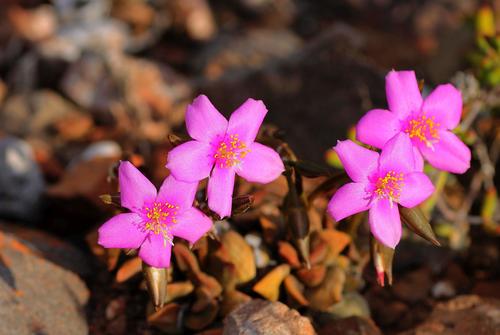
Members are typically small perennial succulents, often forming compact cushions or mats, or possessing a thickened caudex (stem base) or tuberous roots. A highly characteristic feature is the presence of conspicuous hairs or papery scales (interpreted as modified stipules) in the leaf axils, which can be sparse or form dense woolly coverings along the stem. Flowers are often colourful but short-lived (ephemeral), opening for only a few hours in bright sun.
The primary significance of Anacampserotaceae is horticultural, particularly the genus Anacampseros, which is popular among collectors of succulent plants for its diverse leaf shapes, colors, and axillary hairs. They have little to no major economic use otherwise. Their phylogenetic position within the succulent clade of Caryophyllales makes them important for studying the evolution of succulence and adaptations to arid environments.
Quick Facts
- Scientific Name: Anacampserotaceae
- Common Name: Anacampseros family (no widely used common name)
- Number of Genera: 3 (Anacampseros, Grahamia, Talinopsis)
- Number of Species: Approximately 35-40
- Distribution: Disjunct: Southern Africa (main center), Australia, SW USA/Mexico, Argentina
- Evolutionary Group: Eudicots - Core Eudicots - Caryophyllales
- Current Date: March 29, 2025
Key Characteristics
Growth Form and Habit
Perennial succulent herbs or subshrubs, often low-growing, sometimes forming cushions or mats. Frequently possess a thickened caudex or tuberous rootstock. Stems may be short and congested or somewhat elongated.
Leaves
Leaves are alternate (often appearing crowded or rosulate), simple, and usually succulent/fleshy with entire margins. Leaf shape varies from flattened spatulate or ovate to cylindrical or globose. A key feature is the presence of hairs or dry, papery scales in the leaf axils, sometimes very dense and woolly, obscuring the stem.
Inflorescence
Flowers are often solitary or borne in few-flowered terminal cymes or thyrses, frequently subtended by bracts. Flowers are often ephemeral, opening briefly in sunlight.
Flowers
Flowers are bisexual and actinomorphic (radially symmetrical).
- Calyx: Consists of only 2 (rarely 3) fleshy sepals, opposite each other, often persistent around the fruit.
- Corolla: Usually 5 petals (sometimes more, up to 10), distinct or slightly fused at the base. Petals are typically delicate, quickly wilting, and colored white, pink, or purplish.
- Androecium: Stamens number from 5 to about 20 (few to numerous), with distinct filaments that may be shortly fused at the very base.
- Gynoecium: Ovary is superior, composed of 3 fused carpels forming a single locule (unilocular). Ovules are few to many, attached to a free-central or basal placenta. There is a single style, usually ending in 3 receptive stigmatic lobes or branches.
Fruits and Seeds
The fruit is typically a capsule that dehisces loculicidally via 3 valves, often remaining enclosed within the persistent sepals. Sometimes opening resembles a circumscissile capsule (pyxis).
Seeds are numerous, often angled or somewhat flattened, sometimes winged or papillose (covered in small bumps). The embryo is curved around the nutritive perisperm tissue.
Chemical Characteristics
Anacampserotaceae possess betalain pigments for red/yellow coloration, characteristic of the core Caryophyllales. CAM (Crassulacean Acid Metabolism) photosynthesis is likely common given their succulent nature and arid habitats. The axillary hairs or scales are a defining morphological feature.
Field Identification
Identifying Anacampserotaceae relies on recognizing their succulent habit, specific floral structure (especially the 2 sepals), and the characteristic axillary hairs/scales:
Primary Identification Features
- Habit: Small succulent perennial herbs or subshrubs, often low-growing or caudiciform.
- Axillary Hairs/Scales: Presence of often conspicuous hairs or papery scales in the leaf axils (a key feature).
- Alternate, Fleshy Leaves: Simple, entire leaves, often crowded.
- Flowers with 2 Sepals: Calyx consists of only two (rarely three) fleshy, persistent sepals.
- 5 Ephemeral Petals (Usually): Corolla typically has five delicate petals (white, pink, purple) that wilt quickly.
- Superior Ovary with Free-Central/Basal Placentation: Ovary positioned above floral parts, unilocular.
- 3-Valved Capsule Fruit: Fruit typically a capsule opening by three valves, often enclosed by sepals.
- Arid Habitat Distribution: Found in dry regions of Southern Africa, Australia, or the Americas.
Secondary Identification Features
- Betalain Pigments: Flowers (and sometimes leaves) show pink/purple/yellow colors typical of betalains.
- Few-flowered Inflorescences: Flowers often solitary or in small clusters.
- Brief Flower Opening: Flowers may only open for a few hours during the day.
Seasonal Identification Tips
- Year-round: The succulent form and distinctive axillary hairs/scales allow identification of vegetative plants.
- Flowering Season: Varies with species and rainfall patterns in their arid habitats. Look for the characteristic 2-sepaled, 5-petaled flowers opening briefly in sun.
- Fruiting Season: Capsules develop after flowering and may persist, often surrounded by the sepals.
Common Confusion Points
- Portulacaceae sensu stricto (Purslane family): Closely related, also succulent herbs with often 2 sepals. Portulaca typically has more numerous petals and stamens, often opposite upper leaves or an involucre below the flower, and fruit is usually a circumscissile capsule (pyxis). Axillary hairs may be present but often less prominent or different in form.
- Talinaceae / Montiaceae: Other families segregated from the old Portulacaceae. They share succulent habits and belong to Caryophyllales but differ in details of flower structure (e.g., number of sepals/petals/stamens), placentation, fruit type, and presence/absence/type of axillary structures. Talinum (Talinaceae) often has paniculate inflorescences. Montia/Claytonia (Montiaceae) often have 2 sepals but different leaf arrangements and capsule types.
- Crassulaceae (Stonecrop family): Also leaf succulents. Distinguished by typically having flower parts in 4s or 5s (sepals, petals, stamens often equal or double petals), superior ovary usually with distinct or basally fused carpels (not unilocular with free-central placentation), fruit usually follicles, and presence of anthocyanins (not betalains).
- Aizoaceae (Ice Plant family): Also succulent Caryophyllales with betalains. Distinguished by flowers usually having numerous petaloid staminodes (not 5 true petals), often an inferior or half-inferior ovary, and frequently a hygrochastic capsule fruit.
The combination of succulent habit, axillary hairs/scales, 2 sepals, 5 ephemeral petals, superior ovary with free-central/basal placentation, and 3-valved capsule is characteristic of Anacampserotaceae.
Field Guide Quick Reference
Look For:
- Small succulent herbs/subshrubs
- Alternate, fleshy leaves
- Hairs/scales in leaf axils
- Flowers with 2 sepals
- Flowers with 5 (often ephemeral) petals
- Stamens few to many (~5-20)
- Superior ovary, 3 carpels, unilocular
- Fruit a 3-valved capsule
- Arid zone distribution (S Afr, Aus, Am)
Key Variations:
- Axillary structures: Hairs vs. Scales, sparse vs. dense
- Leaf shape: Flattened, terete, globose
- Presence/size of caudex/tuber
- Flower color (white, pink, purple)
- Stamen number
Notable Examples
The family is small, with most diversity within the genus Anacampseros:

Anacampseros rufescens
Sunrise succulent
A popular species in cultivation, native to South Africa. Forms small rosettes of fleshy, pointed leaves that are green above and purplish below, often turning bright colors in strong light. Has sparse white hairs in leaf axils. Produces pink flowers on taller stalks.

Anacampseros telephiastrum
(Variegated form shown)
Another South African species often found in collections, closely related to A. rufescens. Characterized by relatively broad, fleshy leaves. Variegated forms with pink and cream coloration are particularly popular. Axillary hairs are usually sparse.

Anacampseros filamentosa
Hairy Anacampseros
A species from Southern Africa notable for its much denser covering of long, white, crinkly hairs in the leaf axils, often obscuring the small succulent leaves. This dense covering is thought to reflect sunlight and reduce water loss.

Grahamia australis
(Argentine genus)
Represents the genus Grahamia, found in arid regions of Argentina. These are typically small subshrubs with somewhat woody stems, cylindrical succulent leaves, and sparse axillary hairs. Flowers are white or pinkish with 2 sepals and 5 petals, typical for the family.
Phylogeny and Classification
Anacampserotaceae belongs to the order Caryophyllales, specifically within the 'succulent clade' or 'Portulacineae' suborder. This suborder includes families well-known for succulence and adaptation to arid environments, such as Cactaceae, Portulacaceae sensu stricto, Talinaceae, Montiaceae, and Didiereaceae. Anacampserotaceae was segregated from the formerly broad Portulacaceae based on molecular phylogenetic evidence that showed the traditional family was not monophyletic.
Within the Portulacineae clade, Anacampserotaceae appears to be closely related to Portulacaceae s.s. and Cactaceae. Its exact position relative to these families is still an area of research, but it represents a distinct lineage characterized by the combination of axillary hairs/scales, 2 sepals, 5 ephemeral petals, and a 3-carpellary superior ovary with free-central/basal placentation. Its disjunct distribution suggests ancient origins and possible Gondwanan connections or long-distance dispersal events.
Position in Plant Phylogeny
- Kingdom: Plantae
- Clade: Angiosperms (Flowering plants)
- Clade: Eudicots
- Clade: Core Eudicots
- Order: Caryophyllales
- Family: Anacampserotaceae
Evolutionary Significance
Anacampserotaceae provides insights into the evolution of succulents and arid adaptation:
- Part of Succulent Radiation: Represents one distinct lineage within the major evolutionary radiation of succulent plants in the order Caryophyllales.
- Evolution of Axillary Structures: The characteristic hairs or scales in leaf axils are a notable morphological specialization, possibly related to protection, water conservation, or light reflection.
- Biogeography: The highly disjunct distribution across Southern Africa, Australia, and the Americas raises interesting questions about ancient continental connections (Gondwana) versus long-distance dispersal in arid-adapted plants.
- Relationship to Cacti/Portulaca: Its phylogenetic position helps clarify the evolutionary steps leading to the extreme succulence seen in cacti and the specialized features of purslanes.