
Oleandraceae
Oleandra Fern Family
Oleandraceae is a monogeneric family of ferns in the order Polypodiales, containing only the genus Oleandra with approximately 40 species. These distinctive ferns are characterized by their long-creeping rhizomes with dense scales, simple undivided fronds that are articulated at the base, and round sori with reniform (kidney-shaped) indusia. The family has a pantropical distribution, occurring in tropical regions of Asia, Africa, and the Americas, typically as epiphytes or lithophytes in montane forests.
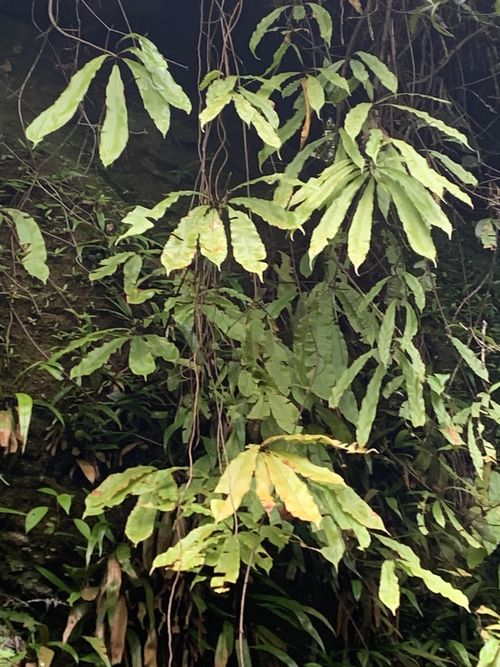
Overview
The Oleandraceae family is a small but distinctive group of ferns represented by a single genus, Oleandra. The name of the genus is derived from the resemblance of its fronds to those of the flowering plant Nerium oleander (Oleander). These ferns are primarily epiphytic or lithophytic, growing on trees or rocks in tropical montane forests.
The family has a pantropical distribution, with species occurring in tropical regions of Asia, Africa, and the Americas. The greatest diversity of species is found in Southeast Asia, particularly in the Malesian region. Many species have relatively restricted distributions and are adapted to specific ecological niches.
Oleandraceae ferns are characterized by their long-creeping rhizomes that allow them to spread across tree trunks or rock surfaces. The simple, undivided fronds emerge at intervals along the rhizome and are distinctively articulated at the base, allowing them to be shed cleanly when they age.
Quick Facts
- Scientific Name: Oleandraceae
- Common Name: Oleandra Fern Family
- Number of Genera: 1 (Oleandra)
- Number of Species: Approximately 40
- Distribution: Pantropical (Asia, Africa, Americas)
- Evolutionary Group: Monilophytes - Leptosporangiate Ferns - Polypodiales
Key Characteristics
Growth Form and Habit
Members of Oleandraceae are primarily epiphytic or lithophytic ferns, growing on trees or rocks. They have long-creeping rhizomes that are densely covered with scales, allowing them to spread across surfaces. Some species may occasionally grow terrestrially in humus-rich soil.
Rhizomes
The rhizomes are long-creeping and typically 3-10 mm in diameter. They are densely covered with distinctive scales that are often dark brown to black, lanceolate, and have denticulate (toothed) margins. These scales are a key diagnostic feature for the family.
Fronds
The fronds of Oleandraceae are simple and undivided (entire), lanceolate to linear-lanceolate in shape, and typically 15-50 cm long. They are articulated at the base (attached to the rhizome by a joint), which is a distinctive feature of the family. The stipes (stems) are usually short, and the laminae (blades) have entire to slightly undulate margins with a prominent midrib.
Reproductive Structures
The sori (clusters of spore-producing structures) are round and arranged in a single row on either side of the midrib. They are covered with reniform (kidney-shaped) indusia that are attached at the notch. The spores are bilateral and monolete (with a single linear scar).
Distinguishing Features
Oleandraceae can be distinguished from other fern families by a combination of:
- Long-creeping rhizomes with distinctive scales
- Simple, undivided fronds articulated at the base
- Round sori with reniform indusia arranged in a row on either side of the midrib
- Epiphytic or lithophytic habit in tropical montane forests

Typical frond structure of an Oleandra species showing the simple, undivided lamina and arrangement of sori along the midrib.
Identification
Field Identification Tips
When trying to identify members of the Oleandraceae family in the field, look for:
- Long-creeping rhizomes densely covered with dark scales
- Simple, undivided fronds emerging at intervals along the rhizome
- Articulation point at the base of each frond
- Round sori arranged in a row on either side of the midrib
- Epiphytic or lithophytic growth habit in tropical montane forests
Similar Families
Oleandraceae may be confused with several other fern families that have simple fronds:
- Polypodiaceae: Some members have simple fronds, but they typically lack the distinctive articulation at the frond base and have different sori arrangements.
- Davalliaceae: Has more divided fronds and different sori structure.
- Nephrolepidaceae: Has pinnate fronds rather than simple ones.
- Lomariopsidaceae: Some members have simple fronds but different rhizome structure and sori arrangement.
Distinguishing Features
The most reliable features for distinguishing Oleandraceae from similar ferns include:
- Articulation at frond base: The distinctive joint where the frond attaches to the rhizome
- Rhizome scales: Dense, dark scales with denticulate margins
- Sori arrangement: Single row on either side of the midrib
- Indusia shape: Reniform (kidney-shaped)
For definitive identification, examination of the rhizome scales and articulation point is often necessary, as these features are the most diagnostic for the family.
Notable Examples
The family Oleandraceae contains only the genus Oleandra with approximately 40 species. Here are some notable representatives:

Oleandra neriiformis
Neriform Oleandra Fern
One of the most widespread species in the genus, found throughout tropical Asia from India to the Pacific islands. It has long-creeping rhizomes with dark brown to black scales and lanceolate fronds that are typically 20-40 cm long. This species is primarily epiphytic in montane forests and is highly variable in morphology across its range.

Oleandra pistillaris
African Oleandra Fern
Native to tropical Africa, this species has erect to ascending rhizomes that are densely covered with reddish-brown scales. The fronds are narrowly lanceolate and typically 15-30 cm long. It grows as an epiphyte or lithophyte in montane forests and is distinguished by its clustered fronds and distinctive rhizome habit.

Oleandra wallichii
Wallich's Oleandra Fern
Found in the Himalayan region and parts of Southeast Asia, this species has long-creeping rhizomes with distinctive black scales. The fronds are narrowly lanceolate, typically 20-35 cm long, and have a characteristic pubescent midrib on the lower surface. It grows as an epiphyte or lithophyte in montane forests at elevations of 1000-2500 meters.
Related Families
Oleandraceae belongs to the order Polypodiales and is phylogenetically related to several other fern families. Based on molecular studies, its closest relatives include:

Davalliaceae
Hare's Foot Fern Family

Polypodiaceae
Polypody Family

Nephrolepidaceae
Sword Fern Family

Lomariopsidaceae
Lomariopsis Family
Phylogenetic Note
Oleandraceae has undergone significant taxonomic revisions based on molecular phylogenetic studies. Previously considered part of Davalliaceae or Dryopteridaceae, it is now recognized as a distinct monogeneric family within the eupolypod I clade of the Polypodiales order. The distinctive morphological features of Oleandra, particularly the articulated fronds and characteristic rhizome scales, support its recognition as a separate family.