Nephrolepidaceae
Sword Fern Family / Boston Fern Family
Nephrolepidaceae is a monogeneric family of ferns (order Polypodiales, clade Eupolypods I) containing the genus Nephrolepis. These terrestrial or epiphytic ferns are pantropical and widely cultivated, recognized by their typically erect rhizomes producing stolons and tubers, pinnate fronds with articulate pinnae, and round sori protected by kidney-shaped indusia.

Overview
Nephrolepidaceae comprises the single, well-known genus Nephrolepis, commonly known as sword ferns or ladder ferns, with the Boston fern (*N. exaltata* 'Bostoniensis') being a ubiquitous houseplant. The family has a pantropical distribution, inhabiting diverse environments including forests (terrestrial or epiphytic), swamps, open woodlands, and rocky areas. Several species have become naturalized or invasive outside their native ranges due to their effective vegetative propagation and adaptability.
These ferns typically grow from short, erect or semi-erect rhizomes covered in scales. A key characteristic is their ability to spread vegetatively via slender, wiry stolons (runners) that creep along or just below the ground, often producing new plantlets and sometimes small, persistent tubers (*N. cordifolia*). The fronds are typically long, narrow, and simply pinnate, with numerous pinnae that are characteristically articulate (jointed) to the rachis, meaning they can detach cleanly, leaving a smooth scar. The sori are round and covered by distinctively kidney-shaped (reniform) indusia.
Quick Facts
- Scientific Name: Nephrolepidaceae Pic.Serm.
- Common Name: Sword Fern Family, Boston Fern Family
- Number of Genera: 1 (Nephrolepis)
- Number of Species: ~20-30
- Distribution: Pantropical; widely cultivated and naturalized.
- Evolutionary Group: Ferns (Polypodiopsida) - Polypodiales - Eupolypods I
Key Characteristics
Note: Nephrolepidaceae (*Nephrolepis*) is characterized by erect/short rhizomes producing stolons/tubers, 1-pinnate fronds with articulate pinnae, and round sori with kidney-shaped indusia.
Sporophyte (Dominant Phase) Structure
The visible fern plant is the diploid sporophyte:
- Rhizome: Typically short, erect or short-creeping, sometimes ascending; covered with scales (often lanceolate to ovate, peltately attached near base, sometimes hairy). Characteristically produces **slender, wiry stolons** (runners) and often **globose tubers** for vegetative propagation and perennation.
- Fronds (Leaves):
- Size & Form: Medium to large, often long and strap-shaped; monomorphic.
- Stipe (Petiole): Usually short relative to blade length; vascular bundles are multiple (3+), round in cross-section, arranged in a U-shape or arc.
- Blade: Strictly **1-pinnate**. Pinnae are numerous, often crowded, typically oblong to lanceolate or falcate (curved), base often unequal (auricled on upper side). Margins entire, crenate, or serrate. **Pinnae distinctly articulate** to the rachis, detaching cleanly with age or stress.
- Veins: **Free**, simple or forked 1-3 times, typically ending in conspicuous hydathodes near the margin.
- Indument: Scales usually present on rhizome and stipe base; blades may be glabrous, hairy, or sparsely scaly.
Reproductive Structures (Sori)
Sori contain the sporangia and are located on the underside of fertile fronds:
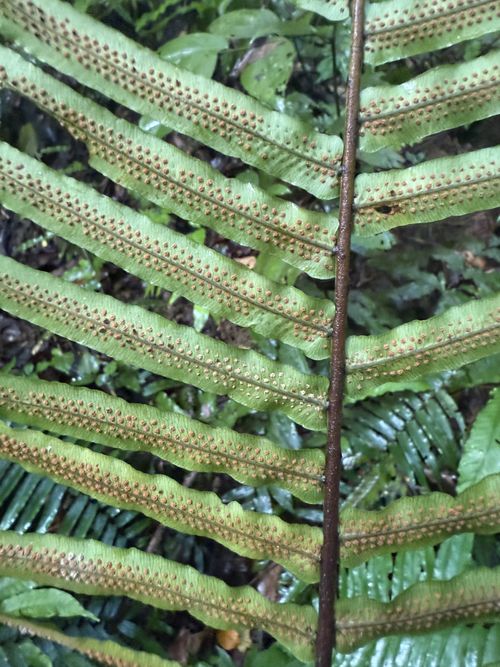
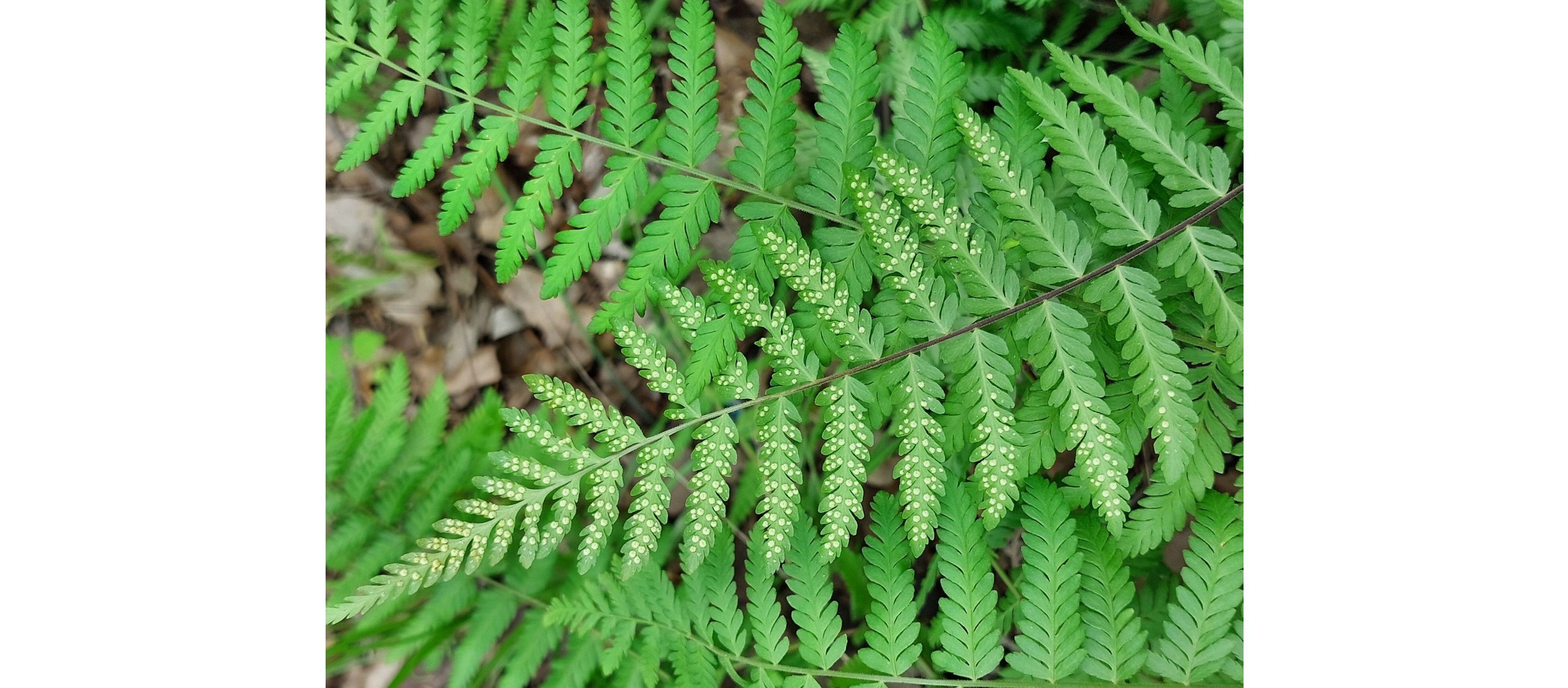
- Shape & Position: Sori are **round**, borne dorsally or (more often) terminally on the acroscopic vein branch (the branch pointing towards the pinna tip), typically forming a single row on each side of the costa, roughly midway between costa and margin or closer to the margin.
- Indusium: **Present**, conspicuous, persistent, characteristically **kidney-shaped (reniform)**, attached at the deep sinus. Sometimes described as circular with a narrow sinus. Opens facing away from the margin.
Sporangia and Spores
- Sporangia: Typical leptosporangiate structure.
- Spores: Monolete (bilateral, bean-shaped); surface typically tuberculate, verrucate (warty), or somewhat spiny.
Gametophyte
The small, haploid gametophyte phase:
- Form: Develops as a green, heart-shaped or slightly elongated prothallus, often bearing glandular hairs.
Field Identification
Identifying Nephrolepidaceae (*Nephrolepis*) relies on recognizing the combination of articulate pinnate fronds, round sori with kidney-shaped indusia, and often the presence of stolons or tubers.
Primary Identification Features
- Articulate Pinnae: Check if the pinnae are clearly jointed where they attach to the rachis (they often detach easily).
- Round Sori with Reniform Indusium: Look for circular sori covered by a distinct kidney-shaped flap (indusium) attached at the notch.
- Stolons/Tubers: Examine the base of the plant for slender runners (stolons) spreading outwards, or small potato-like tubers (especially *N. cordifolia*).
- 1-Pinnate Fronds: Fronds are simply pinnate, often long and relatively narrow.
Secondary Identification Features
- Erect/Short Rhizome: Rhizome is usually compact, not long-creeping (though stolons are long).
- Multiple Stipe Bundles: Cross-section shows several round vascular bundles (requires cutting).
- Habitat/Distribution: Pantropical, common in cultivation and disturbed areas.
Seasonal Identification Tips
- Year-round: Fronds are often evergreen or present for extended periods. Sori, stolons, and tubers can often be found year-round in suitable climates.
Common Confusion Points
Distinguishing *Nephrolepis* requires checking for the combination of key features:
- Lomariopsidaceae (*Cyclopeltis*): Also has articulate pinnae and round, indusiate sori. Differs in lacking stolons/tubers, often having 2-pinnate fronds, and indusia that are often more circular/peltate (though sometimes described as reniform).
- Dryopteridaceae: Shares multiple stipe bundles and round sori with reniform indusia. Crucially lacks articulate pinnae and stolons/tubers. Fronds often more complexly divided.
- Oleandraceae (*Oleandra*): Has round sori with reniform indusia and articulate structures (stipes articulate to rhizome, not pinnae to rachis). Habit is different (long rhizome, often epiphytic).
- Thelypteridaceae: Some have round sori with reniform indusia, but pinnae are not articulate, stipe bundles are two uniting upwards, and often have needle-like hairs.
- Davalliaceae: Has articulate structures (stipes/pinnae) but sori are marginal/submarginal with cup/tubular indusia.
Key differentiator: The combination of **1-pinnate fronds with articulate pinnae**, **round sori with reniform indusia**, and the presence of **stolons/tubers** is highly characteristic of Nephrolepidaceae (*Nephrolepis*).
Field Guide Quick Reference
Look For:
- Fronds: 1-pinnate
- Pinnae: **Articulate** to rachis
- Sori: Round
- Indusium: **Kidney-shaped (Reniform)**
- Base: **Stolons (runners) / Tubers** often present
- Rhizome: Short, erect/creeping
- Stipe Base: **Multiple (3+)** round vascular bundles
Key Distinctions:
- vs. Lomariopsidaceae (*Cyclopeltis*): Lacks stolons/tubers, indusium often circular/peltate.
- vs. Dryopteridaceae: Pinnae **not** articulate, lacks stolons/tubers.
- vs. Oleandraceae: Stipes articulate to rhizome, different habit.
- vs. Thelypteridaceae: Pinnae not articulate, 2 stipe bundles, often hairy.
- vs. Davalliaceae: Different indusium shape/position.
Notable Examples
The family contains only the genus Nephrolepis, several species of which are well-known.
Nephrolepis exaltata
Sword Fern, Boston Fern (cultivars)
The species from which the popular Boston Fern cultivars derive. Native to tropical regions worldwide. Exhibits the typical articulate pinnae and reniform indusia. Spreads via stolons.

Nephrolepis cordifolia
Tuber Sword Fern, Fishbone Fern
Pantropical, known for readily producing small, scaly tubers on its stolons. Often found as an epiphyte or on rocks. Can be invasive in some regions.

Nephrolepis biserrata
Giant Sword Fern
A large, robust species found throughout the tropics, often in more open or disturbed areas. Pinnae can be quite broad and sometimes doubly serrated (hence the name).
Phylogeny and Classification
Nephrolepidaceae, containing only the genus Nephrolepis, belongs to the **Eupolypods I** clade within the order Polypodiales. Its phylogenetic position has been debated, with historical classifications sometimes placing it near Davalliaceae or Oleandraceae due to shared features like articulate structures.
However, molecular data consistently place *Nephrolepis* close to the core genera of Lomariopsidaceae (*Lomariopsis*, *Lomagramma*, *Cyclopeltis*). It is often resolved as the sister lineage to the rest of Lomariopsidaceae. This close relationship leads some classification systems (like PPG I) to include *Nephrolepis* within a broader Lomariopsidaceae, while others maintain it as a distinct, monogeneric family Nephrolepidaceae due to its unique combination of morphological features (especially the stolons/tubers) and deep evolutionary divergence time from the Lomariopsidaceae core group. Recognizing it as a separate family emphasizes its distinct evolutionary trajectory.
Position in Plant Phylogeny
- Kingdom: Plantae
- Division: Pteridophyta (or Polypodiophyta)
- Class: Polypodiopsida
- Order: Polypodiales
- Family: Nephrolepidaceae (or within Lomariopsidaceae)
- (Part of the Eupolypods I clade)
Evolutionary Significance
Nephrolepidaceae (*Nephrolepis*) is significant for:
- Vegetative Propagation: The evolution of stolons and tubers allows for highly effective asexual reproduction and dispersal, contributing to its success and sometimes invasive nature.
- Articulate Pinnae: A key morphological feature shared with some Lomariopsidaceae and convergently evolved in other fern groups.
- Pantropical Success: Represents a highly successful lineage that has colonized diverse tropical habitats worldwide.
- Horticultural Importance: *Nephrolepis exaltata* cultivars are among the most popular and economically important ferns in horticulture.
- Model for Polyploidy/Hybridization: The genus exhibits complex patterns of polyploidy and hybridization, making it a subject for evolutionary studies.