
Davalliaceae
Rabbit's Foot Fern Family
Davalliaceae is a family of ferns in the order Polypodiales, containing a single genus Davallia with approximately 65 species. These distinctive ferns are characterized by their long-creeping rhizomes densely covered with scales, compound fronds that range from once to several times pinnate, and marginal sori that are covered with a protective indusium. The family is primarily distributed in tropical regions of the Old World, with many species being epiphytic (growing on trees) or lithophytic (growing on rocks). Several species are popular as ornamental plants, particularly the rabbit's foot fern (Davallia fejeensis), named for its fuzzy rhizomes that resemble a rabbit's foot.
Overview
The Davalliaceae family is a distinctive group of ferns represented by a single genus, Davallia, with approximately 65 species. These ferns are commonly known as rabbit's foot ferns or hanging ferns due to their characteristic long-creeping rhizomes that are densely covered with scales, often resembling a rabbit's foot or paw.
The family is primarily distributed in tropical regions of the Old World, including parts of Africa, Asia, Australia, and various Pacific islands. They are particularly diverse in Southeast Asia and the Malesian region. Most species are epiphytic (growing on trees) or lithophytic (growing on rocks), though some may occasionally grow terrestrially in humus-rich soil.
Davalliaceae ferns are popular in horticulture, particularly as hanging basket plants, where their distinctive rhizomes can cascade over the edges of containers. The rhizomes eventually form a dense network that can completely cover the container, creating a striking ornamental effect.
Quick Facts
- Scientific Name: Davalliaceae
- Common Name: Rabbit's Foot Fern Family or Hanging Fern Family
- Number of Genera: 1 (Davallia)
- Number of Species: Approximately 65
- Distribution: Tropical regions of the Old World
- Evolutionary Group: Monilophytes - Leptosporangiate Ferns - Polypodiales
Key Characteristics
Growth Form and Habit
Members of Davalliaceae are primarily epiphytic or lithophytic ferns, growing on trees or rocks. They have long-creeping rhizomes that allow them to spread across surfaces. The rhizomes are a distinctive feature of the family, being densely covered with scales that give them a fuzzy or hairy appearance.
Rhizomes
The rhizomes are long-creeping and typically 5-15 mm in diameter. They are densely covered with overlapping scales that are often reddish-brown to golden in color, lanceolate in shape, and have entire to slightly toothed margins. These scales are a key diagnostic feature for the family and give the rhizomes their characteristic fuzzy appearance.
Fronds
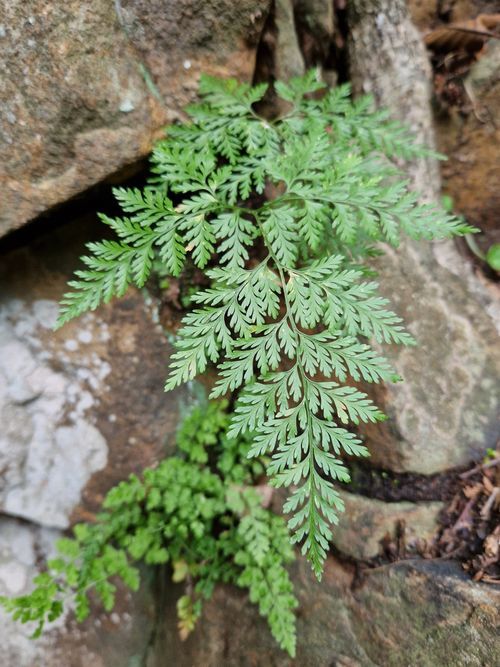
The fronds of Davalliaceae are compound, ranging from once to several times pinnately divided, depending on the species. They typically emerge at intervals along the rhizome and can be 10-100 cm long. The stipes (stems) are often grooved on the upper surface and may have scales, especially at the base. The laminae (blades) are typically triangular to ovate in outline, leathery in texture, and glabrous (smooth).
Reproductive Structures
The sori (clusters of spore-producing structures) are positioned along the margins of the leaflets or leaf divisions. They vary from circular to hemispherical to kidney-shaped and are covered with a membranous protective flap of tissue called an indusium. The spores are bean-shaped (bilateral) and monolete (with a single linear scar).
Distinguishing Features
Davalliaceae can be distinguished from other fern families by a combination of:
- Long-creeping rhizomes densely covered with scales
- Compound fronds with leathery texture
- Marginal sori with distinctive indusia
- Epiphytic or lithophytic habit in tropical regions

Typical frond structure of a Davallia species showing the compound, finely divided lamina and marginal sori.
Identification
Field Identification Tips
When trying to identify members of the Davalliaceae family in the field, look for:
- Long-creeping rhizomes densely covered with reddish-brown to golden scales
- Compound fronds (once to several times pinnately divided) with leathery texture
- Marginal sori covered with a protective indusium
- Epiphytic or lithophytic growth habit in tropical regions
- Triangular to ovate frond outline
Similar Families
Davalliaceae may be confused with several other fern families:
- Polypodiaceae: Some members have similar growth habits but typically have different sori arrangements (not marginal) and often lack indusia.
- Oleandraceae: Has simple, undivided fronds rather than the compound fronds of Davalliaceae.
- Nephrolepidaceae: Has different rhizome structure and sori arrangement.
- Dennstaedtiaceae: Some members have marginal sori but different rhizome structure and overall morphology.
Distinguishing Features
The most reliable features for distinguishing Davalliaceae from similar ferns include:
- Rhizome scales: Dense, overlapping scales giving a fuzzy appearance
- Frond architecture: Compound fronds with leathery texture
- Sori position: Marginal with distinctive indusia
- Growth habit: Primarily epiphytic or lithophytic
For definitive identification, examination of the rhizome scales and sori arrangement is often necessary, as these features are the most diagnostic for the family.
Notable Examples
The family Davalliaceae contains only the genus Davallia with approximately 65 species. Here are some notable representatives:

Davallia fejeensis
Rabbit's Foot Fern
One of the most popular species in cultivation, native to Fiji. It has long-creeping rhizomes densely covered with reddish-brown scales that give them a fuzzy, rabbit's foot-like appearance. The fronds are tripinnate to quadripinnate (divided three to four times), triangular in outline, and typically 30-60 cm long. This species is widely grown as an ornamental, particularly in hanging baskets.

Davallia canariensis
Canary Islands Hare's Foot Fern
Native to the Canary Islands, Madeira, and parts of the Mediterranean region. It has thick, scaly rhizomes and triangular, tripinnate fronds that are typically 20-40 cm long. This species is one of the few members of the family that occurs in more temperate regions and is relatively cold-hardy compared to its tropical relatives.

Davallia trichomanoides
Black Rabbit's Foot Fern
Native to tropical Asia, this species has slender, long-creeping rhizomes covered with dark brown to black scales. The fronds are finely divided (quadripinnate), giving them a delicate, lacy appearance, and are typically 15-30 cm long. It is popular in cultivation for its attractive, finely dissected fronds and distinctive rhizomes.
Related Families
Davalliaceae belongs to the order Polypodiales and is phylogenetically related to several other fern families. Based on molecular studies, its closest relatives include:

Oleandraceae
Oleandra Fern Family

Polypodiaceae
Polypody Family

Nephrolepidaceae
Sword Fern Family

Lomariopsidaceae
Lomariopsis Family
Phylogenetic Note
Davalliaceae has undergone significant taxonomic revisions based on molecular phylogenetic studies. Previously, the family included several genera that have since been moved to other families or elevated to their own families. Modern molecular studies have confirmed Davallia as a distinct monogeneric lineage within the eupolypod I clade of the Polypodiales order. The distinctive morphological features of Davallia, particularly the long-creeping scaly rhizomes and marginal sori, support its recognition as a separate family.