Grubbiaceae
Silky Bush Family
Grubbiaceae is a small, distinctive family of flowering plants containing a single genus, Grubbia, with three species of heath-like shrubs. The family is endemic to the Cape Floristic Region of South Africa, a global biodiversity hotspot. It belongs to the order Cornales and is characterized by its ericoid leaves and unique compound fruit structures.
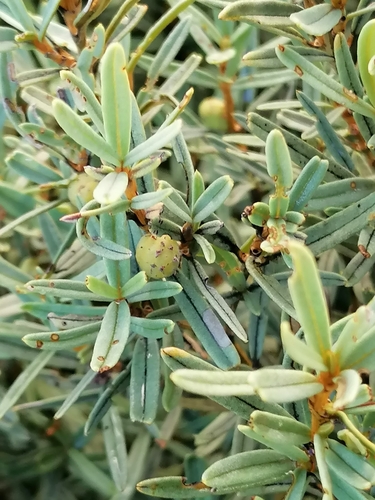
Overview
The Grubbiaceae family is restricted entirely to the Fynbos biome of the Western Cape and Eastern Cape provinces of South Africa. It comprises just one genus, Grubbia, with three currently recognized species of evergreen, heath-like (ericoid) shrubs. These plants are adapted to the nutrient-poor, sandy soils and Mediterranean climate characteristic of the Fynbos.
Members of the family are recognized by their small, needle-like or linear leaves, often covered in silky hairs, and arranged oppositely or in whorls on wiry stems. The flowers are small and inconspicuous, borne in dense clusters. Perhaps the most unusual feature is the fruit, where the individual dry fruits from a flower cluster become fused together with the surrounding bracts and fleshy perianth bases to form a compound, cone-like or berry-like structure.
Grubbiaceae belongs to the order Cornales, which also includes dogwoods (Cornaceae) and hydrangeas (Hydrangeaceae). Its closest relative is thought to be Curtisiaceae, another small family endemic to Africa. Grubbiaceae represents an interesting lineage adapted to the unique conditions of the Cape Floristic Region.
Quick Facts
- Scientific Name: Grubbiaceae
- Common Name: Silky Bush Family
- Number of Genera: 1 (Grubbia)
- Number of Species: Approximately 3
- Distribution: Endemic to the Cape Floristic Region, South Africa.
- Evolutionary Group: Angiosperms - Eudicots - Asterids - Cornales
Key Characteristics
Growth Form and Habit
Evergreen shrubs with a heath-like (ericoid) appearance, typically growing 0.5 to 2.5 meters tall. Stems are often wiry and branched.
Leaves
Leaves are simple, small, linear to needle-like (ericoid), arranged oppositely or sometimes in whorls of three. They are typically leathery, with margins rolled inwards (revolute). Young leaves and stems are often covered in dense, silky hairs, although older leaves may become smoother. Stipules are absent.
Flowers
Flowers are small, inconspicuous, actinomorphic (radially symmetrical), and usually bisexual. They are borne in dense, head-like axillary clusters, typically with three flowers grouped together, subtended by bracts.
- Perianth: Consists of a single whorl of 4 (sometimes 5) fleshy lobes (interpreted as tepals or sepals), fused below into a tube that is fused to the ovary wall, making the ovary appear inferior. Petals are absent.
- Androecium: Stamens number 8 (sometimes 10), arranged in two whorls of 4 (or 5), inserted on the perianth tube.
- Gynoecium: The ovary is inferior, typically composed of 2 carpels but usually appearing 1-locular due to abortion of partitions or ovules. Contains a single pendulous ovule per functional locule. The style is simple and short, with a capitate (head-like) or slightly lobed stigma.
Fruits and Seeds
The fruiting structure is highly distinctive and compound. The individual dry, one-seeded fruits (achenes or nutlets) from the flowers within a cluster become fused together and embedded within the accrescent (enlarging and becoming fleshy) bracts and perianth bases. This results in a globose or ellipsoid, cone-like or berry-like infructescence, often reddish or purplish when mature.
Wood Anatomy
Wood structure details are specific to the genus and order.
Chemical Characteristics
Likely contain tannins. The presence of iridoids is common in the order Cornales and may occur in Grubbiaceae.
Field Identification
Identifying Grubbiaceae in its native Fynbos habitat requires attention to the combination of its heath-like habit, leaf arrangement, flower clusters, and unique compound fruit.
Primary Identification Features
- Habit: Ericoid (heath-like) shrubs.
- Leaves: Small, simple, linear/needle-like, opposite or whorled, often silky-hairy, margins often revolute.
- Flowers: Small, in dense axillary clusters (often 3 together); perianth 4-lobed; petals absent; 8 stamens.
- Ovary: Inferior.
- Fruit: A compound, cone-like or berry-like structure (infructescence) formed from fused fruits, bracts, and perianth parts.
- Distribution: Endemic to South African Fynbos.
Secondary Identification Features
- Wiry stems.
- Silky hairs often present on young growth.
Seasonal Identification Tips
- Year-round: The ericoid leaves and shrubby habit are always visible.
- Flowering: Flowers are small and may appear over extended periods, often spring to summer, but are generally inconspicuous.
- Fruiting: The distinctive compound fruit structures develop after flowering and are the most unique feature for identification when present.
Common Confusion Points
- Ericaceae (Heaths): Many true heaths share the ericoid habit but typically have alternate leaves, urn-shaped or bell-shaped flowers with distinct petals, superior ovaries, and capsule fruits (not compound structures).
- Restionaceae (Cape Reeds): Some restios have wiry stems and reduced leaves, but they are monocots with very different, highly reduced grass-like flowers and lack the compound fruit structure.
- Asteraceae: Some Fynbos Asteraceae have ericoid leaves (e.g., some Metalasia, Eriocephalus), but they produce characteristic composite flower heads (capitula) and achene fruits (often with pappus), not the Grubbiaceae compound fruit.
- Check for the combination of opposite/whorled needle-like leaves, inferior ovary, absence of petals, 8 stamens, and the unique compound fruit.
Field Guide Quick Reference
Look For:
- Ericoid shrub (South African Fynbos)
- Opposite or whorled, small, linear leaves
- Often silky hairs present
- Small flowers in dense clusters
- Inferior ovary, 4 perianth lobes, 8 stamens
- Compound cone/berry-like fruit
Key Variations (within Grubbia):
- Degree of hairiness
- Leaf length and width
- Slight differences in flower/fruit size
Notable Examples
All examples belong to the genus Grubbia.

Grubbia rosmarinifolia
Rosemary Silky Bush
A common species in mountainous Fynbos habitats. It forms a shrub up to 2 meters tall with densely packed, needle-like leaves resembling rosemary, often covered in silvery-silky hairs when young. The compound fruits are ellipsoid.

Grubbia tomentosa
Woolly Silky Bush
This species is characterized by its densely woolly or tomentose leaves and stems, giving it a distinctly gray or whitish appearance. The leaves are typically linear and strongly revolute. Found in sandy or rocky Fynbos areas.

Grubbia stricta
Upright Silky Bush
Often has a more upright growth habit compared to other species. Its leaves may be slightly broader or flatter than G. rosmarinifolia, and sometimes less hairy. It occurs in various Fynbos vegetation types.
Phylogeny and Classification
Grubbiaceae is placed within the order Cornales, which is part of the large Asterids clade of eudicot flowering plants. Cornales is a diverse order containing families such as Cornaceae (dogwoods), Hydrangeaceae (hydrangeas), and Loasaceae (stickleaf family).
Molecular studies indicate that Grubbiaceae's closest relative is Curtisiaceae, another small family with a single genus (Curtisia) endemic to Africa (though more widespread than Grubbiaceae). Together, Grubbiaceae and Curtisiaceae form a distinct clade within Cornales, often sister to the large clade containing Cornaceae, Hydrangeaceae, Loasaceae, Nyssaceae, and Hydrostachyaceae. This placement highlights an early divergence within the order.
Position in Plant Phylogeny
- Kingdom: Plantae
- Clade: Tracheophytes (Vascular Plants)
- Clade: Angiosperms (Flowering Plants)
- Clade: Eudicots
- Clade: Asterids
- Order: Cornales
- Family: Grubbiaceae
Evolutionary Significance
Grubbiaceae is significant from an evolutionary perspective:
- Cape Floristic Region Endemism: Its restriction to this global biodiversity hotspot highlights the unique evolutionary processes occurring in this region.
- Cornales Phylogeny: Its phylogenetic position, alongside Curtisiaceae, helps resolve the basal relationships within the Cornales order.
- Unique Morphology: The ericoid habit and especially the compound fruit structure (infructescence) represent unique morphological adaptations within the order.
- Relictual Lineage: As a small family with limited distribution, it may represent a relictual lineage that diverged early within Cornales.