Curtisiaceae
Assegai Tree Family
Curtisiaceae is a monotypic family of flowering plants containing only one genus, Curtisia, and one species, Curtisia dentata (the Assegai tree). This evergreen tree is native to the Afromontane forests of Southern Africa.
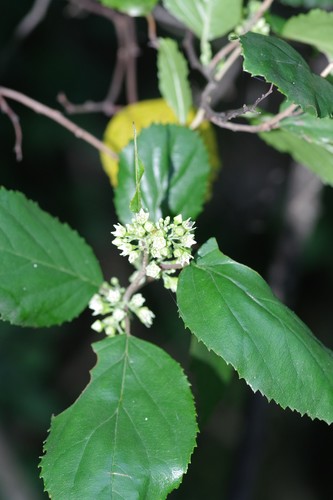
Overview
The Curtisiaceae family consists of a single species, Curtisia dentata, an evergreen tree found in South Africa, Eswatini, Zimbabwe, and Mozambique. It typically grows in moist forests, often along streams or on forest margins, from sea level up to montane regions (Afromontane forests).
Key distinguishing features include the opposite, simple, toothed leaves with densely hairy undersides, the lack of stipules, small 4-parted flowers with an inferior ovary, and small, white, fleshy drupe fruits. The family belongs to the order Cornales within the Asterid clade.
The Assegai tree is known for its hard, heavy, fine-grained wood, historically used by indigenous peoples for making spear shafts (assegais), hence the common name. It is also used for furniture and tool handles, although exploitation has led to reduced populations in some areas.
Quick Facts
- Scientific Name: Curtisiaceae Takht.
- Common Name: Assegai Tree Family
- Number of Genera: 1 (Curtisia)
- Number of Species: 1 (Curtisia dentata)
- Distribution: Southern Africa (South Africa, Eswatini, Zimbabwe, Mozambique)
- Evolutionary Group: Eudicots - Asterids - Cornales
Key Characteristics
Growth Form and Habit
Members are evergreen trees, typically medium to large in size, with dense crowns.
Leaves
Leaves are arranged oppositely. They are simple, leathery (coriaceous), and typically have dentate or serrated margins, especially prominent on young leaves or coppice growth. The upper surface is usually dark green and glossy, while the lower surface is covered in dense, velvety, reddish-brown or silvery hairs (tomentum). Crucially, leaves lack stipules.
Inflorescence
Flowers are borne in dense, branched terminal or axillary panicles or cymes.
Flowers
Flowers are small, generally bisexual (though sometimes functionally unisexual), and radially symmetrical (actinomorphic). They are distinctly 4-merous.
- Calyx: 4 small sepals, fused at the base, persistent.
- Corolla: 4 small petals, free, typically cream-colored or greenish-white, often falling early.
- Androecium: 4 stamens, alternating with the petals, inserted on the edge of an epigynous nectar disc (a disc situated atop the ovary).
- Gynoecium: The ovary is distinctly inferior, composed of 4 fused carpels forming 4 locules. Each locule contains a single pendulous ovule. The style is short with a 4-lobed stigma.
Fruits and Seeds
The fruit is a small, globose, fleshy drupe, typically whitish or cream-colored when mature. It contains 1 to 4 hard stones (pyrenes), each derived from a carpel and usually containing one seed.
Chemical Characteristics
The plant contains tannins, contributing to the durability of the wood and potential traditional uses.
Field Identification
Identifying Curtisia dentata, the sole member of Curtisiaceae, relies on recognizing its distinct vegetative and reproductive features within its Southern African range:
Primary Identification Features
- Opposite, simple, toothed leaves: Look for paired leaves that are not divided into leaflets, with distinctly serrated edges.
- Hairy leaf underside: The lower surface is typically covered in dense, velvety, reddish-brown or silvery hairs.
- Absence of stipules: Check the node where the leaf stalk meets the stem; there should be no stipules or stipule scars.
- Small, 4-parted flowers: If flowering, look for small flowers with parts in fours (4 sepals, 4 petals, 4 stamens) borne in branched clusters. Note the inferior ovary.
- Small, white drupe fruit: The characteristic fruit is a small (pea-sized), round, whitish berry-like drupe.
Secondary Identification Features
- Evergreen tree habit: A woody tree that retains its leaves year-round.
- Southern African distribution: Found specifically in Afromontane forest environments in Southern Africa.
Seasonal Identification Tips
As an evergreen tree, vegetative features are useful throughout the year:
- Year-round: Opposite, simple, toothed leaves with hairy undersides and the lack of stipules are constant features.
- Flowering Season (typically spring/summer): Small, 4-parted flowers in panicles confirm identification.
- Fruiting Season (typically autumn/winter, but may persist): Small, white drupes are diagnostic.
Common Confusion Points
Distinguishing Curtisiaceae from other Southern African trees with opposite, simple leaves:
- Cornaceae (African Cornus species): May have opposite simple leaves, but often have entire margins, different flower structures (e.g., showy bracts in some), and lack the dense reddish/silvery tomentum below.
- Other families: Compare leaf margin (toothed), presence/absence of stipules (absent in Curtisia), leaf texture/hairiness (velvety below in Curtisia), and fruit type (small white drupe in Curtisia).
- Focus on the combination: Opposite + Simple + Toothed + Hairy Underside + No Stipules + White Drupe Fruit is key for Curtisia dentata.
Field Guide Quick Reference
Look For:
- Evergreen trees
- Opposite, simple leaves
- Toothed leaf margins
- Densely hairy leaf underside (reddish/silvery)
- No stipules
- Small, 4-parted flowers (inferior ovary)
- Small, white, globose drupes
Key Variations:
- Leaf shape can vary (ovate to lanceolate)
- Degree of toothing varies (more on young growth)
- Hair color on underside can vary
- Found in Southern African forests
Notable Examples
The Curtisiaceae family is monotypic, containing only one species:

Curtisia dentata
Assegai Tree
The sole species in the family, this evergreen tree is recognized by its opposite, simple, sharply toothed leaves with velvety undersides, lack of stipules, small 4-parted flowers, and distinctive small white drupes. Its hard wood was historically important for spear shafts and remains valued for various uses.
Phylogeny and Classification
Curtisiaceae is placed within the order Cornales, a distinct lineage within the Asterid clade of eudicots. This placement is strongly supported by molecular phylogenetic studies and represents a shift from older classifications that sometimes placed it elsewhere.
Within Cornales, Curtisiaceae is closely related to Grubbiaceae (another small Southern African family) and the larger, more widespread Cornaceae (Dogwood family). These three families form a well-supported clade. The order Cornales also includes other diverse families like Hydrangeaceae and Loasaceae.
Position in Plant Phylogeny
- Kingdom: Plantae
- Clade: Angiosperms (Flowering plants)
- Clade: Eudicots
- Clade: Asterids
- Order: Cornales
- Family: Curtisiaceae
Evolutionary Significance
Curtisiaceae, as a monotypic family, holds interest for understanding plant evolution and biogeography:
- Relictual Lineage?: Its status as a single-species family endemic to Southern Africa might suggest it is a relictual lineage, the sole survivor of a potentially once more diverse group.
- Phylogenetic Position: Its firm placement within Cornales helps resolve relationships within this Asterid order and highlights connections between Southern African flora (Curtisiaceae, Grubbiaceae) and more widespread groups (Cornaceae).
- Biogeography: Contributes to understanding the assembly and history of the unique Afromontane flora.