Woodsiaceae
Cliff Fern Family
Woodsiaceae is a diverse family of ferns in the order Polypodiales, containing approximately 15 genera and 700 species. These ferns are characterized by their highly variable leaf morphology and diverse sori and indusium shapes. The family is distributed nearly worldwide but is most diverse in temperate regions and mountainous tropical areas. Most species are terrestrial in forested habitats or grow on rocks and cliffs. Several genera are popular in cultivation, including Athyrium (lady ferns), Woodsia (cliff ferns), and Cystopteris (fragile ferns), which are valued for their delicate, finely divided fronds and adaptability to shade and rock gardens.
Overview
The Woodsiaceae family is a diverse group of ferns with approximately 15 genera and 700 species. Commonly known as cliff ferns, these plants are widely distributed across the globe but reach their greatest diversity in temperate regions and mountainous tropical areas.
Most members of the family are terrestrial, growing in soil in forested habitats, or lithophytic, growing on rocks and cliffs. Their adaptation to rocky habitats has given the family its common name, as many species, particularly those in the genus Woodsia, are specialized for growing in rock crevices and on cliff faces.
Woodsiaceae ferns exhibit remarkable diversity in leaf morphology, sorus arrangement, and indusium shape, making them a taxonomically complex group. Several genera within the family are popular in horticulture, particularly for shade gardens and rock gardens, due to their attractive, often finely divided fronds and adaptability to various growing conditions.
Quick Facts
- Scientific Name: Woodsiaceae
- Common Name: Cliff Fern Family
- Number of Genera: Approximately 15
- Number of Species: Approximately 700
- Distribution: Nearly worldwide, most diverse in temperate regions and mountainous tropical areas
- Evolutionary Group: Monilophytes - Leptosporangiate Ferns - Polypodiales
Key Characteristics
Growth Form and Habit
Members of Woodsiaceae are primarily terrestrial ferns, growing in soil in forested habitats, or lithophytic, growing on rocks and cliffs. They typically have short to long-creeping rhizomes that are covered with scales. The growth habit varies considerably across the family, from small, tufted cliff-dwelling species to larger, more robust forest floor inhabitants.
Rhizomes
The rhizomes are typically short to long-creeping or sometimes erect, and are covered with scales that are often lanceolate and brown to dark brown in color. The rhizome structure and scale characteristics vary among genera and are important for identification.
Fronds
The fronds of Woodsiaceae show extreme variation in size and morphology across the family. They can range from small (5-10 cm) to quite large (over 1 meter) depending on the species and genus. The fronds are typically pinnately compound, ranging from once to several times pinnate, but the degree of division and the shape of the pinnae (leaflets) vary considerably.
The stipes (stems) are often grooved on the upper surface and may have scales, especially at the base. In some genera, such as Woodsia, the stipes have a characteristic joint or articulation point where old fronds break off cleanly.
Reproductive Structures
The sori (clusters of spore-producing structures) and indusia (protective flaps of tissue) show remarkable diversity in shape and arrangement across the family. The sori can be round, elongated, or curved, and may be positioned along veins, at vein tips, or in other patterns depending on the genus.
The indusia are equally variable, ranging from cup-shaped or hood-like structures to kidney-shaped flaps, or they may be reduced or absent in some genera. This diversity in reproductive structures is a key feature for identification and classification within the family.
Distinguishing Features
Due to the high morphological diversity within Woodsiaceae, it is difficult to identify a single set of distinguishing features for the entire family. However, most members can be recognized by a combination of:
- Terrestrial or lithophytic habit
- Pinnately compound fronds with variable morphology
- Diverse sori and indusia shapes
- Adaptation to temperate or montane habitats

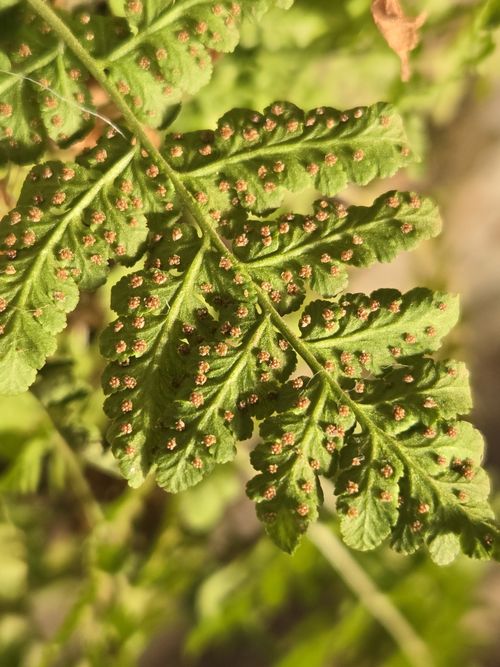
Typical frond structure of a Woodsia species showing the pinnately compound lamina and characteristic sori arrangement.
Identification
Field Identification Tips
When trying to identify members of the Woodsiaceae family in the field, look for:
- Habitat: Many species grow on rocks, cliffs, or in forested areas
- Frond structure: Pinnately compound fronds with variable morphology
- Sori and indusia: Diverse shapes and arrangements depending on the genus
- Size: Ranging from small cliff-dwelling species to larger forest floor inhabitants
- Stipe characteristics: Some genera have jointed stipes where old fronds break off cleanly
Similar Families
Woodsiaceae may be confused with several other fern families:
- Athyriaceae: Previously included within Woodsiaceae, now recognized as a separate family with different sori arrangement and molecular characteristics.
- Cystopteridaceae: Also previously included within Woodsiaceae, now recognized as a separate family with distinctive hood-like indusia.
- Dryopteridaceae: Similar in overall appearance but typically has different indusium shapes and attachment.
- Thelypteridaceae: Distinguished by the presence of characteristic needlelike hairs on the fronds.
Distinguishing Features
Due to the high morphological diversity within Woodsiaceae, identification often requires careful examination of:
- Sori and indusia: The shape, position, and structure of these reproductive features are key for identification
- Frond architecture: The pattern of division and the shape of the pinnae
- Rhizome structure: Creeping vs. erect, scale characteristics
- Stipe characteristics: Presence or absence of articulation points, scaling pattern
For definitive identification, examination of the sori and indusia under magnification is often necessary, as these features are the most diagnostic for distinguishing genera within the family.
Notable Examples
The family Woodsiaceae contains approximately 15 genera and 700 species. Here are some notable representatives:

Woodsia ilvensis
Rusty Cliff Fern
A small, tufted fern native to northern regions of North America, Europe, and Asia. It has pinnate-pinnatifid fronds that are typically 5-15 cm long and densely covered with rusty-brown hairs and scales, giving it a distinctive rusty appearance. This species grows in rock crevices and on cliff faces, often in exposed, harsh environments. It is characterized by its jointed stipes where old fronds break off cleanly.

Athyrium filix-femina
Lady Fern
A widely distributed species found across the Northern Hemisphere. It has large, bipinnate to tripinnate fronds that are typically 50-100 cm long and form elegant, arching clumps. The sori are elongated to curved and covered with hook-shaped indusia. This species grows in moist, shaded forests and is popular in cultivation for shade gardens. Numerous cultivars with varying frond forms and colors have been developed.

Diplazium esculentum
Vegetable Fern
Native to tropical and subtropical regions of Asia and the Pacific. It has large, bipinnate fronds that can reach 1-2 meters in length. The sori are elongated and arranged in pairs along the veins, giving rise to the genus name Diplazium (meaning "double"). This species is economically important as an edible fern, commonly steamed and served as a vegetable in East Asian cuisine. It typically grows in moist, disturbed areas and along streams.
Related Families
Woodsiaceae belongs to the order Polypodiales and is phylogenetically related to several other fern families. Based on molecular studies, its closest relatives include:

Athyriaceae
Lady Fern Family

Cystopteridaceae
Bladder Fern Family

Thelypteridaceae
Marsh Fern Family

Aspleniaceae
Spleenwort Family
Phylogenetic Note
Woodsiaceae has undergone significant taxonomic revisions based on molecular phylogenetic studies. Previously, the family included genera that have since been moved to other families such as Athyriaceae and Cystopteridaceae. The current circumscription of Woodsiaceae is more narrowly defined, focusing on Woodsia and closely related genera. The family is part of the eupolypod II clade within the Polypodiales order, which includes most of the more advanced fern families. Despite the taxonomic changes, Woodsiaceae remains a morphologically diverse group with distinctive adaptations to various habitats, particularly rocky environments.