Thelypteridaceae
Marsh Fern Family
Thelypteridaceae is a large family of ferns in the order Polypodiales, containing approximately 950 species in 5-30 genera (depending on classification). These diverse ferns are characterized by their pinnately compound fronds and distinctive needlelike hairs on the leaves, which sometimes occur in clusters and appear branched. The family is distributed nearly worldwide but is most diverse in tropical regions, with most species being terrestrial and occurring in moist or wet habitats such as marshes, swamps, and wet forests. Common genera include Thelypteris, Phegopteris (beech ferns), and Cyclosorus.
Overview
The Thelypteridaceae family is one of the largest and most diverse families of ferns, with approximately 950 species distributed across 5-30 genera (the number varies depending on taxonomic treatment). These ferns are commonly known as marsh ferns, beech ferns, or maiden ferns, reflecting their frequent occurrence in wetland habitats.
The family has a nearly worldwide distribution, occurring on all continents except Antarctica, but reaches its greatest diversity in tropical and subtropical regions. Many species are important components of forest understories, wetlands, and disturbed habitats. Most members of the family are terrestrial, growing in soil, though some may occasionally grow on rocks or fallen logs.
Thelypteridaceae has undergone significant taxonomic revisions in recent years based on molecular phylogenetic studies. Traditionally treated as a single large genus (Thelypteris) with numerous subgenera, modern classifications recognize multiple distinct genera, though there is still debate about the exact number.
Quick Facts
- Scientific Name: Thelypteridaceae
- Common Name: Marsh Fern Family or Beech Fern Family
- Number of Genera: 5-30 (depending on classification)
- Number of Species: Approximately 950
- Distribution: Nearly worldwide, most diverse in tropical regions
- Evolutionary Group: Monilophytes - Leptosporangiate Ferns - Polypodiales
Key Characteristics
Growth Form and Habit
Members of Thelypteridaceae are primarily terrestrial ferns, growing in soil. They typically have short to long-creeping rhizomes that are covered with scales. Most species prefer moist to wet habitats, including marshes, swamps, wet forests, and stream banks, though some can tolerate drier conditions.
Rhizomes
The rhizomes are typically creeping (horizontal) or sometimes erect, and are covered with scales that are often lanceolate and brown to dark brown in color. The rhizome structure and scale characteristics are important for identification at the genus and species level.
Fronds
The fronds of Thelypteridaceae show considerable variation in size and morphology but are typically pinnately compound (once to twice pinnate). They can range from small (10-20 cm) to quite large (over 1 meter) depending on the species. The stipes (stems) are often grooved on the upper surface and may have scales, especially at the base.
A characteristic feature of the family is the presence of small needlelike hairs on the leaves, particularly along the rachis (main axis) and veins. These hairs sometimes occur in clusters and may appear branched, which is a distinctive feature for identification.
Reproductive Structures
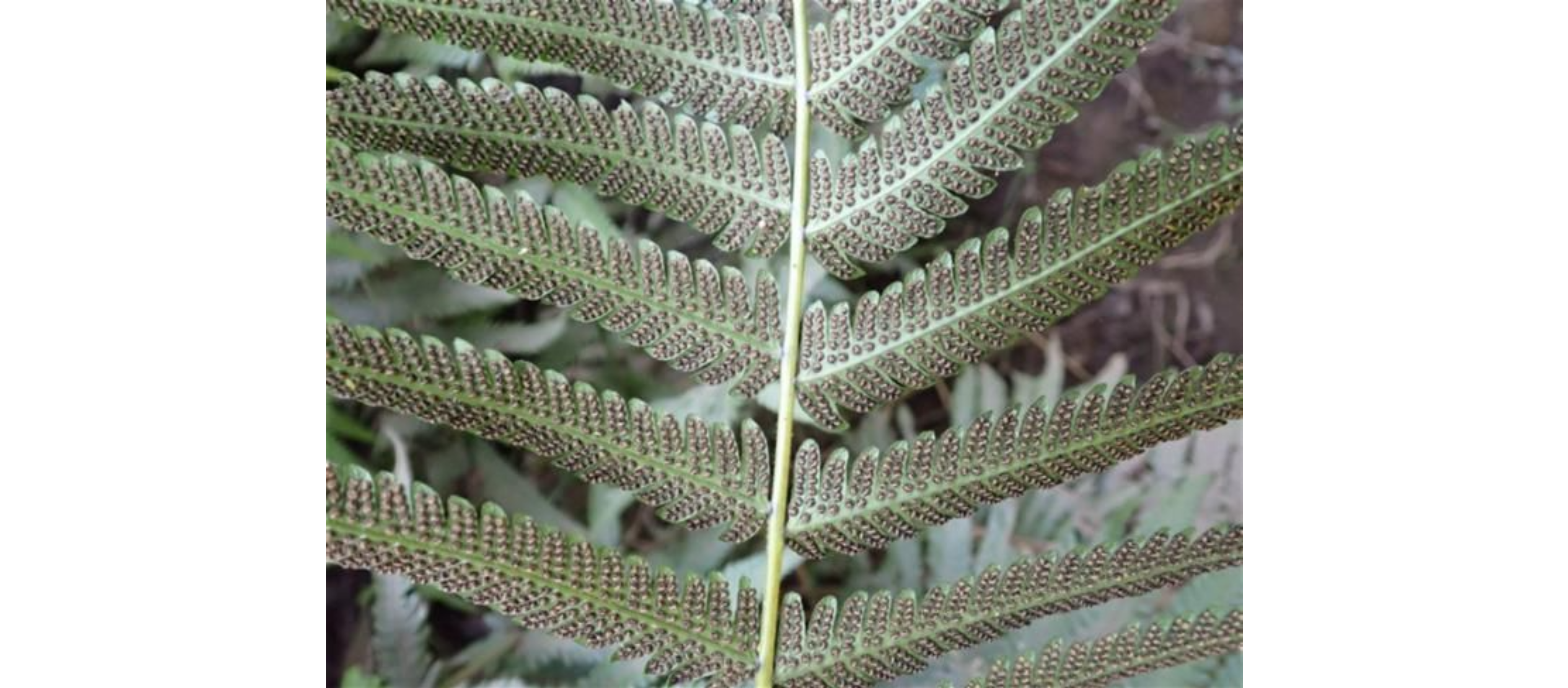
The sori (clusters of spore-producing structures) vary from round to linear in shape and are typically positioned along the veins on the underside of the fronds. They may be covered with a kidney-shaped indusium (protective flap of tissue) in many species, though in some the indusium is reduced or absent. The spores are bean-shaped (bilateral) and monolete (with a single linear scar).
Distinguishing Features
Thelypteridaceae can be distinguished from other fern families by a combination of:
- Needlelike hairs on the fronds (sometimes appearing branched)
- Pinnately compound fronds with characteristic venation patterns
- Round to linear sori, often with kidney-shaped indusia
- Preference for moist to wet habitats

Typical frond structure of a Thelypteris species showing the pinnately compound lamina and characteristic hairs along the rachis and veins.
Identification
Field Identification Tips
When trying to identify members of the Thelypteridaceae family in the field, look for:
- Pinnately compound fronds with characteristic venation patterns
- Needlelike hairs on the fronds, particularly along the rachis and veins (may require magnification)
- Round to linear sori on the underside of fronds, often with kidney-shaped indusia
- Terrestrial growth habit, often in moist to wet habitats
- Creeping rhizomes with scales
Similar Families
Thelypteridaceae may be confused with several other fern families:
- Dryopteridaceae: Similar in overall appearance but typically lacks the characteristic needlelike hairs of Thelypteridaceae and often has more leathery fronds.
- Athyriaceae: Has different sori arrangement and lacks the characteristic hairs of Thelypteridaceae.
- Blechnaceae: Often has dimorphic fronds (separate fertile and sterile fronds) and different sori arrangement.
- Polypodiaceae: Generally epiphytic rather than terrestrial and lacks indusia.
Distinguishing Features
The most reliable features for distinguishing Thelypteridaceae from similar ferns include:
- Needlelike hairs: The presence of small, sometimes clustered or branched hairs on the fronds
- Venation pattern: Characteristic patterns of veins in the pinnae
- Sori arrangement: Typically round to linear, often with kidney-shaped indusia
- Habitat preference: Primarily terrestrial in moist to wet habitats
For definitive identification, examination of the hairs and sori under magnification is often necessary, as these features are the most diagnostic for the family.
Notable Examples
The family Thelypteridaceae contains numerous genera and species. Here are some notable representatives:

Thelypteris palustris
Marsh Fern
A widespread species found in wetland habitats across North America, Europe, and parts of Asia. It has long-creeping rhizomes and pinnate-pinnatifid fronds that are typically 30-80 cm long. The fronds are deciduous, dying back in winter in temperate regions. This species is characteristic of marshes, swamps, and wet meadows, often growing in standing water.

Phegopteris connectilis
Northern Beech Fern
Native to temperate regions of the Northern Hemisphere, this species has triangular fronds with a distinctive pair of downward-pointing basal pinnae. The fronds are typically 20-40 cm long and emerge from long-creeping rhizomes. It grows in moist, shaded forests, often on slopes or near streams, and is named for its common association with beech forests in Europe.

Cyclosorus dentatus
Downy Maiden Fern
A pantropical species with a wide distribution across tropical regions of Africa, Asia, and the Pacific. It has pinnate-pinnatifid fronds that are typically 50-100 cm long and are covered with characteristic hairs, giving them a downy appearance. The sori are round and covered with kidney-shaped indusia. This species often grows in disturbed areas, forest edges, and along streams in tropical regions.
Related Families
Thelypteridaceae belongs to the order Polypodiales and is phylogenetically related to several other fern families. Based on molecular studies, its closest relatives include:

Athyriaceae
Lady Fern Family

Woodsiaceae
Cliff Fern Family

Cystopteridaceae
Bladder Fern Family

Aspleniaceae
Spleenwort Family
Phylogenetic Note
Thelypteridaceae has undergone significant taxonomic revisions based on molecular phylogenetic studies. Previously treated as a single large genus (Thelypteris) with numerous subgenera, modern classifications recognize multiple distinct genera. The family is part of the eupolypod II clade within the Polypodiales order, which includes most of the more advanced fern families. Despite its large size and worldwide distribution, molecular studies have confirmed Thelypteridaceae as a monophyletic group (descended from a common ancestor), with distinctive morphological features supporting its recognition as a separate family.