Takakiaceae
Takakia Moss Family
The Takakiaceae is a unique and phylogenetically isolated family containing the single genus Takakia. These small bryophytes are highly distinctive due to their leaves being deeply divided into cylindrical lobes, unlike the flattened leaves of other mosses and liverworts. They represent the earliest diverging lineage of extant mosses.
Overview
Takakiaceae is one of the most enigmatic families among land plants. For a long time, its sole genus, Takakia, was known only from gametophytes, and its placement was uncertain – sometimes considered a liverwort, sometimes an intermediate group. The discovery of the sporophyte, which possesses a unique combination of moss-like (columella) and liverwort-like (seta elongation timing) features, along with molecular data, has firmly placed Takakia as the sister group to all other living mosses.
It comprises only two known species, found in highly disjunct locations in cold, wet, montane to alpine environments, often associated with late snow patches or seepage areas. Their unique morphology, particularly the cylindrical leaf lobes (phyllids), makes them unlike any other bryophyte.
Quick Facts
- Scientific Name: Takakiaceae S. Hatt. & Inoue
- Common Name: Takakia Moss Family
- Number of Genera: 1 (Takakia)
- Number of Species: 2 (T. lepidozioides, T. ceratophylla)
- Distribution: Highly disjunct: Pacific Northwest North America, Aleutian Islands, Japan, Himalayas, Borneo.
- Evolutionary Group: Bryophytes - Mosses - Class: Takakiopsida
Key Characteristics
Growth Form and Habit
Plants are small (typically 1-2 cm tall), forming loose turfs or mats, often yellowish-green to brownish-green. They possess creeping, subterranean, branched rhizomes from which erect or ascending leafy shoots arise. True rhizoids typical of mosses are absent. Stems and leaves bear distinctive multicellular slime papillae that secrete mucilage.
Leaves (Phyllids)
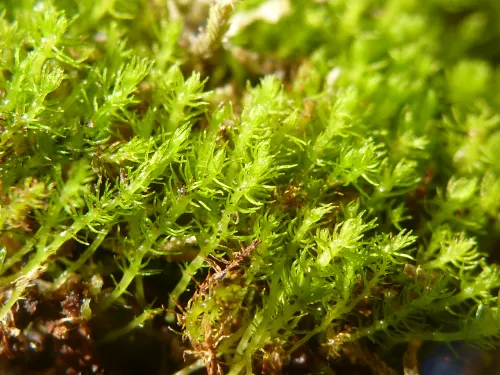
The "leaves" are highly unusual and perhaps better termed phyllids. They are not flattened blades but are deeply dissected from the base into 2-4 (usually 3-4 in T. lepidozioides, 2 in T. ceratophylla) cylindrical, finger-like lobes. These lobes are typically uniseriate (one cell thick) towards the tips but may have a central strand of conducting cells lower down. They are arranged radially around the stem.
Sexual Reproduction
Plants are dioicous (separate male and female plants). Archegonia (female structures) and antheridia (male structures) are borne directly on the stems among the upper leaves, lacking specialized surrounding leaves (perichaetia or perigonia). This 'naked' arrangement is considered a primitive trait.
Sporophyte (Capsule)
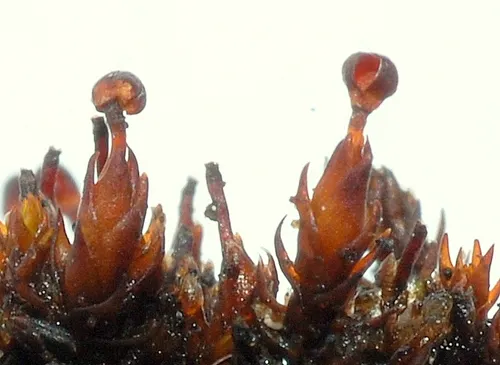
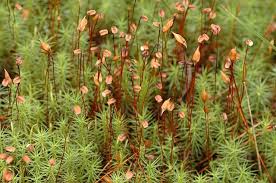
Sporophytes are known only for T. lepidozioides and are rarely produced. The seta (stalk) undergoes significant elongation before the capsule matures (a liverwort-like feature). The capsule is elongate-ovoid, tapering upwards, and contains a central sterile tissue column called a columella (a moss-like feature). The capsule wall is thick. Dehiscence (opening to release spores) is unique: the capsule wall splits along a single, helical (spiral) line from apex to base. There is no operculum (lid) and no peristome. The calyptra (covering the young capsule) is thin and membranous.
Habitat
Takakia grows in very specific, cold, wet, high-elevation (montane to alpine) environments. Typical habitats include non-calcareous rock ledges, crevices, or thin soil constantly irrigated by seepage or snowmelt, often in areas where snow persists late into the growing season. They require high humidity and cool temperatures.
Field Identification
Identifying Takakiaceae relies primarily on its unique vegetative features and habitat:
Primary Identification Features
- Leaves Divided into Cylindrical Lobes: This is the most striking and diagnostic feature. The leaves look like small green fingers or threads clustered on the stem, not flattened blades.
- Habitat: Restricted to cold, wet, alpine or high-montane seepage areas, often near persistent snow patches.
- Slime Papillae: Small, glistening dots (mucilage papillae) often visible on stems and leaves (requires hand lens).
- Rhizomatous Growth: Plants arise from underground creeping rhizomes.
Secondary Identification Features
- Small Size / Turf-Forming Habit: Forms low patches.
- Radial Leaf Arrangement: Cylindrical lobes arranged around the stem.
- Lack of Typical Moss Rhizoids: Base of erect shoots connects to rhizomes.
- Spiral Capsule Dehiscence: Extremely rare to find, but unique if observed.
Seasonal Identification Tips
- Growing Season: Best observed during the snow-free period in their alpine/montane habitats (typically summer).
- Sporophytes: Extremely rare and finding them requires significant luck and careful searching during the appropriate season (likely late summer/fall).
Common Confusion Points
- Highly Distinctive Leaves: The cylindrical leaf lobes are unlike other mosses or typical liverworts.
- Algae: From a distance, might be mistaken for filamentous algae in wet seepage, but closer inspection reveals the organized shoots and leaf lobes.
- Some Leafy Liverworts: Certain finely dissected liverworts (e.g., some Lepidoziaceae or Herbertaceae) might grow in similar habitats, but their leaves, although divided, are typically flattened or composed of different cell types, and they possess underleaves. Takakia lepidozioides was initially described as a liverwort due to superficial resemblance.
Field Guide Quick Reference
Look For:
- Small turfs in cold, wet alpine/montane seepage
- Leaves deeply divided into cylindrical lobes
- Slime papillae often visible
- Plants arising from rhizomes
Key Variations:
- Single genus Takakia (2 species)
- Unique phylogenetic position (Takakiopsida)
- Sporophyte (rare) with spiral dehiscence
Notable Examples
The family contains only one genus with two known species.
Takakia lepidozioides
(No common name widely used)
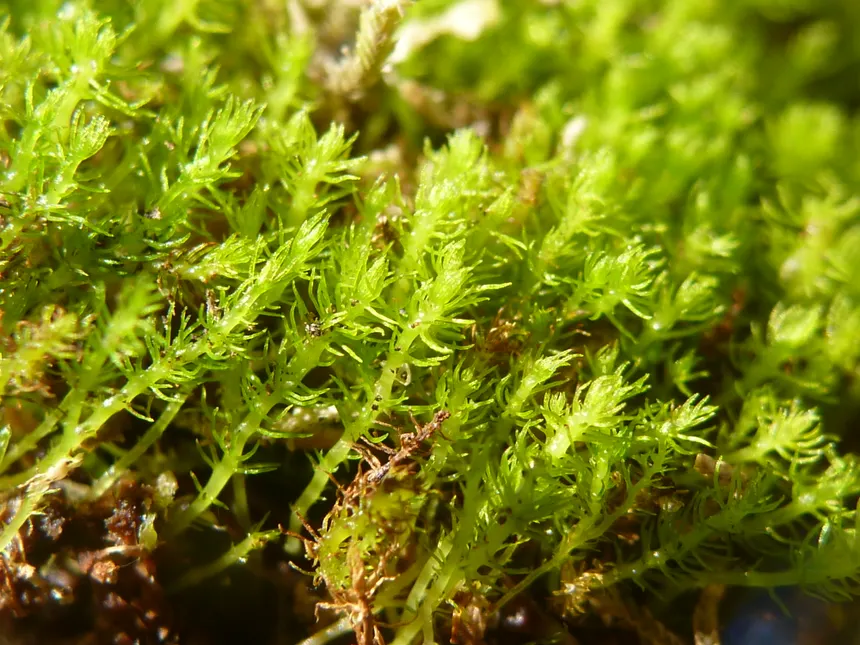
The first described species, named for a superficial resemblance to Lepidozia liverworts. Its leaves are typically divided into 3-4 cylindrical lobes. This is the species for which the unique sporophyte was eventually discovered. Found in disjunct locations across the Northern Pacific rim and the Himalayas.
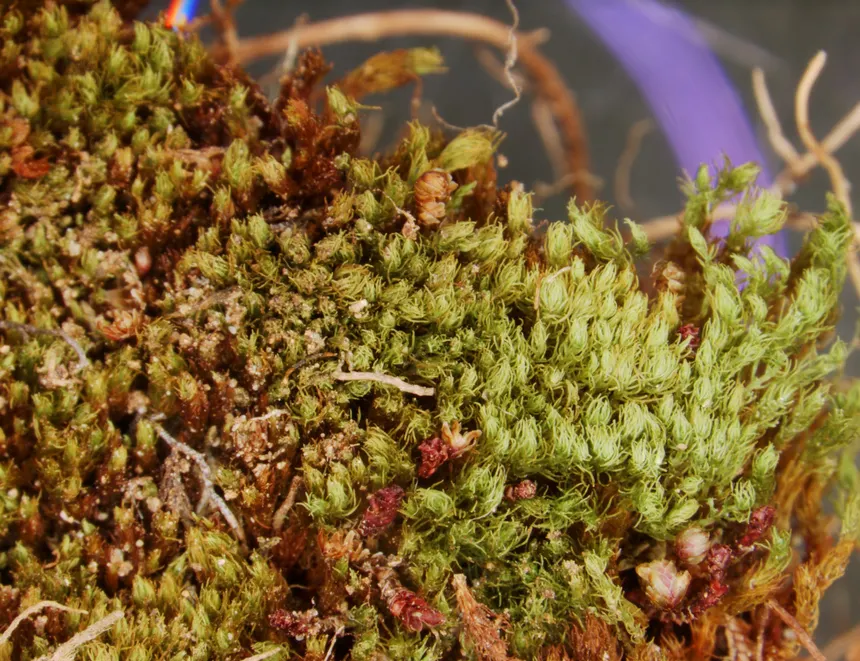
Takakia ceratophylla
(No common name widely used)
The second species, distinguished primarily by its leaves being consistently divided into only 2 cylindrical lobes (bifid), resembling tiny horns (hence "ceratophylla"). Its distribution overlaps with T. lepidozioides but may be somewhat more restricted. Sporophytes have not been definitively reported for this species.
Phylogeny and Classification
Takakiaceae (containing only Takakia) holds a pivotal position in understanding land plant evolution. Initially classified as a liverwort based on some gametophyte features, the discovery of its unique sporophyte (combining moss and liverwort traits) and subsequent molecular phylogenetic analyses have revolutionized its placement.
Current consensus places Takakia as the sister lineage to all other extant mosses. It represents the earliest diverging branch of the moss phylogeny (Division Bryophyta). This deep divergence warrants its placement in its own distinct class, Takakiopsida, separate from all other moss classes like Sphagnopsida, Andreaeopsida, Polytrichopsida, Tetraphidopsida, and the vast Bryopsida.
Position in Plant Phylogeny
- Kingdom: Plantae
- Division: Bryophyta (Mosses)
- Class: Takakiopsida
- Order: Takakiales
- Family: Takakiaceae
Evolutionary Significance
The Takakiaceae family is extremely significant for:
- Basal Position in Moss Phylogeny: Representing the earliest known diverging lineage of extant mosses, providing critical insights into the ancestral traits and early evolution of mosses.
- Intermediate Features: Possessing a unique mosaic of characters considered primitive or shared with liverworts (seta elongation, naked sex organs) and mosses (columella), blurring the lines between these groups.
- Unique Morphology: The cylindrical, divided leaves are unparalleled among bryophytes, representing a distinct evolutionary pathway in vegetative structure.
- Biogeography and Relict Status: Its highly fragmented, disjunct distribution suggests it is a relict lineage, surviving in specific cold, wet refugia from a potentially wider past distribution.