Andreaeaceae
Lantern Moss Family / Rock Moss Family
The Andreaeaceae is a small but distinct family of mosses, commonly known as lantern mosses or rock mosses. These unique bryophytes represent one of the earliest diverging lineages of mosses, placed in their own class, Andreaeopsida. They are characterized by their typically dark coloration (brownish, reddish-black, or black), brittle texture, preference for growing on siliceous (acidic) rock surfaces, and most notably, their unique capsules that dehisce (split open) via 4 or more longitudinal slits.
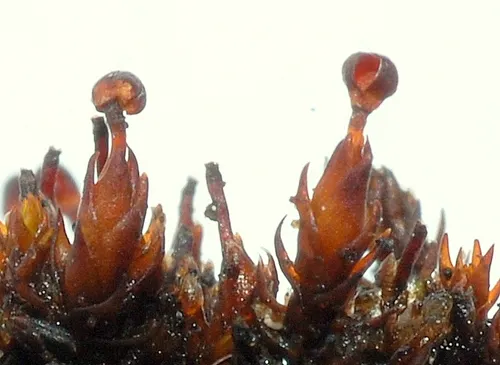
Overview
Andreaeaceae comprises primarily the genus Andreaea, with around 100 species distributed worldwide, particularly concentrated in alpine, arctic, and antarctic regions. They are pioneers on exposed rock surfaces, often forming small, dense, dark tufts or cushions that can withstand harsh environmental conditions, including desiccation and cold temperatures. Their brittle nature is a noticeable characteristic when handled.
The family's common name, "Lantern Moss," derives from the appearance of the mature capsule. Unlike most mosses that release spores through a lid (operculum) and regulated by teeth (peristome), the Andreaeaceae capsule splits along vertical lines, resembling the panes of a tiny lantern, allowing spores to escape through the gaps.
Ecologically, they contribute to primary succession on rock and soil formation in harsh environments. Their unique physiology and evolutionary position make them subjects of significant scientific interest for understanding bryophyte evolution and adaptation to extreme conditions. They have minimal direct economic importance.
Quick Facts
- Scientific Name: Andreaeaceae
- Common Name: Lantern Moss Family, Rock Moss Family
- Number of Genera: 1-2 (Mainly Andreaea; Acroschisma sometimes included/separated)
- Number of Species: Approximately 100
- Distribution: Cosmopolitan, but predominantly on acidic rocks in alpine, arctic, and antarctic regions.
- Evolutionary Group: Bryophytes - Mosses (Class: Andreaeopsida)
Key Characteristics
Growth Form and Habit
Andreaeaceae are acrocarpous mosses, with sporophytes terminating the main stems or branches. They typically form small, dense, often brittle tufts or cushions, usually dark in color (brown, reddish-black, blackish-green). They grow almost exclusively on rock.
Stems
Stems are erect, fragile, and usually branched. A central strand may be present or absent depending on the species.
Leaves
Leaves are small, typically crowded, and appressed to erect-spreading, often ovate to lanceolate or subulate (awl-shaped). A costa (midrib) may be present or absent. Leaf cells are generally small, thick-walled, and often papillose (roughened surface), contributing to their ability to withstand desiccation. Unlike Ambuchananiaceae or Sphagnaceae, they lack the specialized hyaline/chlorophyllose cell structure.
Sporophytes (Reproductive Structures)
Sporophytes are terminal (acrocarpous). The capsule is elevated on a pseudopodium (a stalk of gametophyte tissue), similar to Sphagnum and Ambuchanania. The capsule is the most distinctive feature: it lacks an operculum and peristome. Instead, it dehisces by splitting along 4 (occasionally up to 8-10) longitudinal slits that typically do not reach the apex or the base. As the capsule dries, it shrinks, causing the slits to widen and release spores. When moist, the slits close.
Spores and Dispersal
Spores are released through the longitudinal slits of the capsule as it dries and shrinks. This hygroscopic mechanism (responding to changes in moisture) controls spore release. Spores are typically dispersed by wind.
Habitat
Andreaeaceae species are highly specialized for growing on exposed, non-calcareous (siliceous, acidic) rock surfaces, such as granite, sandstone, or quartzite. They are characteristic of cold environments like alpine tundra, arctic regions, and Antarctica. They are rarely found on soil.
Field Identification
Identifying Andreaeaceae in the field primarily relies on recognizing their characteristic habitat, growth form, and, most definitively, the unique capsule structure when present.
Primary Identification Features
- Habitat: Almost exclusively on exposed, acidic rock (granite, sandstone, etc.) in cold climates (alpine, high latitude/altitude).
- Growth Habit: Small, dense, dark-colored (brownish/reddish/blackish), brittle tufts or cushions. Acrocarpous.
- Capsule Dehiscence (Key Feature): Mature capsules split open via 4 (or more) longitudinal slits, resembling a lantern. No operculum or peristome visible.
- Pseudopodium: Capsule is raised on a fleshy stalk (pseudopodium), not a thin seta (may require careful observation or magnification).
Secondary Identification Features
- Texture: Plants feel brittle when dry.
- Leaf Shape/Costa: Leaves small, crowded; costa present or absent depending on species (requires hand lens).
- Leaf Cells: Cells typically appear dense and opaque due to thick walls (requires magnification).
Seasonal Identification Tips
- Year-round: The dark, tufted gametophytes are visible year-round on their rock substrate.
- Sporophyte Timing: Sporophytes develop following fertilization and may persist for some time. Mature capsules with the characteristic slits are needed for definitive identification and are often found in late spring or summer in temperate alpine zones, but timing varies with climate.
Common Confusion Points
Andreaeaceae can be confused with other dark, acrocarpous mosses growing on rock:
- Grimmiaceae (e.g., Grimmia, Schistidium, Racomitrium): Also common on rocks, often dark-colored and tufted. Distinguished by having capsules with a distinct operculum and peristome (though sometimes rudimentary or hidden) borne on a true seta (usually short). They lack the longitudinal capsule slits and pseudopodium of Andreaeaceae.
- Other dark rock mosses (e.g., some Dicranaceae): Distinguished by capsule features (operculum, peristome, seta) and leaf structure details.
Field Guide Quick Reference
Look For:
- Habitat: Acidic rock in cold regions
- Dark (brown/red/black), brittle tufts
- Acrocarpous growth
- Capsule with 4+ longitudinal slits
- Capsule on fleshy pseudopodium
- No operculum or peristome
Key Variations:
- Number of capsule slits (usually 4)
- Leaf shape (ovate to subulate)
- Presence/absence of costa
- Intensity of dark pigmentation
Notable Examples
The genus Andreaea contains most species in the family:

Andreaea rupestris
Common Rock Moss / Slit Moss
A widespread and variable species found in arctic and alpine regions globally. Forms dense, dark reddish-brown to blackish tufts on acidic rocks. Leaves typically lack a costa (ecostate) and are ovate-lanceolate. Capsules typically have 4 slits.

Andreaea nivalis
Snow Rock Moss
Found at very high elevations and latitudes, often near persistent snow patches. Similar habit to A. rupestris but often has leaves with a distinct costa, at least in the upper part. Also grows on acidic rock and has the characteristic 4-slit capsule.
Phylogeny and Classification
Andreaeaceae holds a pivotal position in moss evolution. It is classified in its own class, Andreaeopsida, which represents one of the earliest diverging lineages within the entire phylum Bryophyta (mosses). Phylogenetic studies place Andreaeopsida as sister to all other mosses combined (including Sphagnopsida, Ambuchananiaceae, Polytrichopsida, Tetraphidopsida, and the vast Bryopsida class), with the exception of the potentially even more basal Takakiopsida.
This ancient lineage retains some unique characteristics (like the slit-dehiscence capsule and pseudopodium) that are not found in the majority of later-diverging moss groups. Studying Andreaeaceae provides crucial insights into the ancestral traits and early evolutionary pathways of mosses.
Position in Plant Phylogeny
- Kingdom: Plantae
- Division: Bryophyta (Mosses)
- Class: Andreaeopsida
- Order: Andreaeales
- Family: Andreaeaceae
Evolutionary Significance
Andreaeaceae is exceptionally important for understanding moss evolution:
- Early Diverging Lineage: Represents one of the oldest branches on the moss tree of life, retaining potentially ancestral traits.
- Unique Capsule Dehiscence: The longitudinal slits offer a different solution to spore dispersal compared to the operculum/peristome mechanism dominant in most other mosses.
- Pseudopodium: The presence of a pseudopodium links it to other basal groups like Sphagnopsida and Ambuchananiales, suggesting this might be an ancestral feature lost in more derived mosses with true setae.
- Adaptation to Extremes: Demonstrates early adaptation of mosses to harsh rock environments in cold climates.