Sphaerocarpaceae
Bottle Liverworts
Sphaerocarpaceae is a small family of thalloid liverworts belonging to the order Sphaerocarpales (class Marchantiopsida). These tiny, often ephemeral plants are best known for the conspicuous flask- or bottle-shaped structures (involucres) that surround each individual sex organ, giving the family its common name. They typically grow on moist soil, especially in regions with Mediterranean climates.
Overview
The Sphaerocarpaceae family comprises two genera: Sphaerocarpos (with about 8-9 species) and the monotypic Geothallus (with one species, G. tuberosus). These liverworts are characterized by their very small, simple gametophytes, which are typically orbicular, fan-shaped, or strap-shaped thalli lacking complex internal differentiation like air chambers. They are strictly dioicous, meaning male and female reproductive structures occur on separate plants.
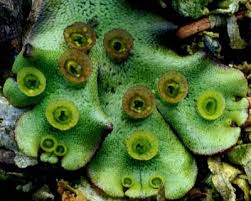
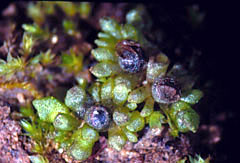
The most striking feature is the presence of prominent involucres – flask-like or bottle-like structures – that individually enclose each archegonium (female organ) or antheridium (male organ). Female plants are often more conspicuous due to their larger involucres. These plants are often annuals, appearing on moist, bare soil after seasonal rains, particularly common in Mediterranean climates and the southwestern United States, but with species found globally.
Asexual reproduction via gemmae is absent in this family. The genus Sphaerocarpos is also notable because its spores typically remain fused in permanent tetrads (groups of four), while Geothallus is unique for forming underground tubers that allow it to survive dry periods.
Quick Facts
- Scientific Name: Sphaerocarpaceae
- Common Name: Bottle Liverworts
- Number of Genera: 2 (Sphaerocarpos, Geothallus)
- Number of Species: Approximately 10-12
- Distribution: Widespread but often localized; notable in Mediterranean climates (e.g., California, Europe, Australia), SW North America, South America, Africa.
- Evolutionary Group: Bryophytes - Liverworts (Marchantiophyta) - Class Marchantiopsida - Order Sphaerocarpales
Key Characteristics
Growth Form and Habit
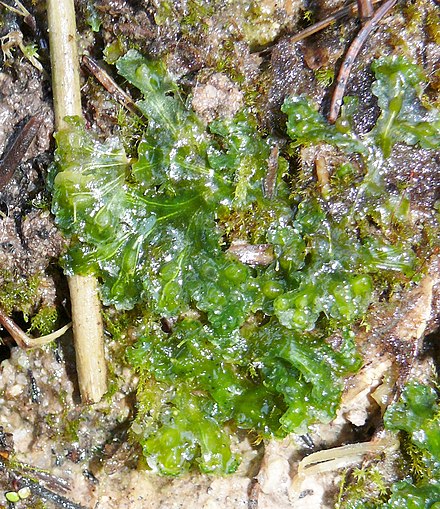
Plants consist of very small (often only a few millimeters across), simple, thalloid gametophytes. The thallus shape varies from nearly circular or fan-shaped to elongated and strap-like, often with slight lobing at the apex. Plants grow prostrate on the soil surface. They are strictly dioicous, with separate male and female individuals that often look different due to the size and density of their involucres. Geothallus forms perennating tubers.
Thallus Structure
The thallus is structurally simple, typically only one cell layer thick at the margins and a few cells thick near the center (midrib region). There is no internal differentiation into air chambers or pores. Small, simple ventral scales may be present. Colorless rhizoids arise from the ventral surface and anchor the plant to the substrate.
Reproductive Structures
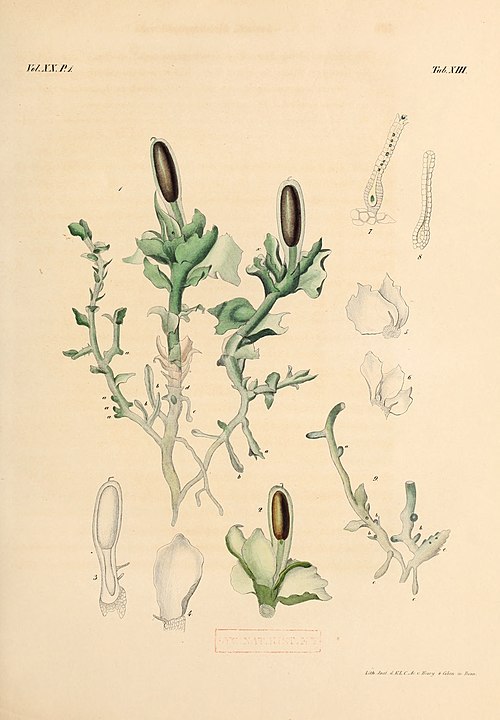
Reproduction is exclusively sexual; asexual gemmae are absent. Plants are dioicous. Antheridia (male organs) occur dorsally, often clustered near the thallus apex, with each antheridium typically enclosed within its own small, flask-shaped or tubular involucre. Archegonia (female organs) are also borne dorsally, scattered over the thallus surface, with each archegonium completely surrounded by a much larger, conspicuous, inflated, bottle-shaped or spherical involucre. These prominent individual involucres are the hallmark of the family.
Sporophyte and Spores
The sporophyte is small and remains entirely enclosed within the female involucre until maturity. It consists of a foot, a very short or virtually absent seta (stalk), and a spherical capsule. The capsule wall is unistratose (one cell layer thick) and lacks cellular thickenings. In Sphaerocarpos, elaters are absent, and the spores usually remain permanently united in tetrads (groups of four). In Geothallus, simple elaters are present, and spores separate individually. Spore release occurs passively through the decay of the capsule wall and the surrounding involucre.
Chemical Characteristics
The secondary chemistry of Sphaerocarpaceae is not particularly notable or well-studied compared to other liverwort groups. Their significance lies primarily in their unique morphology, life cycle adaptations, and phylogenetic position.
Field Identification
Identifying Sphaerocarpaceae requires careful observation, often close to the ground, due to their small size and ephemeral nature:
Primary Identification Features
- Tiny thallus size: Often only a few millimeters wide.
- Prominent involucres: Look for the clusters of bottle- or flask-shaped structures covering the dorsal surface. Female plants have larger, more inflated involucres than male plants.
- Simple thallus structure: No visible air pores or chambers.
- Spores in tetrads: In Sphaerocarpos, mature capsules (within involucres) contain spores grouped in fours (requires microscopy to confirm, but sometimes visible as clumps).
- Absence of gemmae: No specialized asexual reproductive structures like gemma cups or propagules.
Secondary Identification Features
- Habitat: Typically found on bare, moist soil, often appearing seasonally (winter/spring) after rains, especially in open, disturbed areas or fields.
- Dioicous populations: Male and female plants grow intermixed but look different.
- Tubers: In Geothallus (rare), small underground tubers may be present.
Seasonal Identification Tips
- Appearance: Often ephemeral, appearing rapidly after sufficient rainfall and disappearing as conditions dry out. Best searched for during wet seasons (e.g., winter/spring in Mediterranean climates).
- Involucres: The most reliable feature for identification; visible whenever plants are mature.
Common Confusion Points
- Riccia species (Ricciaceae): Also small thalloid liverworts on soil, but typically have internal air chambers (sometimes visible as surface reticulations), lack individual involucres around archegonia (sporophytes are embedded directly in the thallus), and often form rosettes.
- Other small thalloid liverworts: Lack the distinctive individual bottle-shaped involucres covering each sex organ.
- Moss protonemata / young moss gametophytes: Can form small green patches, but are typically filamentous or bud-like, not forming organized thalli with involucres.
- Algal mats: Lack rhizoids, scales, and the organized structure of involucres.
Field Guide Quick Reference
Look For:
- Very small thallus (mm scale)
- Bottle/Flask-shaped involucres covering surface
- Male & female plants look different
- Spores often in tetrads (Sphaerocarpos)
- No gemmae
Key Distinctions:
- Involucres distinguish from Riccia and other thalloids.
- Thalloid structure distinguishes from mosses.
- Habitat: ephemeral on moist soil.
Notable Examples
The family includes two distinct genera:

Sphaerocarpos texanus
Texas Bottlewort
A relatively common and widespread species found in North America, Europe, and other regions. It exemplifies the genus with its small thallus, prominent involucres (larger on female plants), and spores remaining in permanent tetrads. Often found on compacted soil in fields or along paths during wet seasons.

Geothallus tuberosus
Tuberous Bottlewort
A rare species known primarily from California and possibly Chile. While sharing the bottle-like involucres, it is unique in forming underground tubers for perennation through dry seasons. Unlike Sphaerocarpos, its spores separate individually at maturity, and the capsule contains simple elaters.
Phylogeny and Classification
Sphaerocarpaceae belongs to the order Sphaerocarpales, which contains only one other family, the aquatic Riellaceae. The Sphaerocarpales are placed within the class Marchantiopsida. Molecular phylogenetic studies often place Sphaerocarpales as one of the earliest diverging lineages within the Marchantiopsida, possibly sister to all other orders in the class or near the base of the subclass Marchantiidae.
The simple thallus structure, unique involucres, spore characteristics (especially tetrads in Sphaerocarpos), and adaptations to ephemeral environments suggest a long, independent evolutionary history. Studying Sphaerocarpaceae provides insights into the early evolution of thalloid liverworts and the diversification of reproductive strategies within the Marchantiopsida.
Position in Plant Phylogeny
- Kingdom: Plantae
- Clade: Embryophytes (Land plants)
- Division: Marchantiophyta (Liverworts)
- Class: Marchantiopsida
- Order: Sphaerocarpales
- Family: Sphaerocarpaceae
Evolutionary Significance
Sphaerocarpaceae is evolutionarily significant due to:
- Basal Phylogenetic Position: Represents an early diverging lineage within the class Marchantiopsida.
- Simple Gametophyte Structure: Provides insights into potentially ancestral thallus forms.
- Unique Involucres: A distinctive reproductive strategy where individual gametangia are protected.
- Spore Tetrads: The permanent spore tetrads in Sphaerocarpos are unusual and of genetic interest (allowing analysis of meiotic products).
- Adaptations to Ephemeral Habitats: Demonstrates strategies like rapid life cycles and perennation (tubers in Geothallus) for surviving drought.