Marchantiaceae
Marchantia Family
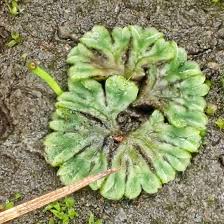
Marchantiaceae is a family of complex thalloid liverworts (division Marchantiophyta), famously represented by the genus Marchantia. They are characterized by a flattened, dichotomously branching thallus with distinct internal air chambers opening via pores, often bearing cup-like structures (gemma cups) for asexual reproduction, and producing sexual structures on specialized upright stalks (gametangiophores).
Overview
Marchantiaceae is a key family within the order Marchantiales and the class Marchantiopsida, representing the complex thalloid liverworts. Liverworts (Marchantiophyta) are one of the three divisions of bryophytes, alongside mosses and hornworts. The family Marchantiaceae is best known for its type genus, Marchantia, which includes common and cosmopolitan species often found on moist, disturbed soil, rocks, or greenhouse benches.
These liverworts exhibit a high degree of structural complexity in their gametophyte generation, which is the dominant phase of their life cycle. The thallus is internally differentiated with specialized photosynthetic chambers and air pores. Asexual reproduction via gemmae produced in gemma cups is common and conspicuous. Sexual reproduction involves elaborate stalked structures (gametangiophores) bearing the antheridia and archegonia, leading to the development of a simple, short-lived sporophyte.
Marchantia polymorpha is a widely used model organism for studying plant development, genetics, and evolution due to its complex structure and ease of cultivation.
Quick Facts
- Scientific Name: Marchantiaceae
- Common Name: Marchantia family
- Notable Genera: Marchantia (main genus)
- Number of Species: Approximately 35-40 (mostly in Marchantia)
- Distribution: Cosmopolitan
- Evolutionary Group: Bryophytes - Liverworts (Marchantiophyta) - Marchantiopsida - Marchantiales
Key Characteristics
Gametophyte (Thallus)
The dominant gametophyte is a complex thallus: flattened, typically dichotomously branched, and several cell layers thick. It shows distinct dorsal (upper) and ventral (lower) differentiation.
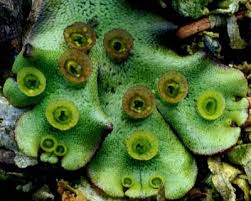
- Dorsal Surface: Green, often patterned with polygonal areas marking underlying air chambers. Each chamber opens to the outside via a central, often barrel-shaped air pore. Photosynthetic filaments arise from the floor of these chambers. Distinctive cup-like structures called gemma cups, containing small asexual propagules (gemmae), are frequently present.
- Ventral Surface: Bears scales (often in multiple rows) and numerous unicellular rhizoids (both smooth and pegged/tuberculate types) for anchorage and water absorption.
- Cellular Features: Cells contain multiple small chloroplasts and distinct membrane-bound oil bodies (characteristic of liverworts).
Reproductive Structures (Gametangia & Gametangiophores)
Plants are typically dioicous. Gametangia are borne on specialized, erect, stalked structures called gametangiophores (or receptacles) that arise from the dorsal thallus surface.
- Antheridiophores (Male): Stalked structures bearing a flattened or lobed disc at the apex. Antheridia are embedded in cavities within the upper surface of this disc.
- Archegoniophores (Female): Stalked structures with an umbrella-like or star-shaped head (capitulum) bearing several radiating lobes or rays. Archegonia are located on the underside of the head, typically hanging downwards and protected by curtain-like involucres (pseudoperianths).
Fertilization occurs when sperm, splashed by rain from the antheridiophore, reach the archegonia on the archegoniophore.
Sporophyte
The diploid sporophyte develops within the archegonium (venter) located underneath the archegoniophore head. It is small, structurally simple, non-photosynthetic at maturity, and entirely dependent on the gametophyte. It consists of:
- Foot: Embedded in the gametophyte tissue of the archegoniophore, absorbing nutrients.
- Seta: A very short, often inconspicuous stalk.
- Capsule (Sporangium): Spherical or ovoid structure containing spores and elaters. The capsule wall is typically only one cell layer thick and lacks stomata.
At maturity, the seta elongates slightly (though remaining short), pushing the capsule out from protective tissues. The capsule typically dehisces by splitting into 4 valves (or irregularly) to release spores and elaters.
Spores and Elaters
Produced within the capsule via meiosis:
- Spores: Typically small, spherical, and often possessing a trilete scar (though sometimes indistinct).
- Elaters: A key feature of liverworts (and Marchantiaceae). These are sterile, single, elongated cells with characteristic spiral thickenings on their walls. They are hygroscopic (respond to humidity changes), twisting and untwisting to help disperse the spores from the capsule.
Cellular and Chemical Features
Presence of oil bodies within cells is characteristic of liverworts. Cells contain multiple chloroplasts. Lack complex conducting tissues like mosses (hydroids/leptoids) or vascular plants. Asexual reproduction via gemmae from gemma cups is highly developed.
Field Identification
Identifying Marchantiaceae usually relies on recognizing the complex thalloid structure, air pores, gemma cups, and the distinctive stalked reproductive structures.
Primary Identification Features
- Complex Thalloid Gametophyte: Flattened, green, dichotomously branched body.
- Dorsal Air Pores: Visible (often with lens) as small openings on the upper surface, leading to air chambers.
- Gemma Cups: Distinctive cup-like structures on the dorsal surface containing gemmae.
- Stalked Gametangiophores: Erect structures bearing male (antheridiophores - often disc-like) or female (archegoniophores - often umbrella/star-like) organs.
- Ventral Scales and Rhizoids: Present on the underside of the thallus.
- Elaters mixed with Spores: Definitive microscopic feature.
Secondary Identification Features
- Habitat: Moist soil, rocks, pavement cracks, greenhouses.
- Oil Bodies in Cells: Microscopic liverwort feature.
- Short-lived Sporophyte: Small capsule on a very short seta, borne under archegoniophore head.
Seasonal Identification Tips
Look for different structures depending on conditions:
- Gametophyte: Often perennial and visible year-round if moisture permits. Gemma cups can be present most of the time.
- Gametangiophores: Develop seasonally, often following periods of favorable growth, making sexual reproduction possible.
- Sporophyte: Develop on female plants after fertilization, appearing as small capsules underneath the archegoniophore heads. They are relatively short-lived compared to moss or hornwort sporophytes.
Common Confusion Points
Marchantiaceae can be confused with:
- Other Complex Thalloid Liverworts (e.g., Conocephalum, Lunularia, Reboulia): Share the complex thallus structure with pores/chambers. Distinguished by details of pore structure, gemma cup shape (or absence), gametangiophore shape, and ventral scale arrangement. Lunularia has crescent-shaped gemma cups. Conocephalum has conical gametangiophores.
- Simple Thalloid Liverworts (e.g., Pellia, Metzgeria): Lack the complex internal differentiation with air chambers and distinct pores.
- Hornworts: Thallus lacks complex chambers/pores and oil bodies; sporophyte is a persistent, horn-like structure with basal growth.
- Mosses: Typically have leafy gametophytes; sporophyte has a distinct seta and complex capsule with peristome.
- Algae / Lichens: Lack the organized thallus structure, rhizoids, pores, gemma cups, and bryophyte reproductive structures.
Field Guide Quick Reference
Look For (Gametophyte):
- Flattened, green, complex thallus
- Air pores on dorsal surface (use lens)
- Gemma cups (often present)
- Ventral scales and rhizoids
- Stalked gametangiophores (male/female)
Look For (Sporophyte & Spores):
- Small capsule on very short seta
- Located under archegoniophore head
- Dehisces by 4 valves (usually)
- Elaters mixed with spores (microscopic)
Notable Examples
The genus Marchantia is the primary representative of this family.

Marchantia polymorpha
Common Liverwort / Umbrella Liverwort
A highly adaptable and cosmopolitan species, often found on damp, disturbed soil, burnt ground, paths, and in greenhouses. It clearly shows the characteristic dichotomously branched thallus, barrel-shaped pores, prominent gemma cups, and distinctive star-shaped (female) or disc-shaped (male) gametangiophores. It's a widely studied model organism.

Marchantia berteroana
(Southern Hemisphere Marchantia)
A species common in the Southern Hemisphere, particularly Australia, New Zealand, and South America, often found along stream banks and moist shaded areas. It is similar in general appearance to M. polymorpha, with a complex thallus, gemma cups, and characteristic gametangiophores, but differs in finer details of pore structure and reproductive parts.
Phylogeny and Classification
Marchantiaceae is a family within the order Marchantiales and the class Marchantiopsida. This class represents the complex thalloid liverworts, one of the major lineages within the division Marchantiophyta (liverworts). Liverworts are considered one of the earliest diverging lineages of land plants.
Within the Marchantiales, Marchantiaceae is characterized by its combination of complex thallus anatomy, specific gametangiophore structures, and gemma cups. Molecular phylogenetics supports its placement among other complex thalloid families like Conocephalaceae, Aytoniaceae, and Ricciaceae, although the exact relationships are continually refined.
Position in Plant Phylogeny
- Kingdom: Plantae
- Clade: Embryophytes (Land Plants)
- Division: Marchantiophyta (Liverworts)
- Class: Marchantiopsida
- Order: Marchantiales
- Family: Marchantiaceae
Evolutionary Significance
Marchantiaceae is significant for:
- Complex Gametophyte Evolution: Represents a high level of structural complexity in the dominant gametophyte generation among land plants, including internal differentiation analogous to leaves in some ways.
- Specialized Reproductive Strategies: Exhibits elaborate structures for both sexual (gametangiophores) and asexual (gemma cups) reproduction.
- Model Organism: Marchantia polymorpha is a key model system for studying fundamental plant biology, genetics, and the evolution of land plants.
- Early Land Plant Lineage: As liverworts, they provide insights into the adaptations required for the colonization of land by plants.