Blasiaceae
Blasia / Flask Liverworts
Blasiaceae is a unique family of liverworts, containing the single species Blasia pusilla. It is often placed in its own order, Blasiales, within the class Marchantiopsida. This liverwort has a thalloid structure but with distinct marginal lobes, giving it a somewhat leafy appearance. It is characterized by specialized structures for asexual reproduction (gemmae) and symbiotic cavities containing nitrogen-fixing cyanobacteria (Nostoc).
Overview
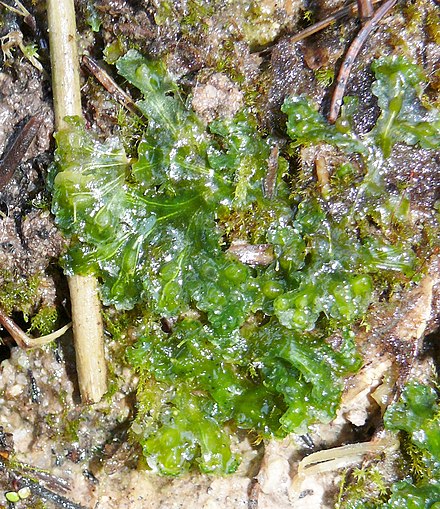
The Blasiaceae family consists of a single genus, Blasia, with one species, Blasia pusilla. This small liverwort forms flattened, dichotomously branched thalli that are noticeably lobed along the margins. A key feature is the presence of specialized ventral pouches or auricles, each containing a colony of the cyanobacterium Nostoc, which fixes atmospheric nitrogen, providing a nutrient advantage to the liverwort, especially in nutrient-poor habitats.
Blasia pusilla is widespread across temperate regions of the Northern Hemisphere, including North America, Europe, and Asia. It typically colonizes moist, disturbed mineral soil, such as stream banks, trail edges, roadside ditches, and recently exposed soil surfaces. It is often considered a pioneer species.
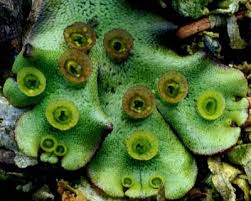
The family is notable for its sophisticated asexual reproduction mechanisms, producing two types of gemmae: star-shaped gemmae in distinctive flask-shaped receptacles at the thallus apex, and smaller, oval gemmae produced directly on the dorsal thallus surface. Its unique combination of features and uncertain phylogenetic position make it important for studies of liverwort evolution.
Quick Facts
- Scientific Name: Blasiaceae
- Common Name: Blasia Liverworts, Flask Liverworts
- Number of Genera: 1 (Blasia)
- Number of Species: 1 (Blasia pusilla)
- Distribution: Widespread in temperate Northern Hemisphere (North America, Europe, Asia).
- Evolutionary Group: Bryophytes - Liverworts (Marchantiophyta) - Class Marchantiopsida - Order Blasiales
Key Characteristics
Growth Form and Habit
Plants form small (typically 1-5 cm long), prostrate, dichotomously branched thalli that adhere closely to the substrate. While fundamentally thalloid, the margins are deeply and regularly lobed, giving a somewhat leafy or ruffled appearance. The thallus has a thickened central midrib region and thinner lateral wings. Both smooth and pegged rhizoids arise from the ventral midrib. A defining feature is the presence of paired ventral auricles (pouches) containing colonies of symbiotic Nostoc (cyanobacteria), which often appear as dark spots.
Thallus Structure
The gametophyte is a flattened thallus, not differentiated into stems and leaves. It branches dichotomously. The margins are distinctly lobed. A central midrib is apparent, especially ventrally. Small, mucilage-secreting scales are present on the ventral surface along the midrib. The most characteristic feature is the presence of ventral auricles near the base of the marginal lobes, housing symbiotic Nostoc colonies. These auricles are crucial for nitrogen fixation.
Reproductive Structures
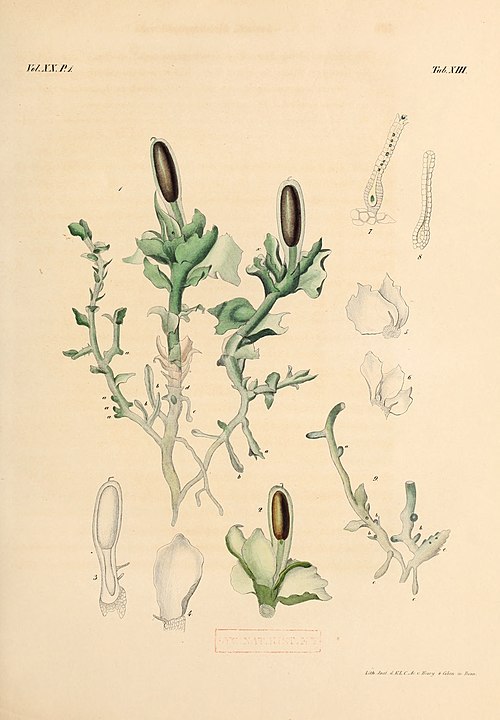
Blasia pusilla can be monoicous or dioicous. Antheridia (male organs) are small and sunken in irregular patches or receptacles along the dorsal midrib. Archegonia (female organs) are also sunken individually in cavities on the dorsal thallus surface. After fertilization, each archegonium develops a conspicuous, long-necked, flask-shaped pseudoperianth that encloses the developing sporophyte.
Asexual reproduction is highly developed. Large, multicellular, star-shaped gemmae are produced within distinctive, long-necked, flask-shaped receptacles located near the thallus apex. Smaller, oval, few-celled gemmae are also produced directly on the dorsal surface of the thallus, often appearing as dark, powdery patches.
Sporophyte and Spores
The sporophyte develops within the protection of the flask-shaped pseudoperianth. It consists of a foot, a short seta (stalk), and a nearly spherical, dark brown to black capsule. The capsule wall is mostly one cell layer thick (unistratose), except for a thickened cap at the apex. Dehiscence is variable, sometimes irregular or splitting into four indistinct valves. The capsule contains spores and spirally thickened elaters that aid in spore dispersal.
Spores are relatively small and dispersed by wind and water splash, often facilitated by the hygroscopic action of the elaters.
Chemical Characteristics
The most significant chemical aspect is the symbiotic nitrogen fixation carried out by the Nostoc colonies within the ventral auricles. This allows Blasia to thrive on nutrient-poor mineral soils. Other secondary chemistry is less distinctive compared to complex thalloid liverworts like Marchantiales.
Field Identification
Identifying Blasia pusilla involves looking for its unique combination of thallus features and specialized reproductive structures:
Primary Identification Features
- Lobed thallus: Flattened, but with distinct, regular lobes along the margins (appearing somewhat leafy).
- Nostoc auricles: Look for small, often dark-colored pouches or spots on the ventral surface, sometimes visible through the thallus from above, especially near the lobe bases.
- Flask-shaped gemma receptacles: Distinctive long-necked flasks near the thallus apex containing star-shaped gemmae (when present).
- Star-shaped gemmae: If dispersed from receptacles, these multicellular green stars may be visible on the substrate nearby.
- Dorsal gemmae: Small, dark, powdery patches of oval gemmae on the thallus surface (when present).
Secondary Identification Features
- Habitat: Moist, disturbed mineral soil (stream banks, path edges, ditches).
- Dichotomous branching: Thallus forks repeatedly.
- Flask-shaped pseudoperianths: If sporophytes are present, they will be enclosed in these structures on the dorsal midrib.
- Ventral scales: Small scales along the underside midrib (requires magnification).
Seasonal Identification Tips
- Gametophyte & Nostoc auricles: Visible year-round when moist.
- Gemmae Receptacles/Gemmae: Often prominent during the growing season (spring to fall).
- Sporophytes/Pseudoperianths: Less common, typically developing seasonally after fertilization, often visible later in the growing season or overwintering.
Common Confusion Points
- Leafy Liverworts (Jungermanniales): Have distinct stems and leaves in 2 or 3 ranks, lack Nostoc auricles and flask-shaped gemma receptacles.
- Pellia (Pelliaceae): Thalloid, but lacks marginal lobes, Nostoc auricles, and specialized gemmae/receptacles. Sporophyte emerges from a flap-like involucre, not a pseudoperianth.
- Fossombronia (Fossombroniaceae): Leafy liverwort with highly ruffled leaves arranged in two ranks along a stem, possesses rhizoids, lacks Nostoc auricles and specialized gemmae.
- Hornworts (Anthocerotophyta): Thalloid, often rosette-forming, possess single large chloroplasts per cell (in many species), have distinctive horn-shaped sporophytes, and may have internal Nostoc cavities but lack external auricles and specialized gemmae.
Field Guide Quick Reference
Look For:
- Small, lobed thallus
- Nostoc auricles (dark spots beneath/within)
- Flask-shaped gemma receptacles (apical)
- Star-shaped gemmae
- Dorsal powdery gemmae patches
- Flask-shaped pseudoperianths (if fertile)
Key Distinctions:
- Lobed thallus distinguishes from unlobed thalloid forms (e.g., Pellia).
- Nostoc auricles and unique gemmae distinguish from leafy liverworts.
- Habitat: moist mineral soil.
Notable Examples
The family Blasiaceae contains only one species:

Blasia pusilla
Flask Liverwort
The sole representative of the family. It exhibits all the key characteristics: a lobed thallus, ventral Nostoc auricles, flask-shaped gemma receptacles producing star-shaped gemmae, dorsal oval gemmae, and flask-shaped pseudoperianths enclosing the sporophytes. Commonly found on disturbed, moist mineral soil across the Northern Hemisphere.
Phylogeny and Classification
The phylogenetic position of Blasiaceae (and its single species Blasia pusilla) has been debated. It is placed within the class Marchantiopsida but often segregated into its own order, Blasiales. Its relationship to other orders within this class (like Marchantiales, Neohodgsoniales, Sphaerocarpales) remains somewhat uncertain and is an area of ongoing research using molecular data.
Some studies suggest Blasiales may be sister to the large subclass Marchantiidae (which includes Marchantiales), while others place it near the base of the Marchantiopsida. Its unique combination of a somewhat complex thallus structure (lobing, midrib, scales), specialized asexual reproduction, and the cyanobacterial symbiosis makes it difficult to place definitively without robust molecular evidence. It clearly represents a distinct and relatively isolated evolutionary lineage within the liverworts.
Position in Plant Phylogeny
- Kingdom: Plantae
- Clade: Embryophytes (Land plants)
- Division: Marchantiophyta (Liverworts)
- Class: Marchantiopsida
- Order: Blasiales
- Family: Blasiaceae
Evolutionary Significance
Blasiaceae is evolutionarily significant due to:
- Unique combination of traits: Blends features of simple thalloid structure with some complexity (lobing, midrib, scales) and highly specialized reproductive structures.
- Nostoc Symbiosis: Represents one of the few liverwort lineages with consistent, specialized structures (auricles) for housing nitrogen-fixing cyanobacteria.
- Specialized Asexual Reproduction: The flask-shaped receptacles and star-shaped gemmae are unique among liverworts.
- Phylogenetic Position: Its placement near the base or as sister to major groups within Marchantiopsida makes it important for understanding the diversification of this class.