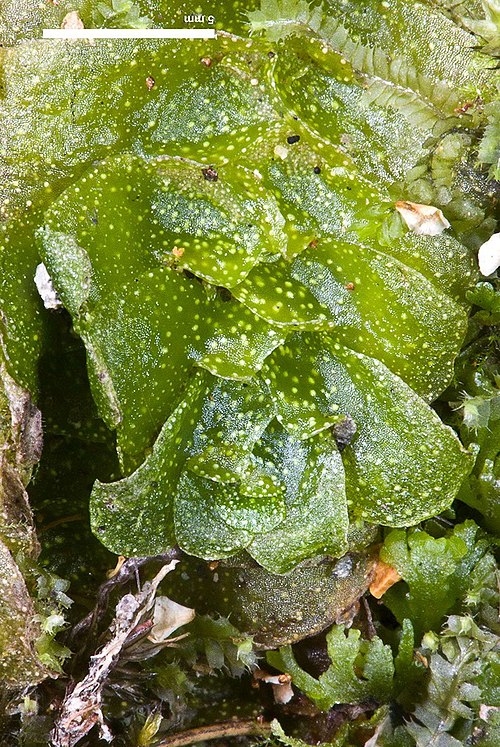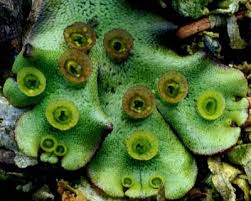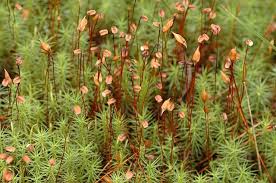
Haplomitriaceae
Haplomitrium Liverworts
Haplomitriaceae is a small but evolutionarily significant family of liverworts, representing one of the earliest diverging lineages within the Marchantiophyta. These unique plants possess features considered ancestral among liverworts, providing crucial insights into early land plant evolution. They are characterized by their leafy appearance, lack of rhizoids, and often subterranean axes.
Overview
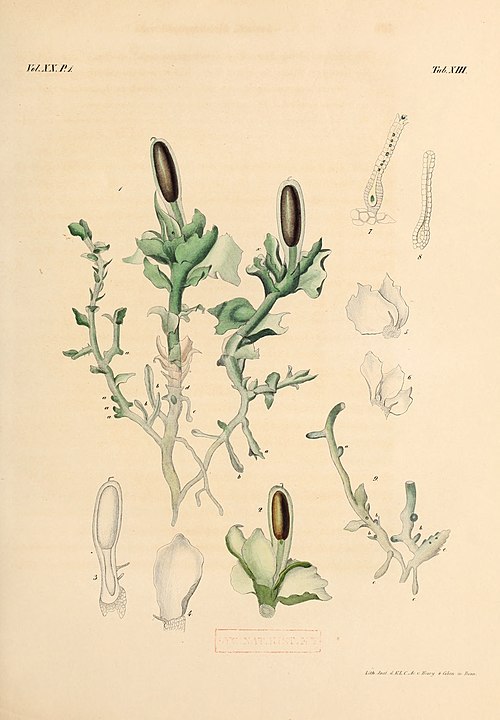
The Haplomitriaceae family comprises a single genus, Haplomitrium, with about 10-15 species. These liverworts are distinct from most others due to their relatively erect, leafy gametophytes that lack the typical anchoring structures called rhizoids. Instead, they often have underground, rhizome-like axes from which the leafy shoots arise. They possess mucilage-secreting papillae, especially near the shoot apex.
Species of Haplomitrium have a scattered global distribution, found in moist, shaded habitats, typically on soil or humus, often in temperate or tropical montane regions. Their unique morphology and phylogenetic position make them a key group for studying the evolutionary history of liverworts and the transition of plants to land.
Economically, Haplomitriaceae have no direct importance, but their scientific value is immense. Studying their genetics, morphology, and physiology helps scientists understand the fundamental traits of early land plants and the evolutionary relationships among bryophytes (liverworts, mosses, and hornworts).
Quick Facts
- Scientific Name: Haplomitriaceae
- Common Name: Haplomitrium liverworts
- Number of Genera: 1 (Haplomitrium)
- Number of Species: Approximately 10-15
- Distribution: Scattered worldwide, primarily temperate and tropical montane regions (e.g., Australasia, Southeast Asia, Europe, Americas)
- Evolutionary Group: Bryophytes - Liverworts (Marchantiophyta) - Class Haplomitriopsida
Key Characteristics
Growth Form and Habit
Plants are typically small, erect or ascending leafy gametophytes arising from a subterranean, often branched, colorless rhizome-like axis. A key feature is the complete absence of rhizoids. Anchorage may be aided by the subterranean axes and associated fungi. Mucilage papillae are present, especially near the apex and associated with leaves.
Leaves
Leaves are simple, unlobed, and typically arranged in three distinct ranks around the stem: two ranks of larger lateral leaves and one rank of smaller ventral leaves (underleaves), giving the shoot a radially symmetric appearance (though variations exist). Leaf insertion can be transverse or succubous (obliquely inserted with the lower edge of one leaf overlapping the upper edge of the leaf below it). Leaves lack a midrib (costa).
Reproductive Structures
Haplomitriaceae are typically dioicous (male and female reproductive structures on separate plants). The sex organs (gametangia) are borne either terminally on main shoots or laterally. Antheridia (male organs) are stalked, ovoid structures, often mixed with slime papillae, sometimes protected by modified leaves. Archegonia (female organs) are flask-shaped, also often mixed with slime papillae and surrounded by perianth-like leaves (perichaetium).
Sporophyte and Spores
The sporophyte, which develops after fertilization, consists of a foot embedded in the gametophyte, a long, relatively thick seta (stalk), and a capsule. The capsule is typically cylindrical or ellipsoidal and contains spores and elaters. The capsule wall lacks the thickenings found in many other liverworts. Dehiscence (opening to release spores) occurs via one to four longitudinal slits. The elaters are elongated cells with spiral thickenings that aid in spore dispersal by twisting and untwisting with changes in humidity.
Spores are small, typically spherical, and dispersed primarily by wind after the capsule opens.
Chemical Characteristics
While not known for the complex secondary metabolites found in families like Asteraceae, Haplomitriaceae are notable for their production of mucilage from specialized slime papillae. This mucilage likely protects the growing points and reproductive organs from desiccation. Mycorrhizal associations (symbiosis with fungi) in the subterranean axes are also characteristic and important for nutrient uptake in the absence of rhizoids.
Field Identification
Identifying Haplomitriaceae in the field requires careful observation, often with a hand lens, due to their small size and similarity to some other leafy liverworts. Key features include:
Primary Identification Features
- Leafy gametophyte: Plants look like small, leafy stems, not flattened thalli.
- Absence of rhizoids: This is a crucial diagnostic feature. Check the base of the leafy shoots and any subterranean axes – no hair-like rhizoids should be present.
- Three ranks of leaves: Look for two rows of larger lateral leaves and one row of smaller ventral underleaves (best viewed from below or side-on).
- Mucilage papillae: Small, often club-shaped slime-secreting hairs may be visible near the shoot tip or among leaves/gametangia (requires magnification).
- Subterranean axes: Often, the green leafy shoots arise from pale, underground stems.
Secondary Identification Features
- Leaf shape and insertion: Leaves are generally simple and unlobed, inserted transversely or succubously.
- Habitat: Found in consistently moist, shaded environments, often on mineral soil, humus, or among other bryophytes.
- Sporophyte structure: If present, the long seta and cylindrical capsule splitting into slits are characteristic.
Seasonal Identification Tips
- Gametophyte: Present year-round in suitable habitats, though growth may slow in dry or cold periods.
- Sporophyte: Development is often seasonal, typically appearing after periods of sufficient moisture and fertilization. The mature sporophyte with its long seta might be more conspicuous at certain times of the year.
Common Confusion Points
- Other leafy liverworts (Jungermanniales): Most other leafy liverworts possess rhizoids, typically have only two ranks of well-developed leaves (underleaves often absent or very different), and different sporophyte characteristics.
- Mosses (Bryophyta): Mosses have leaves that are usually spirally arranged (not strictly in 3 ranks), possess rhizoids, often have a costa (midrib) in the leaf, and have a distinct sporophyte structure (e.g., often with a peristome for spore release).
Field Guide Quick Reference
Look For:
- Leafy liverwort appearance
- NO RHIZOIDS
- Three ranks of leaves (2 lateral, 1 ventral)
- Subterranean axes
- Mucilage papillae (with lens)
- Long-stalked, cylindrical capsule (if present)
Key Distinctions:
- Distinguished from most leafy liverworts by lack of rhizoids and 3-ranked leaves.
- Distinguished from mosses by leaf arrangement, lack of costa, and sporophyte structure.
- Habitat: moist, shaded soil/humus.
Notable Examples (Genus Haplomitrium)
All members of the family belong to the genus Haplomitrium. Here are a couple of representative species:

Haplomitrium gibbsiae
(No common name)
Found in Australasia (New Zealand, Australia, Tasmania). It grows on damp soil banks and humus in shaded forests. This species typically has relatively broad lateral leaves and distinct underleaves, showcasing the characteristic features of the genus.

Haplomitrium hookeri
Hooker's Scalewort (rarely used)
This species has a wider, albeit scattered, distribution, occurring in temperate regions of both the Northern and Southern Hemispheres (e.g., Europe, North America, southern South America). It often grows in moist, peaty soil or among Sphagnum moss. It is considered a classic example of the genus, studied for its unique morphology and phylogenetic importance.
Phylogeny and Classification
Haplomitriaceae holds a crucial position in the phylogeny of land plants. Molecular and morphological data place the class Haplomitriopsida (containing Haplomitriaceae and its sister family Treubiaceae) as one of the two earliest diverging lineages within the liverworts (Marchantiophyta), the other being the rest of the liverworts combined. This basal position means they retain features likely present in the ancestors of all liverworts.
The family likely originated very early in liverwort evolution, possibly dating back hundreds of millions of years. Studying Haplomitriaceae helps reconstruct the characteristics of early embryophytes and understand the evolutionary steps involved in plant terrestrialization, such as the development of gametangia, sporophytes, and water-conducting tissues (though specialized conducting cells in Haplomitrium are simple compared to vascular plants).
Position in Plant Phylogeny
- Kingdom: Plantae
- Clade: Embryophytes (Land plants)
- Division: Marchantiophyta (Liverworts)
- Class: Haplomitriopsida
- Order: Haplomitriales
- Family: Haplomitriaceae
Evolutionary Significance
Haplomitriaceae is highly significant for understanding plant evolution due to:
- Basal phylogenetic position: Represents one of the earliest branches of the liverwort lineage.
- Ancestral traits: Features like the lack of rhizoids, radial symmetry (in some aspects), and simple sporophyte structure may reflect characteristics of early land plants.
- Insights into terrestrialization: Studying their adaptations (e.g., subterranean axes, mucilage production, mycorrhizal associations) provides clues about how plants colonized land.
- Comparative morphology: Contrasting their features with other liverworts, mosses, hornworts, and vascular plants helps trace the evolution of key plant structures.