Smilacaceae
Greenbrier Family / Catbrier Family
Smilacaceae is a family of monocotyledonous plants, primarily consisting of climbing vines (though sometimes herbs or shrubs) belonging to the order Liliales. The vast majority of species belong to the genus Smilax. They are widespread globally and often characterized by prickly stems, distinctive net-veined leaves (unusual for monocots) bearing paired petiolar tendrils, small unisexual flowers typically in umbels, and berry fruits.
Overview
The Smilacaceae family belongs to the order Liliales, placing it within the monocots alongside familiar families like Liliaceae (lilies). While sometimes considered to include a few small genera, most modern treatments regard the family as comprising essentially only the large genus Smilax, which contains around 260 species. These plants, commonly known as greenbriers or catbriers, have a broad distribution across tropical, subtropical, and temperate regions worldwide.
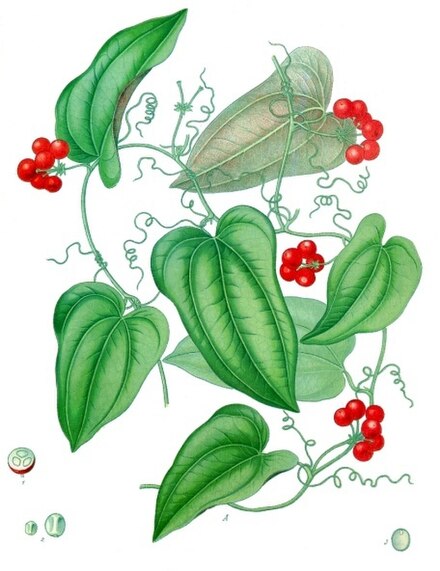
Members of Smilacaceae are typically climbing vines, often woody and frequently armed with sharp prickles on the stems. They climb using characteristic pairs of tendrils that arise from the base of the leaf petiole. One of the most notable features, quite unusual for monocots which typically have parallel leaf venation, is their possession of broad leaves with distinct reticulate (net-like) venation, usually with several prominent main veins running from base to tip. The plants are dioecious, bearing small, inconspicuous male and female flowers on separate individuals.
Ecologically, greenbriers can be significant components of forest understories, thickets, and disturbed areas, providing structure, cover, and food (berries) for wildlife. Some species have historical uses, such as the roots of certain tropical Smilax species being used to make sarsaparilla flavoring.
Quick Facts
- Scientific Name: Smilacaceae
- Common Name: Greenbrier family, Catbrier family
- Number of Genera: 1 (Smilax) (primarily)
- Number of Species: Approximately 260
- Distribution: Widespread in tropical and temperate regions worldwide
- Evolutionary Group: Monocots - Liliales
Key Characteristics
Growth Form and Habit
The vast majority are perennial vines, which can be herbaceous or woody. Stems are often tough and frequently armed with sharp prickles or thorns. Climbing is achieved via paired tendrils attached to the petioles. A few species are erect herbs or subshrubs. Many possess tuberous rhizomes.
Leaves
Leaves are typically arranged alternately (sometimes opposite). They are simple, often broad (ovate, heart-shaped, etc.), and usually have entire margins. The most distinctive feature is the venation pattern: unlike the parallel venation typical of most monocots, Smilax leaves exhibit prominent reticulate (net-like) venation, usually with 3-7 major longitudinal veins arching from the base and connected by a network of finer veins. The petiole base typically bears a pair of slender tendrils, considered modified stipules or parts of the leaf sheath.
Inflorescence
Flowers are borne in axillary inflorescences, most commonly simple umbels (clusters where flower stalks arise from a single point), which are often borne on a distinct peduncle (inflorescence stalk). Less frequently, flowers may be in racemes or spikes.
Flowers
Flowers are small, inconspicuous, radially symmetrical (actinomorphic), and strictly unisexual, with male and female flowers occurring on separate plants (dioecious). Key floral features include:
- Perianth: Consists of 6 distinct (free) tepals arranged in two similar whorls of 3. Tepals are typically small, greenish, yellowish, or brownish, not brightly colored.
- Androecium (in male flowers): Usually consists of 6 distinct stamens (sometimes 3, 9, or more). Anthers typically open via longitudinal slits.
- Gynoecium (in female flowers): The pistil is composed of 3 fused carpels (syncarpous). The ovary is positioned superiorly and is typically divided into 3 chambers (locules), each containing 1 or 2 ovules on axile placentas. There are usually 3 distinct styles or a single style with 3 stigmas, often short and recurved. Staminodes (sterile stamens) may be present.
Fruits and Seeds
The fruit is a fleshy berry, typically globose, containing 1 to 3 (sometimes more) seeds. The berries are often red, blue, or black when mature and are dispersed by animals, primarily birds.
Chemical Characteristics
Many species contain steroidal saponins, which have foaming properties and contribute to the historical use of some Smilax roots (e.g., sarsaparilla) for flavoring and in traditional medicine. Tannins are also common.
Field Identification
Identifying members of Smilacaceae (primarily Smilax) involves recognizing their unique combination of monocot floral traits with vine habits and distinctive leaves:
Primary Identification Features
- Habit: Look for climbing vines, frequently armed with prickles on the stems.
- Leaves: Identify the usually alternate, simple leaves possessing distinct reticulate (net-like) venation (with several strong parallel main veins).
- Tendrils: Note the characteristic pair of slender tendrils arising from the petiole near its base.
- Flowers: Small, inconspicuous, with 6 greenish/yellowish tepals, unisexual (male and female on separate plants - dioecious), typically arranged in stalked axillary umbels.
- Fruit: Look for small, fleshy berries (red, blue, or black when mature).
- Monocot Traits: Remember it's a monocot despite net-veined leaves (flower parts in 3s - 6 tepals, 6 stamens, 3 carpels).
Secondary Identification Features
- Ovary Position: Superior ovary (visible in female flowers).
- Rhizomes: Often spreads via underground rhizomes.
Seasonal Identification Tips
- Year-round: Woody or persistent stems (often prickly) and rhizomes are present. Dried tendrils may remain.
- Growing Season: Distinctive net-veined leaves with petiolar tendrils are key.
- Flowering: Umbels of small flowers appear seasonally (often spring/early summer). Need to check if flowers are male (stamens) or female (pistil).
- Fruiting: Berries develop later (summer through fall, sometimes persisting into winter) and can be conspicuous.
Common Confusion Points
- Dioscoreaceae (Yam family): Also monocot vines, sometimes prickly, often net-veined leaves. Distinguished by typically having inferior ovaries, different inflorescence types (often spikes/panicles), and fruit usually a winged capsule or samara. Tendrils usually arise from nodes, not petioles.
- Eudicot Vines (Grapes, Moonseeds, etc.): While vines, these are eudicots. Grapes (Vitaceae) have tendrils opposite leaves; Moonseeds (Menispermaceae) lack tendrils and have very different flowers/fruits; Legume vines (Fabaceae) have characteristic pods and often compound leaves with stipules. None share the specific combination of Smilacaceae features.
Field Guide Quick Reference
Look For:
- Monocot vine (usually prickly)
- Leaves alternate, simple
- Leaves with reticulate venation
- Paired petiolar tendrils
- Small, 6-tepaled, unisexual flowers
- Flowers in axillary umbels
- Fruit a berry (red/blue/black)
Key Distinctions:
- Reticulate veins + Petiolar tendrils (unique combo)
- Superior ovary (vs. inferior in Dioscoreaceae)
- Berry fruit (vs. capsule/samara in Dioscoreaceae)
- Monocot features (6 tepals) (vs. Eudicot vines)
Notable Examples (Genus Smilax)
The family is dominated by the genus Smilax, which includes many common species:

Smilax rotundifolia
Common Greenbrier, Catbrier
A very common, vigorous, deciduous woody vine native to eastern North America. It forms dense, impenetrable thickets with stout, green stems armed with sharp prickles. Leaves are broadly ovate to nearly round, shiny green, with distinct reticulate venation and petiolar tendrils. Produces small greenish flowers in umbels followed by blue-black berries.

Smilax herbacea
Carrion Flower, Smooth Carrion Flower
An herbaceous (non-woody), non-prickly climbing vine found in eastern and central North America. It climbs using petiolar tendrils and has typical net-veined leaves. It is named for the unpleasant, carrion-like odor of its flowers, which attracts flies for pollination. Produces clusters of dark blue to black berries.

Smilax bona-nox
Saw Greenbrier, Fringed Greenbrier
A common woody or semi-woody vine in the southeastern United States, known for its variable leaf shapes (often fiddle-shaped, triangular, or heart-shaped, sometimes with lighter mottling) and stems that are usually heavily armed with stiff prickles. Produces black berries.
Phylogeny and Classification
Smilacaceae is a distinct family within the monocot order Liliales. This order also includes well-known families such as Liliaceae (true lilies), Melanthiaceae (trilliums, false hellebore), Colchicaceae (autumn crocus, gloriosa lily), and Alstroemeriaceae (Peruvian lilies).
Within Liliales, Smilacaceae represents a unique lineage characterized by its predominantly climbing habit, the unusual (for monocots) presence of broad leaves with reticulate venation, and the development of paired petiolar tendrils. These features suggest an early adaptation to a vining lifestyle within the order. While historically sometimes split into multiple genera (like Heterosmilax), molecular phylogenetic studies strongly support recognizing a single large genus, Smilax, encompassing nearly all the diversity within the family.
Position in Plant Phylogeny
- Kingdom: Plantae
- Clade: Angiosperms (Flowering plants)
- Clade: Monocots
- Order: Liliales
- Family: Smilacaceae
Evolutionary Significance
The Smilacaceae family is significant for:
- Monocot Vine Evolution: Represents a major monocot lineage that successfully adopted a climbing vine habit, utilizing specialized petiolar tendrils.
- Leaf Venation Convergence: The evolution of reticulate venation, similar to that found in eudicots, is a notable example of convergent evolution within monocots, likely related to supporting broader leaf blades.
- Dioecy: The strict dioecious condition (separate male and female plants) is a prominent reproductive strategy within the family.
- Ecological Roles: Greenbriers play important roles in ecosystems as structural components, providing habitat and food resources (berries, browse) for wildlife.