Colchicaceae
Meadow Saffron Family
Colchicaceae is a family of flowering plants belonging to the monocots (order Liliales), comprising about 15 genera and roughly 285 species. These are perennial herbs growing from underground corms or rhizomes, typically featuring simple leaves with parallel venation and flowers with parts in threes (6 tepals, 6 stamens). The family is perhaps best known for containing the potent alkaloid colchicine, found notably in Meadow Saffron (Colchicum autumnale). The fruit is typically a capsule.
Overview
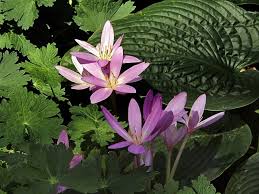
The Colchicaceae family has a widespread distribution across temperate and tropical regions of the Old World (Europe, Africa, Asia) and Australasia, with the notable exception of the genus Uvularia (bellworts) native to North America. Key genera include Colchicum, famous for its autumn-blooming, crocus-like flowers that appear long before the leaves, Gloriosa (glory lilies), which are striking climbers using leaf-tip tendrils, and the aforementioned Uvularia, common woodland wildflowers in eastern North America.
The family is chemically significant due to the presence of colchicine and related tropolone alkaloids. Colchicine is highly toxic if ingested but has historical medicinal use, particularly for treating gout (though safer alternatives are now often preferred). Its ability to interfere with cell division (specifically microtubule formation) also makes it a valuable tool in plant breeding for inducing polyploidy (doubling chromosome sets), which can lead to larger flowers or other desirable traits.
Several species are cultivated as ornamentals, including various Colchicum species for their unique autumn bloom, the exotic-looking Gloriosa lilies, and shade-tolerant woodland plants like Uvularia and Disporum. Some species native to Oklahoma (as of March 2025) include Bellworts, such as Uvularia grandiflora, found in eastern woodland habitats.
Quick Facts
- Scientific Name: Colchicaceae DC.
- Common Name: Meadow Saffron family
- Number of Genera: Approximately 15-20
- Number of Species: Approximately 245-285
- Distribution: Widespread temperate and tropical, mainly Old World (Europe, Africa, Asia, Australia), also North America (Uvularia).
- Evolutionary Group: Monocots
- Order: Liliales
Key Characteristics
Growth Form and Habit
Perennial herbs regenerating from underground storage organs, typically corms (e.g., Colchicum) or rhizomes (e.g., Uvularia). Stems can be simple and erect, or sometimes branched and climbing via tendrils formed at the leaf tips (Gloriosa).
Leaves
Leaves are simple with entire (smooth) margins and parallel venation, typical of monocots. They are usually arranged alternately along the stem (spirally or in two ranks) or arise basally directly from the corm/rhizome. Leaf bases often sheath the stem. In Colchicum, the broad leaves typically emerge in spring, well after the flowers have bloomed and withered the previous autumn. Some Uvularia species have leaves that are perfoliate (stem appears to pass through the leaf blade).
Inflorescence
Flower arrangement varies. Flowers may be solitary and terminal or axillary (often appearing basal in Colchicum due to the long perianth tube extending from the underground corm), or borne in terminal racemes, umbels, or cymes.
Flowers
Flowers are usually bisexual, typically actinomorphic (radially symmetric), though sometimes slightly zygomorphic (e.g., Gloriosa due to tepal/stamen positioning). Flower parts are characteristically in threes (trimerous). Key features include:
- Perianth: Composed of 6 tepals (undifferentiated sepals and petals), usually petal-like and often large and showy. Arranged in two whorls of 3. Tepals can be free (distinct) or fused at the base into a tube, which can be extremely long and subterranean in Colchicum. Tepal color varies widely (white, yellow, pink, purple, red, sometimes patterned). Nectaries are usually present at the base of the tepals. In Gloriosa, tepals are strongly reflexed (bent backwards).
- Androecium: Stamens number 6, arranged in two whorls of 3, typically free from each other. Filaments are attached to the base of the tepals or the top of the perianth tube. Anthers usually dehisce via longitudinal slits, releasing pollen outwards (extrorse) or sideways (latrorse).
- Gynoecium: Ovary is superior (positioned above the attachment point of tepals and stamens), composed of 3 fused carpels forming 3 distinct locules (chambers). Placentation is axile (ovules attached to the central axis where partitions meet). Styles are typically 3 and distinct (free) for most of their length, though sometimes fused at the very base. Stigmas are small, often dot-like or slightly elongated.
Fruits and Seeds
The fruit is characteristically a capsule, usually septicidal (splitting along the septa, or partitions, between the locules), allowing the carpel walls to peel away from the central axis. Less commonly, the capsule is loculicidal (splitting down the back of each locule). Seeds are numerous, often globose or angled, and sometimes possess a fleshy appendage (aril or elaiosome) which may attract ants for dispersal.
Chemical Characteristics
The family is chemically defined by the presence of unique and potent tropolone alkaloids, primarily colchicine and its derivatives (e.g., demecolcine). These alkaloids interfere with microtubule formation during cell division (mitosis). Saponins may also be present in some species.
Field Identification
Identifying Colchicaceae involves recognizing its monocot features, specific floral formula, superior ovary with three styles, and capsular fruit, along with genus-specific traits.
Primary Identification Features
- Monocot Habit: Herbaceous perennial growing from a corm or rhizome.
- Parallel Venation: Leaves simple, entire, with parallel veins.
- Flower Parts in Threes: Typically 6 petal-like tepals and 6 stamens.
- Superior Ovary: Ovary located above tepal and stamen attachment.
- Three Distinct Styles: Usually 3 separate styles (unlike the single style of Liliaceae).
- Capsule Fruit: Dry fruit splitting open (often septicidally) to release multiple seeds.
- (Caution): Many species are highly toxic due to colchicine.
Secondary Identification Features
- Corm or Rhizome: Presence of underground storage organ.
- Flowering Time: Spring flowering (Uvularia, Gloriosa) vs. Autumn flowering without leaves (Colchicum).
- Flower Shape/Features: Long subterranean tube (Colchicum), strongly reflexed tepals (Gloriosa), nodding bell shape (Uvularia).
- Climbing Habit: Leaf-tip tendrils present (Gloriosa).
- Leaf Arrangement: Basal, alternate, perfoliate (Uvularia).
Seasonal Identification Tips
- Spring: Peak flowering time for woodland species like Uvularia (Bellworts). Leaves of Colchicum appear now, but flowers bloomed last fall.
- Summer: Gloriosa lilies flower. Fruits develop on spring-flowering species.
- Fall: Colchicum autumnale flowers emerge directly from the ground without leaves.
- Winter: Plants are dormant underground as corms or rhizomes.
- (Current Time Context: Late March in Oklahoma - Woodland Bellworts (Uvularia) in eastern OK might be starting to emerge or flower soon).
Common Confusion Points
- Liliaceae (Lily Family): Similar 6 tepals, 6 stamens, superior ovary. Key differences: Liliaceae typically grow from bulbs, usually have a single style with a 3-lobed stigma (vs. 3 distinct styles in Colchicaceae), anthers often versatile (attached near middle and pivoting).
- Iridaceae (Iris Family): Also has 6 tepals (often differentiated into falls and standards), but only 3 stamens, and ovary is inferior. Leaves often equitant (flattened in one plane, overlapping at base).
- Melanthiaceae (Bunchflower Family): Variable family also in Liliales. Trillium has parts in 3s but distinct sepals/petals and whorled leaves. Veratrum has parts in 6s but often paniculate inflorescences, different alkaloids. Styles can be distinct but other features differ.
- Amaryllidaceae (Amaryllis Family, incl. Alliums): Usually have 6 tepals, 6 stamens, but ovary is typically inferior (superior in Allioideae). Often grow from bulbs, may have umbellate inflorescence with papery bracts (Allium).
- Crocus (Iridaceae): Spring or autumn flowering from corms, but have inferior ovary and only 3 stamens. Colchicum is often called "Autumn Crocus" but is distinct.
Focus on: 6 tepals, 6 stamens, superior ovary, 3 distinct styles, and capsule fruit to distinguish Colchicaceae within the Liliales context.
Field Guide Quick Reference
Look For:
- Herbaceous perennial (corm/rhizome)
- Leaves simple, parallel-veined
- Flowers with 6 tepals, 6 stamens
- Ovary superior
- Styles 3, distinct
- Fruit a capsule (often septicidal)
- (Often toxic - Colchicine)
Key Variations:
- Corm vs. Rhizome
- Climbing vs. Erect habit
- Autumn vs. Spring flowering
- Tepals free vs. fused (long tube)
- Tepal shape (reflexed, bell)
- Leaf arrangement (basal, alternate, perfoliate)
Notable Examples
The Meadow Saffron family includes unique wildflowers, striking ornamentals, and medicinally important plants.

Colchicum autumnale
Autumn Crocus / Meadow Saffron
A perennial herb native to Europe, famous for producing pinkish-purple (or white), crocus-like flowers directly from the underground corm in autumn, without any leaves present. The large, strap-like leaves emerge in spring, along with the maturing capsule fruit. All parts are highly toxic due to colchicine.

Gloriosa superba
Glory Lily / Flame Lily
A striking climbing perennial herb native to tropical Africa and Asia, grown as an ornamental. Uses tendrils formed at the tips of its alternate leaves to climb. Flowers are spectacular, with 6 strongly reflexed tepals often colored red and yellow, resembling flames. Stamens project outwards. Also contains colchicine and is toxic.

Uvularia grandiflora
Large-flowered Bellwort
A perennial woodland wildflower native to eastern North America, including eastern Oklahoma. Grows from rhizomes. Stems bear alternate leaves that are often perfoliate (stem appears to pierce the leaf). Produces solitary, nodding, yellow, bell-shaped flowers in spring with 6 twisted tepals. Fruit is a three-angled capsule.

Disporum lanuginosum
Yellow Mandarin / Fairy Bells
A rhizomatous perennial herb native to eastern North American woodlands. Has alternate, sessile leaves with parallel veins. Produces pairs or small clusters of nodding, bell-shaped, greenish-yellow flowers at the stem tips in spring. Fruit is a yellowish berry (unusual for the family, sometimes placed near Uvulariaceae which is now often sunk here). Genus Disporum shows Old and New World disjunction.

Tricyrtis hirta
Toad Lily
A rhizomatous perennial herb native to Japan, cultivated for its unusual, late-season flowers. Stems are often arching with alternate, clasping leaves. Flowers are borne in leaf axils or terminally, typically white or pale lilac with heavy purple spotting. Tepals spread outwards or slightly recurve, nectaries are sac-like at the base. Stamens form a cone initially; styles are distinct and often branched. Fruit is a capsule. (Note: Sometimes placed in Liliaceae, but molecular data often places Tricyrtis closer to or within Colchicaceae lineage).
Phylogeny and Classification
Colchicaceae is a family of monocotyledonous flowering plants placed in the order Liliales. This order includes other well-known families like Liliaceae (true lilies), Melanthiaceae (bunchflowers, trilliums), Smilacaceae (greenbriers), and Alstroemeriaceae (Peruvian lilies). Molecular phylogenetics has significantly clarified the relationships within Liliales, establishing Colchicaceae as a distinct monophyletic group, separate from Liliaceae sensu stricto.
The family's position within the monocots highlights a separate evolutionary trajectory from the eudicot families discussed previously. Key evolutionary aspects include the development of potent tropolone alkaloids (colchicine) as a chemical defense, diversification of underground storage organs (corms, rhizomes), specialized pollination mechanisms suggested by diverse flower shapes, and unique life cycles such as the hysteranthous flowering of Colchicum (flowers before leaves). The inclusion of genera previously placed elsewhere (like parts of Uvulariaceae) reflects ongoing refinement based on molecular data.
Position in Plant Phylogeny
- Kingdom: Plantae
- Clade: Angiosperms (Flowering plants)
- Clade: Monocots
- Order: Liliales
- Family: Colchicaceae
Evolutionary Significance
Colchicaceae represents an important lineage within the monocot order Liliales, characterized by its unique alkaloid profile (colchicine) and diverse life history strategies. The evolution of colchicine provided potent defense and had secondary consequences allowing its use by humans in medicine and genetics. The family showcases morphological diversity ranging from typical lily-like forms to highly specialized climbers (Gloriosa) and species with unusual phenology (Colchicum). Studying Colchicaceae helps understand diversification patterns, chemical evolution, and biogeography within the Liliales and monocots more broadly.


