
Namaceae
Nama Family
Namaceae is a family of flowering plants in the order Boraginales, comprising approximately 75 species across 4 genera. These plants are characterized by their diverse growth forms, ranging from small annual herbs to large shrubs and even small trees. Members of this family typically have alternate, simple leaves that are often hairy or glandular, and bell-shaped or funnel-shaped flowers with 5 fused petals, typically blue, purple, or white. The family is notable for its diverse ecological adaptations, from desert-dwelling annuals to chaparral shrubs and tropical understory plants. Namaceae has a primarily New World distribution, with the greatest diversity in the southwestern United States, Mexico, and parts of South America, though some species occur in Hawaii and other Pacific islands.
Overview
The Namaceae family comprises a group of flowering plants that were previously included in the Hydrophyllaceae family but are now recognized as a distinct family based on molecular and morphological evidence. The family name is derived from the genus Nama, which comes from the Greek word "nama," meaning "stream" or "spring," referring to the habitat of some species.
Namaceae has a primarily New World distribution, with the greatest diversity in the southwestern United States, Mexico, and parts of South America. Some species have also reached Hawaii and other Pacific islands. The family shows remarkable ecological adaptability, with species found in a wide range of habitats from desert and semi-desert environments to chaparral, woodland, and even tropical forest understories.
Members of this family are ecologically important as components of various ecosystems, particularly in arid and semi-arid regions of North America. Several Namaceae species have economic importance as ornamental plants, particularly in the genera Eriodictyon (yerba santa) and Wigandia. Some species, especially in the genus Eriodictyon, have traditional medicinal uses among indigenous peoples of western North America for treating respiratory conditions and other ailments.
Quick Facts
- Scientific Name: Namaceae
- Common Name: Nama Family
- Number of Genera: 4 (Nama, Eriodictyon, Wigandia, Turricula)
- Number of Species: Approximately 75
- Distribution: Primarily New World (southwestern United States, Mexico, South America, Hawaii)
- Evolutionary Group: Angiosperms - Eudicots - Asterids - Boraginales
Key Characteristics
Growth Form and Habit
Members of Namaceae exhibit diverse growth forms, ranging from small annual herbs (particularly in the genus Nama) to perennial herbs, shrubs, and even small trees (in the genera Eriodictyon and Wigandia). The stems are typically pubescent (hairy) or glandular and may be herbaceous or woody, depending on the genus and species. Some species, particularly in Wigandia, can reach heights of several meters, while others are low-growing, prostrate herbs.
Leaves
The leaves of Namaceae are simple, alternate, and without stipules. They are typically ovate, elliptic, or lanceolate in shape with margins that may be entire, serrate, or lobed, depending on the species. A distinctive feature is the often pubescent or glandular texture of the leaf surface, which is covered with various types of trichomes (hairs). In some species, particularly in the genus Eriodictyon, the leaves are covered with a sticky, resinous exudate that gives them a shiny appearance and aromatic scent. The venation is usually pinnate.
Reproductive Structures
The inflorescences of Namaceae are typically cymose, often arranged in scorpioid cymes (coiled like a scorpion's tail) that gradually unfurl as the flowers bloom sequentially, though some species have more open, paniculate inflorescences. The flowers are typically bisexual and have a 5-lobed calyx that often persists in fruit. The corolla is 5-lobed and typically bell-shaped or funnel-shaped, with colors ranging from white to blue, purple, or pink. The androecium consists of 5 stamens attached to the corolla tube, and the gynoecium has a superior ovary with 2 carpels and 2 styles that may be partially fused at the base. A distinctive feature is the presence of parietal placentation, with the ovules attached to the walls of the ovary rather than to a central axis. The fruit is a capsule that typically contains numerous small seeds.
Anatomical Features
A notable anatomical feature in some Namaceae species, particularly in the genera Wigandia and Turricula, is the presence of stinging trichomes (hairs) that can cause skin irritation upon contact. These specialized structures contain irritant compounds and have a structure similar to those found in stinging nettles (Urticaceae), though they evolved independently. The leaves of many species also contain various secondary metabolites, including flavonoids, terpenes, and phenolic compounds, which may have medicinal properties and serve as chemical defenses against herbivores.
Distinguishing Features
Namaceae can be distinguished from other plant families by a combination of:
- Alternate, simple leaves, often with pubescent or glandular surfaces
- Cymose inflorescences, often scorpioid
- Bell-shaped or funnel-shaped flowers with 5 fused petals
- Superior ovary with 2 carpels and parietal placentation
- Capsule fruits containing numerous small seeds

Leaves and flowers of Eriodictyon crassifolium (Thick-leaved Yerba Santa), showing the characteristic resinous leaves and bell-shaped flowers arranged in cymose inflorescences.
Identification
Field Identification Tips
When trying to identify members of the Namaceae family in the field, look for:
- Growth habit: Diverse forms from small annual herbs to shrubs or small trees
- Leaves: Alternate, simple, often with pubescent or glandular surfaces
- Inflorescence: Cymose, often scorpioid (coiled at the tip)
- Flowers: Bell-shaped or funnel-shaped with 5 fused petals, typically blue, purple, or white
- Habitat: Various habitats from desert to woodland, with highest diversity in southwestern North America
Similar Families
Namaceae may be confused with several other plant families:
- Hydrophyllaceae: Closely related family with similar inflorescences but typically with different leaf morphology and often more deeply lobed leaves
- Boraginaceae: Similar inflorescences in some genera but typically with different fruit types (nutlets rather than capsules)
- Heliotropiaceae: Similar inflorescences but typically with different leaf morphology and fruit types
- Solanaceae: Some members have similar flowers but with different inflorescence structure and fruit types
Distinguishing Features
The most reliable features for distinguishing Namaceae from similar families include:
- Leaf morphology: Often resinous or glandular, particularly in Eriodictyon
- Placentation: Parietal placentation (ovules attached to the walls of the ovary)
- Fruit type: Capsule fruits (versus nutlets in Boraginaceae)
- Stinging trichomes: Present in some genera (Wigandia, Turricula), absent in related families
For definitive identification, examination of the ovary structure and placentation is often necessary, as these features are key diagnostic characteristics for the family.
Notable Examples
The family Namaceae contains approximately 75 species across 4 genera. Here are some notable representatives:

Eriodictyon californicum
Yerba Santa
An evergreen shrub native to California and Oregon, typically growing in chaparral and woodland habitats. It reaches 1-3 meters in height and has lance-shaped, resinous leaves with a distinctive aromatic scent when crushed. The plant produces clusters of lavender to white, bell-shaped flowers in spring. Eriodictyon californicum has significant ethnobotanical importance, having been used extensively by indigenous peoples of California for treating respiratory conditions, hence the common name "yerba santa" (holy herb). The resinous coating on the leaves helps the plant conserve water in its dry habitat and may also deter herbivores. The genus Eriodictyon includes about 10 species, all native to the southwestern United States and northwestern Mexico.

Wigandia caracasana
Caracas Wigandia
A large shrub or small tree native to Mexico, Central America, and northern South America. It can reach heights of 3-6 meters and has large, velvety leaves that can be up to 50 cm long. The plant is covered with stinging hairs that can cause skin irritation upon contact. It produces showy clusters of purple to blue flowers arranged in scorpioid cymes. Wigandia caracasana is occasionally cultivated as an ornamental plant in frost-free regions due to its dramatic foliage and attractive flowers. In its native range, it often grows in disturbed areas and can be a pioneer species following disturbances such as landslides or volcanic activity. The genus Wigandia includes about 3 species, all native to tropical regions of the Americas.

Nama demissum
Purple Mat
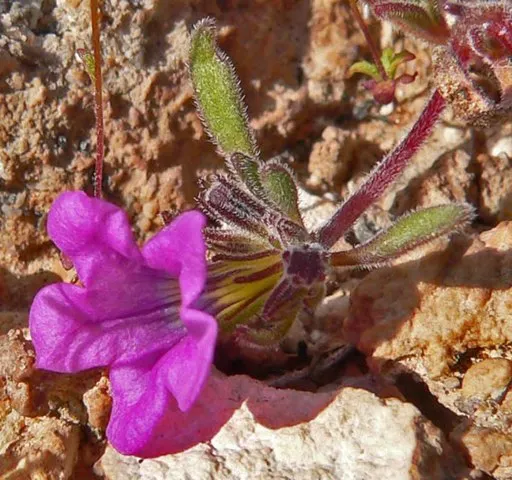
A small annual herb native to desert regions of the southwestern United States and northwestern Mexico. It has a low, mat-forming growth habit with stems radiating from a central point. The leaves are small, spatulate, and covered with glandular hairs. The plant produces purple to lavender, funnel-shaped flowers that are relatively large compared to the size of the plant. Nama demissum is adapted to desert conditions and typically appears after winter rains, completing its life cycle quickly before summer drought. It can form spectacular displays in desert areas during good rainfall years. The genus Nama is the largest in the family, with about 60 species distributed across the Americas, particularly in arid and semi-arid regions.
Related Families
Namaceae belongs to the order Boraginales and is phylogenetically related to several other plant families. Based on molecular studies, its closest relatives include:

Hydrophyllaceae
Waterleaf Family

Boraginaceae
Borage Family

Heliotropiaceae
Heliotrope Family

Ehretiaceae
Ehretia Family
Phylogenetic Note
Namaceae has undergone significant taxonomic revisions based on molecular phylogenetic studies. The genera now included in this family were previously placed in Hydrophyllaceae, but molecular evidence has supported their recognition as a distinct family within the Boraginales order. The family is characterized by a unique combination of morphological features, particularly the parietal placentation and the presence of stinging trichomes in some genera. Within Namaceae, molecular studies have revealed interesting evolutionary patterns, with the four genera forming a well-supported monophyletic group. The presence of stinging trichomes in Wigandia and Turricula represents an interesting case of convergent evolution with similar structures in unrelated families such as Urticaceae (nettles). The taxonomic history of Namaceae illustrates the ongoing refinement of our understanding of plant relationships as new evidence emerges from molecular studies.