
Hydrophyllaceae
Waterleaf Family
Hydrophyllaceae is a family of flowering plants in the order Boraginales, comprising approximately 20 genera and 300 species. These plants are characterized by their primarily herbaceous habit and distinctive scorpioid cymes (coiled inflorescences that unfurl as the flowers bloom). Members of this family typically have alternate, often deeply lobed or compound leaves that are frequently hairy or bristly, and 5-petaled flowers that are typically blue, purple, or white. The family is notable for its diverse adaptations to different habitats, from moist woodlands to desert environments. Hydrophyllaceae has a primarily North American distribution, with the greatest diversity in western North America, particularly California, though some genera occur in South America and other parts of the world.
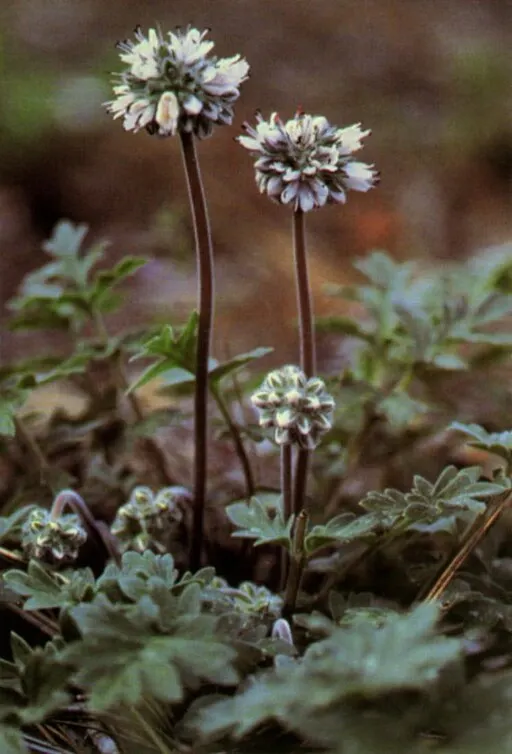
Overview
The Hydrophyllaceae family comprises a diverse group of flowering plants that have traditionally been recognized as a distinct family, though some modern classification systems include them as a subfamily (Hydrophylloideae) within the broader Boraginaceae family. The family name is derived from the genus Hydrophyllum, which comes from the Greek words "hydro" (water) and "phyllon" (leaf), referring to the water spots that appear on the leaves of some species.
Hydrophyllaceae has a primarily North American distribution, with the greatest diversity in western North America, particularly California and the Pacific Northwest. Some genera extend into South America, and a few occur in other parts of the world. The family shows remarkable ecological adaptability, with species found in a wide range of habitats from moist woodlands and riparian areas to dry, rocky slopes and desert environments.
Members of this family are ecologically important as components of various ecosystems and as food sources for pollinators, particularly bees, which are attracted to their nectar-rich flowers. Several Hydrophyllaceae species have economic importance as ornamental plants, particularly in the genera Nemophila (baby blue eyes) and Phacelia. Some Phacelia species are also grown as cover crops and green manure due to their ability to improve soil structure and attract beneficial insects.
Quick Facts
- Scientific Name: Hydrophyllaceae
- Common Name: Waterleaf Family
- Number of Genera: Approximately 20, including Hydrophyllum, Phacelia, Nemophila, Eriodictyon
- Number of Species: Approximately 300
- Distribution: Primarily North America, with some representation in South America and other regions
- Evolutionary Group: Angiosperms - Eudicots - Asterids - Boraginales
Key Characteristics
Growth Form and Habit
Members of Hydrophyllaceae are primarily herbaceous plants, though some genera include subshrubs or shrubs. They may be annuals, biennials, or perennials. The stems are typically pubescent (hairy) or hispid (bristly) and may be erect, ascending, or prostrate, depending on the species and habitat. Many species have a basal rosette of leaves from which flowering stems arise.
Leaves
The leaves of Hydrophyllaceae are alternate (occasionally opposite in some genera) and without stipules. A distinctive feature is that they are often deeply lobed, divided, or compound, particularly in genera like Phacelia and Hydrophyllum. The leaf surface is typically pubescent or hispid, covered with various types of trichomes (hairs) that may be glandular in some species. The venation is usually pinnate. In Hydrophyllum, the leaves often have pale spots that look like water stains, which gives the genus its name.
Reproductive Structures
The inflorescences are typically scorpioid cymes (coiled like a scorpion's tail or a fiddlehead fern) that gradually unfurl as the flowers bloom sequentially from the base to the tip. The flowers are typically bisexual and have a 5-lobed calyx that often enlarges in fruit. The corolla is 5-lobed and typically bell-shaped, funnel-shaped, or rotate (wheel-shaped), with colors ranging from white to blue, purple, or pink. A distinctive feature in many species is the presence of scales or appendages (also called fornices) inside the corolla tube, often near the base of the stamens. The androecium consists of 5 stamens attached to the corolla tube, and the gynoecium has a superior ovary with 2 carpels and 1-2 styles. The fruit is a capsule that typically contains 1 to many seeds, depending on the genus.
Ecological Adaptations
Hydrophyllaceae species have evolved various adaptations to their diverse habitats:
- Drought tolerance: Many species, particularly in the genus Phacelia, have adaptations for surviving in arid environments, including deep root systems, reduced leaf surface area, and pubescence that reduces water loss
- Short life cycles: Many desert-adapted species are annuals that complete their life cycle quickly during brief periods of favorable conditions
- Specialized pollination: Many species have evolved features that attract specific pollinators, particularly bees
- Seed dormancy mechanisms: Seeds of many species have dormancy mechanisms that prevent germination until conditions are favorable
Distinguishing Features
Hydrophyllaceae can be distinguished from other plant families by a combination of:
- Scorpioid cyme inflorescences (coiled like a scorpion's tail)
- Alternate, often deeply lobed or compound leaves
- 5-lobed calyx and corolla
- Presence of scales or appendages inside the corolla tube in many species
- Capsule fruits containing 1 to many seeds

The distinctive scorpioid cyme inflorescence of Phacelia, showing the characteristic coiled structure that gradually unfurls as the flowers bloom sequentially.
Identification
Field Identification Tips
When trying to identify members of the Hydrophyllaceae family in the field, look for:
- Inflorescence: Distinctive scorpioid cymes that are coiled at the tip
- Growth habit: Primarily herbaceous plants, often with hairy or bristly stems
- Leaves: Alternate, often deeply lobed or compound, typically hairy or bristly
- Flowers: 5-lobed calyx and corolla, typically blue, purple, or white
- Habitat: Various habitats from moist woodlands to desert environments, with highest diversity in western North America
Similar Families
Hydrophyllaceae may be confused with several other plant families:
- Boraginaceae: Closely related family with similar inflorescences but typically with different leaf morphology and fruit types
- Heliotropiaceae: Similar inflorescences but typically with different leaf morphology and fruit types
- Polemoniaceae: Some members have similar flowers but with different inflorescence structure and typically opposite leaves
- Scrophulariaceae: Some members have similar growth habit but with different inflorescence structure and often opposite leaves
Distinguishing Features
The most reliable features for distinguishing Hydrophyllaceae from similar families include:
- Inflorescence structure: Scorpioid cymes are highly characteristic
- Leaf morphology: Often deeply lobed or compound leaves
- Corolla appendages: Presence of scales or appendages inside the corolla tube in many species
- Fruit type: Capsule fruits (versus nutlets in Boraginaceae)
For definitive identification, examination of the inflorescence structure and corolla appendages is often most helpful, as these features are distinctive for the family.
Notable Examples
The family Hydrophyllaceae contains approximately 300 species across 20 genera. Here are some notable representatives:

Phacelia tanacetifolia
Lacy Phacelia
An annual herb native to California and northern Mexico, widely cultivated as a cover crop and ornamental plant. It typically grows to 30-90 cm tall and has finely divided, fern-like leaves that are covered with bristly hairs. The plant produces dense scorpioid cymes of lavender-blue flowers with protruding stamens. Phacelia tanacetifolia is valued for its ability to attract beneficial insects, particularly bees and hoverflies, making it popular in sustainable agriculture and wildlife gardening. As a cover crop, it helps improve soil structure, prevent erosion, and suppress weeds. The genus Phacelia is the largest in the family, with approximately 200 species primarily distributed in western North America.

Nemophila menziesii
Baby Blue Eyes
An annual herb native to California and Oregon, widely cultivated as an ornamental plant. It has a low, spreading growth habit with delicate, lobed leaves that are sparsely hairy. The plant produces charming, saucer-shaped blue flowers with white centers, typically 2-3 cm in diameter. Nemophila menziesii is a popular garden plant, particularly for wildflower meadows and naturalistic plantings. In its native habitat, it often forms spectacular displays in open woodlands and grasslands during spring. The genus Nemophila includes about 11 species, all native to North America, and is known for its attractive, often blue or white flowers.

Hydrophyllum virginianum
Virginia Waterleaf
A perennial herb native to eastern North America, particularly in deciduous forests and moist woodlands. It grows from rhizomes to form colonies and has pinnately divided leaves that often show pale spots resembling water stains (hence the common name "waterleaf"). The plant produces compact clusters of bell-shaped, white to pale purple flowers with protruding stamens. Hydrophyllum virginianum is adapted to the forest understory and typically blooms in late spring before the tree canopy fully develops. The young leaves are edible and were used as a potherb by Native Americans and early settlers. The genus Hydrophyllum includes about 8 species, all native to North America, and is the type genus for the family.
Related Families
Hydrophyllaceae belongs to the order Boraginales and is phylogenetically related to several other plant families. Based on molecular studies, its closest relatives include:

Boraginaceae
Borage Family

Heliotropiaceae
Heliotrope Family

Namaceae
Nama Family

Ehretiaceae
Ehretia Family
Phylogenetic Note
Hydrophyllaceae has undergone significant taxonomic revisions based on molecular phylogenetic studies. Traditionally recognized as a distinct family, it is now often treated as a subfamily (Hydrophylloideae) within a more broadly defined Boraginaceae family in some classification systems, though many botanists continue to recognize it at the family level. The family is characterized by a unique combination of morphological features, particularly the scorpioid cyme inflorescences, often deeply lobed or compound leaves, and capsule fruits. Within Hydrophyllaceae, molecular studies have revealed several distinct lineages, with the largest genus, Phacelia, showing remarkable diversification in western North America, particularly in response to diverse habitats and pollination systems. Some genera formerly included in Hydrophyllaceae, such as Nama and its relatives, are now sometimes placed in their own family, Namaceae, based on molecular evidence. These taxonomic changes reflect our improved understanding of evolutionary relationships within the Boraginales order.