
Heliotropiaceae
Heliotrope Family
Heliotropiaceae is a family of flowering plants in the order Boraginales, comprising approximately 450 species across several genera, with Heliotropium being the largest. These plants are characterized by their herbaceous to shrubby habit and distinctive scorpioid cymes (coiled inflorescences that unfurl as the flowers bloom). Members of this family typically have alternate, simple leaves that are often hairy or rough-textured, and small, tubular flowers with 5 fused petals that are typically white, purple, or blue. The family is notable for the sweet fragrance of many species, particularly those in the genus Heliotropium. Heliotropiaceae has a worldwide distribution, with species occurring in tropical, subtropical, and temperate regions across all continents except Antarctica, and is particularly diverse in arid and semi-arid environments.
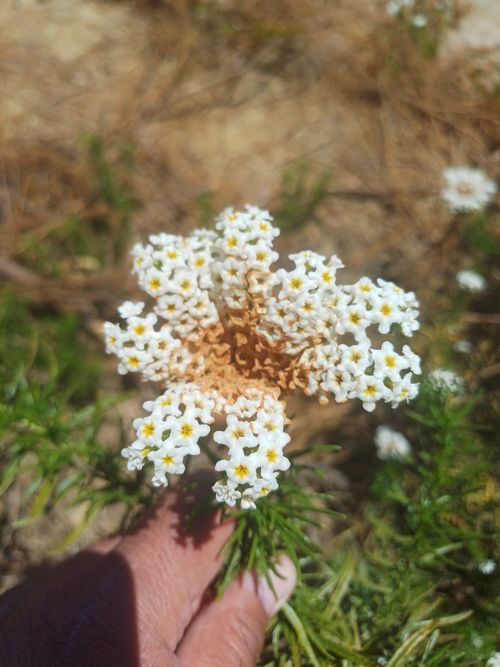
Overview
The Heliotropiaceae family comprises a diverse group of flowering plants that were previously included in the Boraginaceae family but are now recognized as a distinct family based on molecular and morphological evidence. The family name is derived from the genus Heliotropium, which comes from the Greek words "helios" (sun) and "tropos" (turn), referring to the ancient belief that the flowers turn to follow the sun.
Heliotropiaceae has a worldwide distribution, with species occurring in tropical, subtropical, and temperate regions across all continents except Antarctica. The family shows remarkable ecological adaptability, with species found in a wide range of habitats from coastal areas and rainforests to deserts and high mountains. Many species are particularly well-adapted to arid and semi-arid environments, where they have evolved various drought-tolerance mechanisms.
Members of this family are ecologically important as components of various ecosystems and as food sources for pollinators, particularly bees and butterflies, which are attracted to their nectar-rich flowers. Several Heliotropiaceae species have economic importance as ornamental plants, particularly Heliotropium arborescens (garden heliotrope), which is widely cultivated for its fragrant, purple flowers. Some species have traditional medicinal uses, though caution is warranted as many contain pyrrolizidine alkaloids that can be toxic to humans and livestock.
Quick Facts
- Scientific Name: Heliotropiaceae
- Common Name: Heliotrope Family
- Number of Genera: Several, including Heliotropium, Euploca, Tournefortia, Myriopus
- Number of Species: Approximately 450
- Distribution: Worldwide (tropical, subtropical, and temperate regions)
- Evolutionary Group: Angiosperms - Eudicots - Asterids - Boraginales
Key Characteristics
Growth Form and Habit
Members of Heliotropiaceae exhibit diverse growth forms, ranging from annual or perennial herbs to shrubs and occasionally small trees. Many species have a bushy habit with multiple stems arising from the base. The stems are typically pubescent (hairy) and may be erect, ascending, or prostrate, depending on the species and habitat. Some desert-adapted species have developed a compact, cushion-like growth form as an adaptation to harsh environmental conditions.
Leaves
The leaves of Heliotropiaceae are simple, alternate, and without stipules. They are typically ovate, elliptic, or lanceolate in shape with entire margins, though some species have undulate (wavy) margins. A distinctive feature is the often pubescent or scabrous texture of the leaf surface, which is covered with various types of trichomes (hairs). The venation is usually pinnate. The leaves may be petiolate or sessile and are often somewhat succulent in desert-adapted species.
Reproductive Structures
The most distinctive feature of Heliotropiaceae is the scorpioid cyme inflorescence, which is coiled like a scorpion's tail or a fiddlehead fern and gradually unfurls as the flowers bloom sequentially from the base to the tip. The flowers are typically small and have a 5-lobed calyx that persists in fruit. The corolla is tubular or salverform (with a narrow tube and flat, spreading lobes), with 5 fused petals that are typically white, purple, or blue, often with a yellow or white "eye" in the center. The androecium consists of 5 stamens attached to the corolla tube, and the gynoecium has a superior ovary with 2 carpels that is often 4-lobed due to false septa (partitions). The style is terminal or gynobasic (arising from between the ovary lobes). The fruit is typically a schizocarp that splits into 2-4 nutlets at maturity, though in some genera it may be a drupe with 2-4 pyrenes.
Chemical Characteristics
Many Heliotropiaceae species contain pyrrolizidine alkaloids, secondary metabolites that serve as chemical defenses against herbivores but can be toxic to humans and livestock. These compounds are particularly concentrated in the genus Heliotropium. The family is also known for the production of various aromatic compounds, particularly in Heliotropium arborescens and related species, which give the flowers their characteristic sweet, vanilla-like fragrance.
Distinguishing Features
Heliotropiaceae can be distinguished from other plant families by a combination of:
- Scorpioid cyme inflorescences (coiled like a scorpion's tail)
- Alternate, simple leaves with pubescent or scabrous texture
- Small, tubular or salverform flowers with 5 fused petals
- Fruits that split into 2-4 nutlets or form drupes with 2-4 pyrenes
- Often aromatic, particularly in the flowers

The distinctive scorpioid cyme inflorescence of Heliotropium, showing the characteristic coiled structure that gradually unfurls as the flowers bloom sequentially.
Identification
Field Identification Tips
When trying to identify members of the Heliotropiaceae family in the field, look for:
- Inflorescence: Distinctive scorpioid cymes that are coiled at the tip
- Growth habit: Herbs or shrubs, often with pubescent stems
- Leaves: Alternate, simple, often with pubescent or rough texture
- Flowers: Small, tubular or salverform, with 5 fused petals, typically white, purple, or blue
- Fragrance: Many species, particularly in the genus Heliotropium, have sweetly fragrant flowers
Similar Families
Heliotropiaceae may be confused with several other plant families:
- Boraginaceae: Closely related family with similar inflorescences but typically with more bristly hairs and different fruit structure
- Hydrophyllaceae: Similar inflorescences in some genera but typically with different leaf morphology and fruit types
- Verbenaceae: Some members have similar growth habit but with opposite leaves and different inflorescence structure
- Solanaceae: Some members have similar flowers but with different inflorescence structure and fruit types
Distinguishing Features
The most reliable features for distinguishing Heliotropiaceae from similar families include:
- Inflorescence structure: Scorpioid cymes are highly characteristic
- Leaf arrangement: Alternate leaves (versus opposite in many similar-looking families)
- Fruit structure: Schizocarp splitting into 2-4 nutlets or drupe with 2-4 pyrenes
- Floral morphology: Tubular or salverform corolla with 5 fused petals
For definitive identification, examination of the inflorescence structure is often sufficient, as the scorpioid cyme is a key diagnostic feature for the family.
Notable Examples
The family Heliotropiaceae contains approximately 450 species across several genera. Here are some notable representatives:

Heliotropium arborescens
Garden Heliotrope
A perennial shrub native to Peru, widely cultivated as an ornamental plant worldwide. It typically grows to 1-1.5 meters tall and has ovate, wrinkled leaves with a velvety texture. The plant produces dense clusters of intensely fragrant, purple flowers in scorpioid cymes. The fragrance is often described as vanilla-like or resembling cherry pie, which has led to the common name "cherry pie plant" in some regions. Heliotropium arborescens is valued primarily for its ornamental qualities and sweet scent, though it contains pyrrolizidine alkaloids and should not be ingested. Numerous cultivars have been developed with variations in flower color, from deep purple to pale lavender and white.

Heliotropium curassavicum
Salt Heliotrope
A perennial herb native to the Americas but now with a nearly worldwide distribution in coastal and inland saline habitats. It has a prostrate to ascending growth habit with succulent, glaucous (bluish-green) leaves that are narrow and somewhat fleshy. The plant produces small, white flowers with a yellow center, arranged in the characteristic scorpioid cymes. Heliotropium curassavicum is notable for its high salt tolerance, allowing it to thrive in saline soils where few other plants can grow. It plays an important ecological role in stabilizing soils in coastal areas and salt flats. Some indigenous peoples have used this plant medicinally, though its pyrrolizidine alkaloid content warrants caution.

Euploca procumbens
Creeping Heliotrope
A prostrate perennial herb native to tropical and subtropical regions of the Americas, Africa, and Asia. It forms spreading mats with slender stems that root at the nodes. The leaves are small, elliptic to oblong, and covered with appressed hairs that give them a silky appearance. The flowers are tiny, white with a yellow center, and arranged in slender scorpioid cymes. Euploca procumbens (formerly known as Heliotropium procumbens) is adapted to a variety of habitats, from sandy coastal areas to disturbed sites inland. It is particularly common in seasonally wet areas that dry out periodically. The plant has various traditional medicinal uses in different cultures, particularly for treating skin conditions and wounds.
Related Families
Heliotropiaceae belongs to the order Boraginales and is phylogenetically related to several other plant families. Based on molecular studies, its closest relatives include:

Boraginaceae
Borage Family

Ehretiaceae
Ehretia Family

Cordiaceae
Cordia Family

Hydrophyllaceae
Waterleaf Family
Phylogenetic Note
Heliotropiaceae has undergone significant taxonomic revisions based on molecular phylogenetic studies. Traditionally, the genera now included in this family were placed in Boraginaceae in a broad sense. However, molecular evidence has supported the recognition of Heliotropiaceae as a distinct family within the Boraginales order. The family is characterized by a unique combination of morphological features, particularly the scorpioid cyme inflorescences and the fruit structure. Within Heliotropiaceae, molecular studies have led to the reclassification of many species, with some former Heliotropium species now placed in Euploca and former Tournefortia species redistributed among several genera. These taxonomic changes reflect our improved understanding of evolutionary relationships within the family. The presence of pyrrolizidine alkaloids in many Heliotropiaceae species is a shared chemical characteristic that further supports the family's monophyly.