Lennoaceae
Sand Food Family
Lennoaceae is a small family of flowering plants in the order Boraginales, comprising only 4 species across 2 genera. These plants are characterized by their holoparasitic nature, completely lacking chlorophyll and deriving all nutrients from their host plants through specialized root connections. Members of this family have fleshy, scale-covered stems that emerge from the ground, bearing dense, cylindrical or spherical inflorescences of small, tubular flowers. The family is notable for its extreme specialization for parasitism and unusual morphology. Lennoaceae has a restricted distribution in arid regions of southwestern North America and parts of Central America, where they parasitize the roots of various desert shrubs and are often found in sandy soils.
Overview
The Lennoaceae family comprises a small group of highly specialized parasitic flowering plants. The family name is derived from the genus Lennoa, which was named in honor of Archbishop Juan Francisco Lennó, a 19th-century Mexican botanist and patron of science.
Lennoaceae has a restricted distribution in arid and semi-arid regions of southwestern North America (southwestern United States and Mexico) and parts of Central America (Guatemala). These plants are adapted to desert and near-desert environments, where they parasitize the roots of various host plants, particularly in the families Asteraceae, Euphorbiaceae, and Zygophyllaceae.
Members of this family are of particular interest to botanists due to their extreme specialization for parasitism and unusual morphology. Unlike many parasitic plants that retain some photosynthetic capability, Lennoaceae species are holoparasites, completely lacking chlorophyll and deriving all nutrients from their host plants. This has led to significant morphological reduction and specialization, with the plants consisting primarily of underground haustorial connections to host roots and above-ground reproductive structures.
Quick Facts
- Scientific Name: Lennoaceae
- Common Name: Sand Food Family
- Number of Genera: 2 (Lennoa and Pholisma)
- Number of Species: 4
- Distribution: Southwestern North America and parts of Central America
- Evolutionary Group: Angiosperms - Eudicots - Asterids - Boraginales
Key Characteristics
Growth Form and Habit
Members of Lennoaceae are holoparasitic plants that lack chlorophyll and are unable to photosynthesize. They consist of two main parts: an underground system of haustorial connections to host roots, and above-ground reproductive structures that emerge from the soil during the flowering period. The visible portion of the plant is a fleshy, scale-covered stem that may be simple or branched, typically 5-30 cm tall, though most of the plant's biomass is underground. The coloration is typically yellowish, brownish, or purplish, reflecting the absence of chlorophyll.
Parasitic Structures
The underground portion of Lennoaceae plants consists of an extensive system of haustorial connections to the roots of host plants. These specialized structures penetrate the host's vascular tissue to extract water, nutrients, and carbohydrates. The haustorial system can be quite extensive, with connections to multiple host plants simultaneously. This parasitic relationship is obligate, meaning that Lennoaceae plants cannot survive without their hosts.
Leaves
True leaves are absent or highly reduced in Lennoaceae. The stems bear scale-like structures that are homologous to leaves but lack chlorophyll and serve primarily as protective coverings for the developing inflorescence rather than as photosynthetic organs.
Reproductive Structures
The inflorescences of Lennoaceae are dense, cylindrical or spherical clusters of numerous small flowers. The flowers are typically arranged in a thyrse (a compact, mixed inflorescence) or in dense spikes. Each flower has a tubular calyx with 5-10 lobes and a tubular corolla with 5-10 lobes that may be white, pink, or purplish. The androecium consists of 5-10 stamens attached to the corolla tube, and the gynoecium has a superior ovary with 6-14 carpels that are partially fused. A distinctive feature is the presence of false septa (partitions) that divide each carpel into two locules, resulting in twice as many locules as carpels. The fruit is a schizocarp that splits into numerous small nutlets at maturity, each containing a single seed.
Distinguishing Features
Lennoaceae can be distinguished from other plant families by a combination of:
- Holoparasitic habit, completely lacking chlorophyll
- Fleshy, scale-covered stems emerging from the ground
- Dense, cylindrical or spherical inflorescences
- Flowers with 5-10 corolla lobes and stamens
- Ovary with 6-14 carpels, each divided by a false septum
- Restricted distribution in arid regions of North and Central America

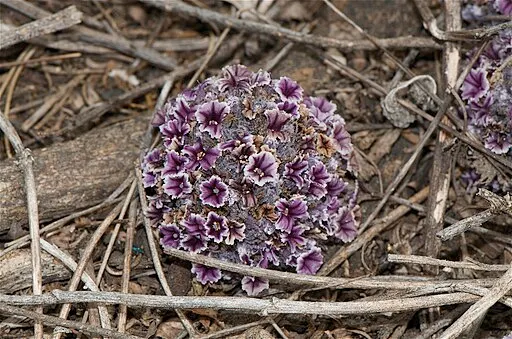
The dense, spherical inflorescence of Pholisma arenarium, showing the numerous small, tubular flowers characteristic of the Lennoaceae family.
Identification
Field Identification Tips
When trying to identify members of the Lennoaceae family in the field, look for:
- Habitat: Arid or semi-arid regions of southwestern North America and parts of Central America, often in sandy soils
- Growth form: Fleshy, scale-covered stems emerging from the ground, lacking green coloration
- Inflorescence: Dense, cylindrical or spherical clusters of small, tubular flowers
- Coloration: Typically yellowish, brownish, or purplish, reflecting the absence of chlorophyll
- Seasonality: Often visible only during brief flowering periods following rainfall events
Similar Families
Lennoaceae may be confused with several other parasitic plant families:
- Orobanchaceae: Contains many holoparasitic species but with different floral structure and fruit types
- Balanophoraceae: Similar growth habit but with different floral structure and primarily tropical distribution
- Hydnoraceae: Similar parasitic habit but with very different floral morphology and primarily African and South American distribution
- Cynomoriaceae: Similar growth habit but with different floral structure and Old World distribution
Distinguishing Features
The most reliable features for distinguishing Lennoaceae from similar families include:
- Floral structure: Flowers with 5-10 corolla lobes and stamens
- Gynoecial structure: Ovary with 6-14 carpels, each divided by a false septum
- Inflorescence type: Dense, cylindrical or spherical clusters
- Geographic distribution: Restricted to arid regions of North and Central America
For definitive identification, examination of the floral structure and gynoecial morphology is often necessary, as these features are the most diagnostic for the family.
Notable Examples
The family Lennoaceae contains only 4 species across 2 genera. Here are the notable representatives:

Pholisma sonorae
Sand Food
A holoparasitic plant native to the Sonoran Desert of Arizona, California, and northwestern Mexico. It parasitizes the roots of various desert shrubs, particularly in the families Asteraceae and Zygophyllaceae. The plant consists of a large, fleshy, subterranean stem that can reach 1 meter in diameter, with only the mushroom-like reproductive structure emerging above ground. This structure is typically 5-15 cm tall and bears a dense, spherical inflorescence of small, purplish flowers. Pholisma sonorae is notable for its extreme adaptation to desert conditions, with most of its biomass remaining underground to avoid desiccation. The common name "sand food" refers to its historical use as a food source by indigenous peoples of the Sonoran Desert, particularly the Tohono O'odham, who would harvest and cook the underground portions.

Pholisma arenarium
Desert Christmas Candle
A holoparasitic plant native to coastal and desert regions of California and Baja California, Mexico. It parasitizes the roots of various shrubs, particularly in the families Asteraceae and Polygonaceae. The plant produces cylindrical, spike-like inflorescences that emerge from the sand, typically 5-20 cm tall, bearing numerous small, purplish-white flowers. The common name "desert Christmas candle" refers to the candle-like appearance of the inflorescence. Pholisma arenarium is typically found in sandy soils, often in coastal dune systems or desert washes. It is less common than P. sonorae and is considered rare and of conservation concern in parts of its range.

Lennoa madreporoides
Coral Plant
A holoparasitic plant native to Mexico, Guatemala, and parts of the southwestern United States. It parasitizes the roots of various plants, particularly in the families Asteraceae and Euphorbiaceae. The plant produces branched, coral-like inflorescences that emerge from the ground, typically 5-15 cm tall, bearing numerous small, white to pinkish flowers. The specific epithet "madreporoides" and the common name "coral plant" refer to the resemblance of the inflorescence to coral (madrepore). Lennoa madreporoides is the only species in the genus Lennoa and is further divided into two forms based on minor morphological differences. It is less well-studied than the Pholisma species and is relatively rare throughout its range.
Ecological Note
Lennoaceae species play unique ecological roles in the arid ecosystems where they occur. As holoparasites, they represent an interesting case of extreme specialization and dependency on host plants. Despite their parasitic nature, they generally do not cause significant harm to their hosts, as they typically parasitize well-established shrubs with extensive root systems. The plants are adapted to the unpredictable rainfall patterns of desert environments, with the above-ground portions appearing only briefly after sufficient rainfall and then withering away, while the underground haustorial system persists. The flowers are visited by various insects, particularly small bees and flies, which serve as pollinators. The seeds are small and may be dispersed by wind or water. Due to their specialized habitat requirements and restricted distribution, many Lennoaceae species are relatively rare and potentially vulnerable to habitat disturbance and climate change.
Related Families
Lennoaceae belongs to the order Boraginales and is phylogenetically related to several other plant families. Based on molecular studies, its closest relatives include:

Ehretiaceae
Ehretia Family

Heliotropiaceae
Heliotrope Family

Boraginaceae
Borage Family

Hydrophyllaceae
Waterleaf Family
Phylogenetic Note
Lennoaceae has undergone significant taxonomic revisions based on molecular phylogenetic studies. Traditionally recognized as a distinct family, it has sometimes been included within Boraginaceae in a broad sense, though most modern classifications maintain its status as a separate family within the Boraginales order. Molecular studies have shown that Lennoaceae is most closely related to Ehretiaceae, despite the dramatic morphological differences resulting from the holoparasitic lifestyle of Lennoaceae. This relationship illustrates the profound morphological changes that can occur when plants evolve a parasitic habit, often making it difficult to recognize their true evolutionary relationships based on morphology alone. The evolution of holoparasitism in Lennoaceae represents an independent origin of this lifestyle within the Boraginales, distinct from the parasitic lineages in other orders such as Lamiales (Orobanchaceae) and Santalales (various families). This provides an interesting case study in convergent evolution of parasitism across different plant lineages.