Dicksoniaceae
Dicksonia Tree Fern Family
Dicksoniaceae is a family of mostly tree ferns belonging to the order Cyatheales. They are characterized by their typically stout, erect trunks, large pinnately compound fronds, and a covering of conspicuous hairs (rather than scales) on the trunk apex and stipe bases. Their sori are marginal and protected by distinctive two-valved indusia. The family is predominantly found in the Southern Hemisphere.
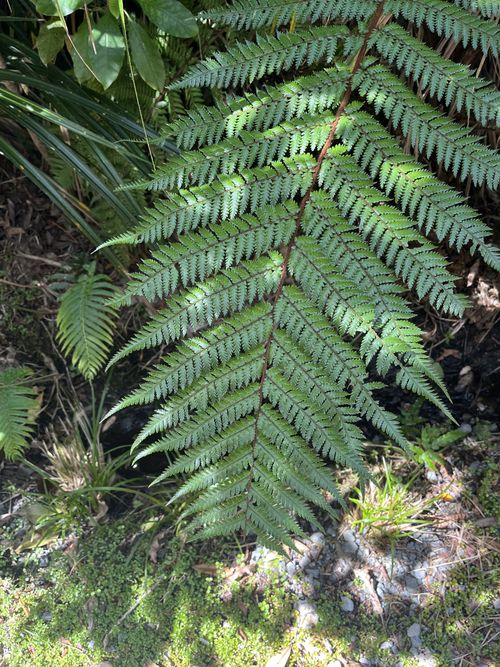
Overview
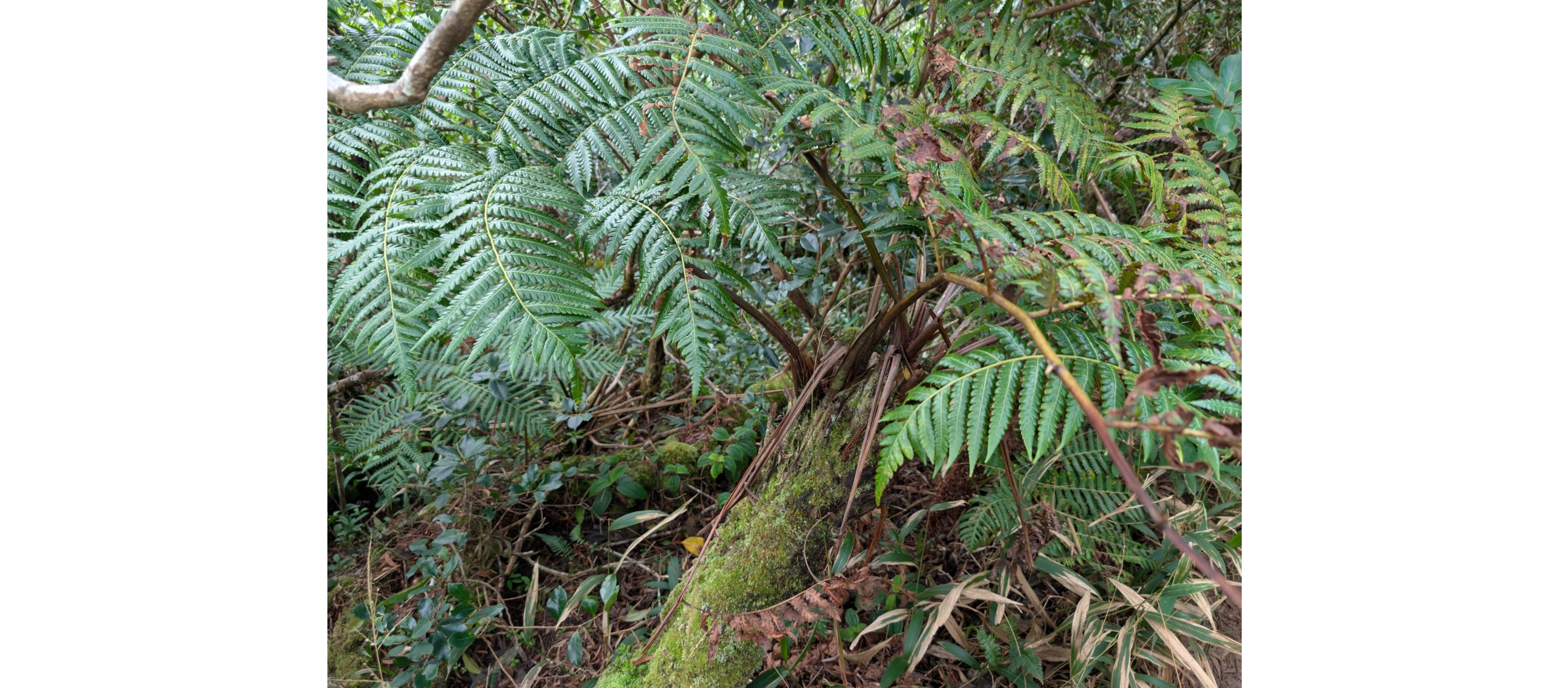
Dicksoniaceae is one of the core families of tree ferns within the Cyatheales order, closely related to Cyatheaceae. Most members, particularly in the genus Dicksonia, develop robust, upright trunks (caudices) that can reach significant heights, supporting a large crown of finely divided fronds. These trunks are often covered in a dense mat of adventitious roots and persistent stipe bases.
A key distinguishing feature from the often similar-looking Cyatheaceae is the indument: Dicksoniaceae are characterized by dense hairs (often long, somewhat stiff, and reddish-brown) covering the rhizome/trunk apex and stipe bases, whereas Cyatheaceae typically have prominent scales. While some hairs might be present in Cyatheaceae and some minor scales might occur in Dicksoniaceae, the dominant type of covering is usually different.
The family is most diverse in the Southern Hemisphere, particularly in Australia, New Zealand, South America, and various islands, but also extends into Malesia and the Philippines. They typically inhabit cool, moist, temperate or subtropical rainforest environments. Dicksoniaceae are homosporous, and their reproductive structures (sori) are characteristically marginal and protected by a two-flapped (bivalvate) indusium.
Quick Facts
- Scientific Name: Dicksoniaceae
- Common Name: Dicksonia Tree Fern Family
- Number of Genera: Approximately 3 (Dicksonia, Calochlaena, Lophosoria - Note: PPG I places Lophosoria in Lophosoriaceae. Excluding it here gives 2 genera). Let's use ~2-3 genera for broader scope.
- Number of Species: Approximately 30-50
- Distribution: Primarily Southern Hemisphere (Australia, NZ, S. America, St. Helena, Malesia, Philippines).
- Key Features: Mostly tree ferns with trunks, dense hairs (not scales) on apex/stipes, large compound fronds, marginal sori with bivalvate indusia, homosporous.
- Evolutionary Group: Polypodiopsida (Leptosporangiate Ferns) - Cyatheales
Key Characteristics
Growth Form and Habit
Mostly arborescent (tree-like) ferns with stout, erect trunks (caudices) formed from the stem, persistent stipe bases, and often a dense mantle of adventitious roots. Some species (e.g., in Calochlaena) have creeping rhizomes and lack a distinct trunk.
Fronds (Leaves)
Fronds are large (often 1-4 meters long), borne in a terminal crown on arborescent species.
- Structure: Typically 2-pinnate to 4-pinnate, often with a somewhat harsh texture.
- Vernation: Young fronds exhibit prominent circinate vernation, often densely covered in hairs.
- Petioles (Stipes): Stout, covered at the base with characteristic hairs.
Fronds are generally monomorphic.
Hairs (Indument)
Rhizomes/trunk apices and petiole bases are characteristically covered in dense, often long, multicellular hairs. These hairs are typically reddish-brown to yellowish-brown and somewhat stiff, but are clearly hairs, not flattened scales like those prominent in Cyatheaceae.
Sori and Indusial Characters
Dicksoniaceae are homosporous. Spores are produced in sori located on the frond margins.
- Sorus Position: Sori are marginal or submarginal, borne at the terminus of veins on the ultimate segments (lobes).
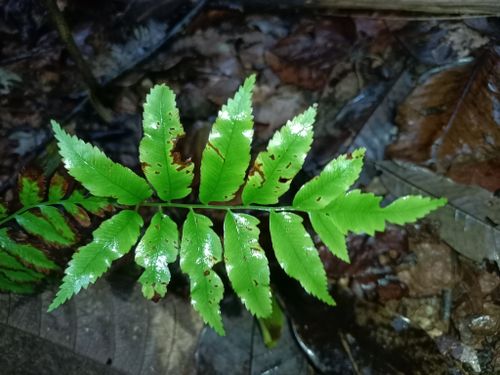
- Indusium: Each sorus is protected by a distinctive two-valved (bivalvate) indusium. The outer valve is formed by the reflexed, often greenish, modified tooth or lobe of the leaf margin. The inner valve is a true indusium, typically brownish and membranous. These two flaps form a cup or purse-like structure open towards the margin.
- Receptacle: Sporangia are attached to a receptacle within the indusium.
Spores
Spores are trilete, globose-tetrahedral, and ornamentation varies (e.g., smooth, granular, ridged).
Field Identification
Identifying Dicksoniaceae involves recognizing the tree fern habit (usually), the dense hairy covering (not scales), and the characteristic marginal sori with two-valved indusia.
Primary Identification Features
- Habit: Mostly tree ferns with distinct trunks (check for exceptions like Calochlaena).
- Indument: Dense covering of hairs (check apex, stipe bases) - reddish-brown, yellowish, etc.; lack of prominent scales.
- Marginal/Submarginal Sori: Sori located at or very near the edge of the ultimate frond segments.
- Bivalvate Indusium: Sori protected by two distinct flaps (outer = modified margin, inner = true indusium).
- Large, Divided Fronds: Fronds typically large and 2-4 times pinnate.
Common Confusion Points
- Cyatheaceae: The most similar group, but typically distinguished by having prominent scales on stipes/apex (rather than just hairs), and sori that are usually round, located away from the margin, and have different indusial types (cup-shaped, globose, scale-like, or absent) - not bivalvate and marginal.
- Culcitaceae: Also has marginal, bivalvate sori and hairy indument. However, Culcita typically forms shorter, stouter, often decumbent bases rather than tall, slender trunks, and the hair quality/density might differ.
- Dennstaedtiaceae: Some large hairy ferns, but sori are often different (e.g., cup-shaped formed only from margin) or indument differs.
Field Guide Quick Reference
Look For:
- Tree habit (mostly)
- Dense hairs on apex/stipes (not scales)
- Large (2-4 pinnate) fronds
- Marginal/submarginal sori
- Two-valved indusium
- Southern Hemisphere bias
Distinguish From:
- Cyatheaceae (scales, non-marginal sori)
- Culcitaceae (habit, hair details)
- Dennstaedtiaceae (soral details)
Notable Examples
The family includes the widely recognized Dicksonia tree ferns and the related genus Calochlaena.

Dicksonia
Dicksonia Tree Fern
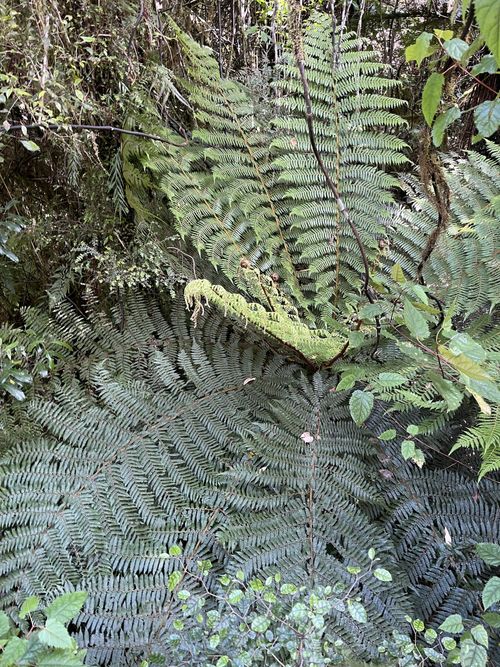
The namesake genus, containing most of the arborescent species. Characterized by stout trunks often covered in fibrous roots and dense hairs at the apex. Includes the very popular horticultural species D. antarctica (Tasmanian Tree Fern) and D. squarrosa (Wheki) from New Zealand.

Calochlaena
Ground Fern
A small genus of large ferns that typically have creeping rhizomes rather than forming distinct trunks. Fronds are large and finely divided, often somewhat soft-textured and hairy. C. dubia (Common Ground Fern) is widespread in eastern Australia.
Phylogeny and Classification
Dicksoniaceae is a core family within the order Cyatheales. It is closely related to Cyatheaceae, Metaxyaceae, and Cibotiaceae, forming a major clade of tree ferns and their relatives. The genus Lophosoria, sometimes included here, is now generally placed in its own family (Lophosoriaceae) representing an earlier diverging lineage within Cyatheales based on molecular data (PPG I).
The family Dicksoniaceae (excluding Lophosoriaceae) is characterized morphologically by the combination of hairy indument (lacking prominent scales) and marginal sori with bivalvate indusia. Its diversification, primarily across the Southern Hemisphere, reflects ancient Gondwanan connections and subsequent regional evolution.
Position in Plant Phylogeny
- Kingdom: Plantae
- Clade: Tracheophytes (Vascular plants)
- Class: Polypodiopsida (Leptosporangiate ferns)
- Order: Cyatheales
- Family: Dicksoniaceae
Evolutionary Significance
Dicksoniaceae is important for:
- Tree Fern Evolution: Represents a major lineage of arborescent ferns alongside Cyatheaceae.
- Biogeography: Its predominantly Southern Hemisphere distribution reflects Gondwanan history.
- Morphological Characters: The distinction between hair-dominated (Dicksoniaceae) and scale-dominated (Cyatheaceae) indument is a key feature in tree fern classification.
- Horticulture: Contains some of the most widely cultivated ornamental tree ferns.