Cannaceae
Canna Lily Family
Cannaceae is a monogeneric family, containing only the genus Canna, with about 10-12 species of large, perennial monocot herbs native to the tropical and subtropical Americas. They are widely recognized for their large, banana-like leaves and showy, brightly colored, asymmetrical flowers where the conspicuous "petals" are actually modified sterile stamens (staminodes). The family is characterized by its rhizomatous habit, inferior ovary (often warty), capsule fruit, and very hard, round seeds ('Indian shot'). Cannaceae belongs to the order Zingiberales.
Overview
The Cannaceae family consists solely of the genus Canna, commonly known as Canna Lilies (though they are not true lilies). These are robust perennial herbs that grow from thick, fleshy rhizomes and are native to moist or wet habitats in the tropical and subtropical New World. They are characterized by large, broad leaves resembling those of bananas or gingers, arranged spirally around stout, upright stems.
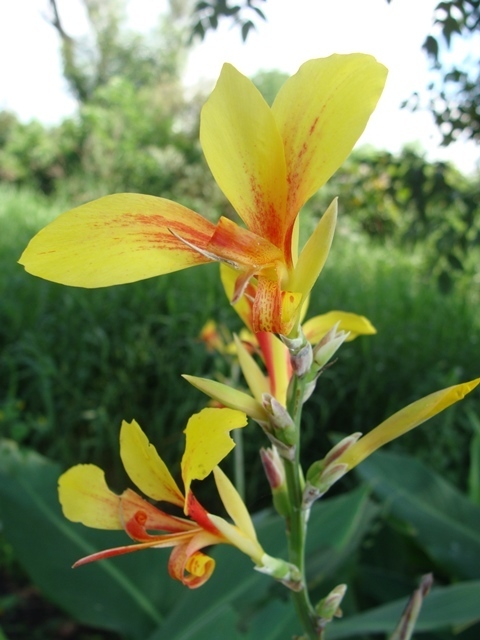
The most striking feature of Canna is its flamboyant and complex flower structure. The flowers are large, brightly colored (red, orange, yellow, pink), and highly asymmetrical. Unlike typical flowers where petals are the main showy parts, in Canna, the display is created primarily by modified sterile stamens called staminodes, which look like large petals. Only one half of one stamen is actually fertile, bearing pollen. The ovary is inferior and develops into a warty capsule containing numerous hard, round seeds often called 'Indian shot'.
Many species and especially numerous hybrids are widely cultivated worldwide as popular ornamental plants in gardens and containers, valued for both their tropical-looking foliage and vibrant flowers. Some species, like Canna indica (Achira), have edible starchy rhizomes. Phylogenetically, Cannaceae is part of the Zingiberales order, a group of tropical monocots that includes gingers, bananas, heliconias, and prayer plants.
Quick Facts
- Scientific Name: Cannaceae
- Common Name: Canna Lily Family
- Number of Genera: 1 (Canna)
- Number of Species: Approximately 10-12
- Distribution: Native to tropical/subtropical Americas; widely cultivated and naturalized pantropically.
- Evolutionary Group: Monocots - Commelinids - Zingiberales
- Habit: Large perennial herbs with rhizomes.
Key Characteristics
Growth Form and Habit
Large perennial herbs developing from thick, fleshy, starchy rhizomes. Stems (pseudostems formed by leaf sheaths and true stems) are stout, erect, and typically unbranched below the inflorescence. Often form large clumps.
Leaves
Leaves are large, broad (ovate to elliptic), simple, with entire margins. They are arranged alternately and spirally around the stem (sometimes appearing 2-ranked). Leaf bases form prominent sheaths that wrap around the stem. Blades have a strong midrib and characteristic pinnate-parallel venation (major lateral veins run parallel to each other but arise pinnately from the midrib). Leaves resemble those of bananas or gingers.
Flowers and Inflorescence
Flowers are borne in terminal spikes, racemes, or branched panicle-like thyrses, often subtended by noticeable bracts. Individual flowers are large, showy, bisexual, and highly asymmetrical (zygomorphic). The underlying structure is 3-merous.
- Sepals: 3, separate, usually green and relatively small, persistent on the fruit.
- Petals: 3, usually smaller than the staminodes, often yellowish or greenish, sometimes pointed or reflexed. They are typically fused at the base along with the staminodes and style to form a tube.
- Androecium (Showy Part): Highly modified and petaloid. Consists of:
- 1 to 4 (usually 3) petaloid staminodes: Brightly colored (red, orange, yellow, pink, etc.) sterile stamens that resemble petals. One staminode is often modified into a prominent, recurved lip or labellum.
- One fertile half-stamen: This unique structure is petaloid but bears a single functional anther locule (theca) attached along one edge.
- Ovary: Distinctly inferior (positioned below the flower parts). Composed of 3 fused carpels forming 3 locules with numerous ovules on axile placentas. The ovary surface is characteristically warty or tuberculate (covered in small bumps or projections). Septal nectaries are present.
- Style/Stigma: A single style is present, which is distinctively flattened and petaloid, with the receptive stigma forming a line along one edge near the apex.
Fruits and Seeds
The fruit is a dry or slightly fleshy capsule, typically 3-valved, and its surface is usually covered in warts or soft spines derived from the ovary wall. The persistent sepals remain at the apex of the capsule.
Seeds are numerous, spherical or ovoid, very hard, and typically black or dark brown, resembling buckshot (leading to the common name 'Indian shot'). They possess copious, hard endosperm and also perisperm.
Chemical Characteristics
The rhizomes are rich in starch and are edible in some species (e.g., Canna indica - Achira). Plants also contain various phenolic compounds and tannins.
Field Identification
Cannaceae (Canna) is generally easy to recognize due to its large stature, broad leaves, and especially its unique, showy, asymmetrical flowers:
Primary Identification Features
- Habit: Large perennial herb growing from a rhizome.
- Leaves: Large, broad (banana/ginger-like), simple, alternate/spiral, with sheathing bases and pinnate-parallel venation.
- Flowers: Large, showy, bright-colored (red/orange/yellow/pink), distinctly asymmetrical.
- Showy Floral Parts: The large "petals" are actually modified sterile stamens (petaloid staminodes, usually 3 including a labellum) plus one fertile half-stamen bearing a single anther sac.
- Ovary/Fruit: Ovary is inferior and usually warty; fruit is a warty (or spiny) capsule.
- Seeds: Numerous, hard, round, black/brown ('Indian shot').
Secondary Identification Features
- Inflorescence: Terminal spike, raceme or panicle-like thyrse, often with bracts.
- Sepals: 3, small, green, persistent.
- Petals: 3, smaller than staminodes, often inconspicuous.
- Style: Flattened and petaloid.
- Habitat: Prefers moist to wet soils, often near water or in gardens.
Seasonal Identification Tips
- Growing Season: Robust vegetative growth with large leaves during warm, moist periods.
- Flowering: Flowers are produced seasonally, typically summer through fall in temperate climates, or more continuously in tropical regions. The unique flowers are the most diagnostic feature.
- Fruiting: The warty capsules develop after flowering and contain the hard seeds.
- Dormancy: Rhizomes allow plants to survive unfavorable conditions (cold or drought), resprouting when conditions improve.
Common Confusion Points
- Other Zingiberales (Gingers, Bananas, Heliconias, etc.): Share the large herbaceous habit and often large leaves. However, they differ in specific floral structures: Zingiberaceae have 1 fertile stamen + large labellum from fused staminodes; Musaceae have unisexual flowers in huge pendant bracteate inflorescences; Heliconiaceae/Strelitziaceae have different numbers of fertile stamens (usually 5) and highly specialized flower/bract shapes. None have exactly the 1 fertile half-stamen + multiple large petaloid staminodes structure of Canna.
- Large-leaved Araceae (e.g., Colocasia - Taro): Also large herbs from rhizomes/corms with large leaves, but belong to Alismatales. Leaves often peltate or sagittate with net venation (not pinnate-parallel). Flowers are tiny, unisexual, apetalous, borne on a spadix enclosed by a spathe.
The combination of large herb habit, broad leaves with pinnate-parallel venation, and especially the unique asymmetrical flower composed primarily of colorful petaloid staminodes and a single fertile half-stamen, along with the inferior warty ovary/capsule, makes Cannaceae unmistakable.
Field Guide Quick Reference
Look For:
- Large perennial herb from rhizome
- Leaves large, broad, alternate/spiral, sheathing
- Leaf veins pinnate-parallel
- Flowers large, showy, asymmetrical
- Colors red, orange, yellow, pink
- Showy parts = Petaloid staminodes (incl. labellum) + 1 fertile half-stamen
- Ovary inferior, often warty
- Fruit a warty capsule
- Seeds hard, round, black/brown ('Indian shot')
Key Variations (within Canna):
- Flower color and patterns (many hybrids)
- Leaf color (green, bronze, variegated)
- Plant height (dwarf to tall)
- Subtle differences in staminode shapes
Notable Examples
The family consists of the single genus Canna, known for wild species and numerous garden hybrids.

Canna indica
Indian Shot, Achira
A widespread species native to the Americas, now naturalized pantropically. Typically has green leaves and relatively smaller red or yellow flowers compared to modern hybrids. Its starchy rhizomes (Achira) are edible and traditionally cultivated as a food source in the Andes. The hard seeds give the common name 'Indian Shot'.

Canna × generalis (pro sp.)
Garden Canna, Hybrid Canna
This name encompasses the vast majority of large-flowered cannas grown ornamentally in gardens worldwide. They are complex hybrids derived from several wild species, selected for large, vibrant flowers in shades of red, orange, yellow, pink, and cream (often spotted or bi-colored) and sometimes for colorful foliage (bronze or variegated).
Phylogeny and Classification
Cannaceae belongs to the order Zingiberales, a major group within the Commelinid clade of monocots. This order is renowned for its large tropical herbs with showy, often complex flowers, including bananas, gingers, heliconias, birds-of-paradise, and prayer plants.
Within Zingiberales, Cannaceae is placed in a clade together with Marantaceae (Prayer Plant family). This Cannaceae-Marantaceae clade is characterized by having only one or one-half fertile stamen, with other stamens modified into petaloid staminodes. This clade is sister to the larger clade containing the remaining Zingiberales families (Zingiberaceae, Costaceae, Musaceae, Heliconiaceae, Strelitziaceae, Lowiaceae), which typically have 5 or 6 fertile stamens (except Zingiberaceae and Costaceae with 1).
Cannaceae stands out as a monogeneric family, representing a distinct evolutionary lineage characterized by its unique floral asymmetry and modifications.
Position in Plant Phylogeny
- Kingdom: Plantae
- Clade: Angiosperms (Flowering plants)
- Clade: Monocots
- Clade: Commelinids
- Order: Zingiberales
- Family: Cannaceae
Evolutionary Significance
Cannaceae is evolutionarily interesting for:
- Floral Specialization: Demonstrates extreme modification of the androecium (stamens) where sterile members (staminodes) become the primary organs of floral display, alongside reduction to a single half-fertile stamen. This highlights the evolutionary plasticity of floral organs.
- Evolution of Asymmetry: Contributes to understanding the evolution of zygomorphy (bilateral symmetry) in monocot flowers, a prominent theme in Zingiberales.
- Phylogeny within Zingiberales: Its relationship with Marantaceae helps resolve the major evolutionary splits within the order.
- Domestication and Horticulture: Represents a lineage where human selection has led to edible varieties (C. indica) and a vast array of ornamental cultivars based on floral and foliar variation.
- Seed Structure: The very hard 'Indian shot' seeds are distinctive and relate to dispersal and germination strategies.