Zingiberaceae
Ginger Family
Zingiberaceae, the ginger family, is the largest family in the order Zingiberales (Monocots), comprising about 56 genera and over 1,300 species. These are perennial herbs native primarily to the tropics of the Old World, especially Southeast Asia. They are well-known for their aromatic properties due to essential oils stored in fleshy rhizomes. Key characteristics include distichous (two-ranked) leaves with a ligule, highly zygomorphic flowers usually with only one fertile stamen and a prominent labellum (lip) formed from sterile stamens, an inferior ovary, and typically capsular fruit often containing arillate seeds.
Overview
The Ginger family is of immense economic importance, providing staple spices used globally, including ginger (Zingiber officinale), turmeric (Curcuma longa), cardamom (Elettaria cardamomum), and galangal (Alpinia galanga). These spices derive from the aromatic rhizomes, which contain complex essential oils and pungent compounds. Many species also have traditional medicinal uses related to these chemical constituents.
Beyond spices, Zingiberaceae includes numerous popular ornamental plants cultivated for their exotic foliage and often showy, complex flowers or colorful bracts. Examples include ginger lilies (Hedychium), shell gingers (Alpinia), torch gingers (Etlingera - though sometimes separate), dancing ladies gingers (Globba), and peacock gingers (Kaempferia). The intricate flowers are highly specialized for pollination, often by specific bees, moths, or birds.
Distinguishing features include the fleshy, often pungent rhizomes, leaves arranged in two ranks (distichous) along the stem, each possessing a ligule (a small appendage at the junction of the sheath and blade), and the complex flower structure where the most conspicuous 'petal' is actually a lip (labellum) formed by fused sterile stamens (staminodes), while only one true stamen is functional. Plants are native to tropical climates and are not found wild in Oklahoma (current location as of March 27, 2025), though some ornamentals might be grown in protected conditions or as houseplants.
Quick Facts
- Scientific Name: Zingiberaceae Martinov
- Common Name: Ginger family
- Number of Genera: Approximately 50-56
- Number of Species: Approximately 1,300-1,600
- Distribution: Pantropical, with main center of diversity in Indo-Malesian region (Southeast Asia).
- Evolutionary Group: Monocots (Commelinids)
- Order: Zingiberales
Key Characteristics
Growth Form and Habit
Perennial herbs arising from fleshy, often aromatic, branched rhizomes (underground stems). Aerial shoots are herbaceous, unbranched or branched, formed either by rolled leaf sheaths (pseudostems) or true stems.
Leaves
Leaves are simple with entire margins, arranged alternately in two distinct ranks (distichous) along the stem. A key feature is the presence of a ligule, a typically membranous or hairy appendage, located at the summit of the open leaf sheath where it joins the leaf blade. The leaf blade usually has a prominent midrib and pinnate-parallel venation. Leaves are often aromatic when crushed.
Inflorescence
Inflorescence structure is often complex and visually striking. It can be a terminal spike, raceme, or thyrse borne on the leafy shoot, or it can arise separately on a leafless stalk directly from the rhizome. Flowers are typically subtended by bracts, which are often large, colorful, closely overlapping, and sometimes fused, forming cone-like or head-like structures (e.g., Zingiber, Curcuma).
Flowers
Flowers are usually bisexual, strongly zygomorphic (bilaterally symmetric), and derived from a 3-merous plan but highly modified. They are often relatively short-lived and fragrant.
- Perianth: Differentiated into calyx and corolla.
- Calyx: Composed of 3 sepals fused into a tube (synsepalous), usually thin, often splitting down one side, typically inconspicuous. Located atop the ovary.
- Corolla: Composed of 3 petals fused into a tube below, with 3 lobes above. The dorsal (upper) lobe is typically larger than the two lateral lobes.
- Androecium: Highly modified and petaloid, forming the most conspicuous parts of the flower. Usually only 1 fertile stamen (the median stamen of the ancestral inner whorl) is present, typically with a large anther that may have crests or appendages. The other stamens are sterile and modified:
- Labellum: Two lateral staminodes of the inner whorl are fused together to form a large, prominent, lip-like structure (the labellum), which often functions as a landing platform for pollinators and is frequently colorful and lobed.
- Lateral Staminodes: Two lateral staminodes of the outer whorl are either small and tooth-like or petaloid (sometimes large and resembling corolla lobes), or occasionally absent. The median stamen of the outer whorl is always absent.
- Gynoecium: Ovary is inferior, composed of 3 fused carpels, typically forming 3 locules (sometimes reduced to 1). Placentation is usually axile (sometimes parietal or basal). Ovules are usually numerous. A single, long, slender style runs upwards, characteristically passing through a groove or channel in the filament and anther of the fertile stamen. The stigma is usually small, cup-shaped or funnel-shaped, often fringed with hairs, and emerges beyond the anther. Two epigynous nectaries (nectar glands located on top of the ovary) are typically present.
Fruits and Seeds
The fruit is typically a capsule that dehisces loculicidally (splits into the locules) or irregularly, though sometimes it is fleshy and berry-like. The capsule wall can be thin or thick, dry or fleshy. Seeds are usually numerous, rounded or angled, and characteristically possess a brightly colored, often red or orange, fleshy aril (an outgrowth covering part or all of the seed coat), which likely aids in dispersal by birds or other animals.
Chemical Characteristics
The family is defined by its abundance of essential oils and pungent compounds stored in specialized oil cells, particularly in the rhizomes. These include various terpenoids (e.g., zingiberene, cineole), phenylpropanoids, and diarylheptanoids (e.g., gingerols, shogaols in ginger; curcuminoids in turmeric). These compounds contribute to the characteristic aromas, flavors, and medicinal properties of ginger, turmeric, cardamom, etc. Starch is the primary storage carbohydrate in rhizomes.
Field Identification
Identifying Zingiberaceae relies on recognizing the combination of aromatic rhizomes, distichous leaves with ligules, and highly specialized zygomorphic flowers with a prominent labellum and single fertile stamen.
Primary Identification Features
- Aromatic Rhizomes/Leaves: Plants often have a characteristic spicy or fragrant aroma when parts are bruised.
- Distichous Leaves: Leaves arranged alternately in two distinct ranks along the stem.
- Ligule Present: A small appendage at the junction of the leaf sheath and blade.
- Highly Zygomorphic Flowers: Bilaterally symmetric flowers dominated by a lip-like labellum.
- 1 Fertile Stamen: Only one functional stamen is typically visible (others are modified into petal-like staminodes forming the labellum and lateral structures).
- Inferior Ovary: Ovary located below the attachment of floral parts.
- Capsule Fruit with Arillate Seeds: Fruit typically a capsule; seeds often have a colorful fleshy aril.
Secondary Identification Features
- Pinnate-Parallel Venation: Parallel veins arising from a distinct midrib.
- Inflorescence Structure: Often dense spikes or cone-like structures with prominent bracts, sometimes arising separately from the rhizome.
- Labellum Shape and Color: Details of the lip structure.
- Anther Appendages: Crests or spurs on the fertile anther.
- Habitat: Typically tropical or subtropical forests or disturbed areas.
Seasonal Identification Tips
- Tropical/Cultivated Settings: Growth and flowering often occur during warm, rainy seasons. Rhizomes allow plants to survive dry or cool periods.
- Harvest Time: Rhizomes of spices (ginger, turmeric) are typically harvested when mature, often after aerial parts have senesced.
- (Oklahoma Context: Not applicable for field ID in the wild. Identification would be of cultivated ornamentals or grocery store rhizomes).
Common Confusion Points
- Costaceae (Spiral Gingers): Closely related, also aromatic rhizomes and showy flowers with labellum. Key difference: Leaves are arranged spirally around the stem, not distichously. Ligules may be different.
- Marantaceae (Prayer Plants): Also in Zingiberales with distinct leaves often showing movement (pulvinus). Key differences: Flowers are asymmetric (not simply zygomorphic), typically in pairs, complex stamen/staminode structure differs.
- Cannaceae (Cannas): Also in Zingiberales with large leaves (spiral or distichous). Key differences: Flowers are asymmetric, showy parts are mostly staminodes, fertile stamen has only half an anther, fruit a warty capsule.
- Musaceae/Strelitziaceae/Heliconiaceae: Other large herbs in Zingiberales, generally lack strong aroma in rhizomes/leaves, different flower structures (e.g., 5 fertile stamens in Musa).
- Orchidaceae (Orchids): Also monocots with highly zygomorphic flowers and often inferior ovary. Key differences: Pollen aggregated into pollinia; distinct column structure fusing stamen(s) and style; different leaf/stem structure; not typically aromatic in the same way.
- Araceae (Arum family): Herbaceous monocots, but flowers tiny on a spadix with a spathe, different leaf venation.
Focus on: Aromatic Rhizome + Distichous Leaves + Ligule + Zygomorphic Flower with Labellum & 1 Stamen + Inferior Ovary.
Field Guide Quick Reference
Look For:
- Herbaceous perennial with aromatic rhizome
- Leaves alternate, distichous (2-ranked)
- Ligule present at sheath/blade junction
- Flowers strongly zygomorphic
- Prominent labellum (lip) present
- 1 fertile stamen (usually)
- Ovary inferior
- Fruit a capsule (often), seeds often arillate
Key Variations:
- Rhizome aroma/color (ginger, turmeric)
- Inflorescence position (on leafy shoot vs. separate stalk)
- Bract color and structure (cone-like)
- Labellum shape, size, color
- Presence/size of lateral staminodes
- Fruit type (capsule vs. berry-like)
Notable Examples
The Ginger family provides essential spices and stunning ornamental plants known for their exotic beauty and fragrance.

Zingiber officinale
Ginger
A perennial herb likely originating in Southeast Asia, cultivated globally for its pungent, aromatic rhizome used as a spice and in traditional medicine. Features leafy stems with distichous, lanceolate leaves and a ligule. The inflorescence is a dense, cone-like spike with yellowish-green bracts, bearing pale yellow flowers with a purplish labellum, often arising on a separate stalk from the rhizome. Rarely flowers in cultivation.

Curcuma longa
Turmeric
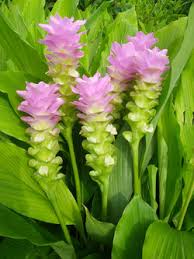
A perennial herb native to South Asia, cultivated for its bright orange-yellow rhizome, used as a spice (key ingredient in curry powder), dye, and in traditional medicine. Features large, oblong leaves arising from the rhizome. The inflorescence is a cylindrical spike with pale green or whitish bracts, often tipped with pink, bearing pale yellow flowers. Contains curcuminoids, responsible for the color and bioactivity.

Elettaria cardamomum
Cardamom / Green Cardamom
A perennial herb native to southern India, cultivated for its aromatic seed pods used as a spice worldwide. Features tall leafy stems and separate, sprawling flowering stems that arise near the base of the plant. Flowers are whitish with violet veins on the labellum. The fruit is a small, greenish, spindle-shaped capsule containing numerous small, black, aromatic seeds.

Alpinia zerumbet
Shell Ginger / Pink Porcelain Lily
A large perennial herb native to East Asia, widely cultivated as an ornamental in tropical and subtropical regions. Forms clumps of tall leafy stems. Produces beautiful, arching or pendulous racemes of flowers. Flower buds resemble porcelain shells; open flowers are fragrant, white or pinkish with a yellow labellum marked with red.

Hedychium coronarium
White Ginger Lily / Butterfly Ginger
A perennial herb native to the Himalayas region of Asia, cultivated for its intensely fragrant white flowers resembling butterflies. Features tall leafy stems. Flowers are borne in dense terminal spikes with green bracts. The labellum is large and white, often with a pale yellow base; lateral staminodes are also large and petal-like. Can be invasive in some humid tropical areas.

Globba winitii
Dancing Ladies Ginger / Mauve Dancing Girl
A perennial herb native to Southeast Asia, grown as an ornamental for its unique and graceful inflorescence. Features leafy stems and produces long, pendulous terminal inflorescences with showy magenta or purple bracts. Small yellow flowers emerge from the bracts, often accompanied by bulbils (small vegetative propagules). The common name refers to the delicate appearance of the dangling flowers.
Phylogeny and Classification
Zingiberaceae is the largest family in the monocot order Zingiberales, belonging to the Commelinid clade. This order forms a distinct and well-supported group characterized by large herbs, specialized floral structures, often pinnate-parallel leaf venation, and inferior ovaries. Within Zingiberales, Zingiberaceae is part of the core 'ginger group', closely related to Costaceae (spiral gingers), from which it is distinguished primarily by its distichous (vs. spiral) leaf arrangement and details of the labellum structure.
The family itself is divided into several subfamilies and tribes, reflecting diversification across the Old World tropics. Key evolutionary trends include the development of diverse aromatic compounds (essential oils, pungent principles) likely involved in defense and potentially allelopathy, the extreme modification of the androecium (stamens/staminodes) into specialized floral parts (labellum, single fertile stamen) related to intricate pollination mechanisms often involving specific insects or birds, and the frequent occurrence of colorful bracts enhancing inflorescence showiness.
Position in Plant Phylogeny
- Kingdom: Plantae
- Clade: Angiosperms (Flowering plants)
- Clade: Monocots
- Clade: Commelinids
- Order: Zingiberales
- Family: Zingiberaceae
Evolutionary Significance
Zingiberaceae represents a major radiation of tropical monocots, characterized by sophisticated chemical defenses (aromatic compounds) and highly specialized floral morphology linked to specific pollinators. The evolution of the labellum from sterile stamens provides a striking example of how existing structures can be repurposed for new functions (pollinator attraction/guidance). The family's economic importance as a source of globally traded spices highlights the significance of plant secondary metabolites in human history. Studying Zingiberaceae contributes to understanding diversification patterns, pollination biology, and chemical evolution within the derived monocot clade Commelinids.


