Bryoxiphiaceae
Sword Moss Family
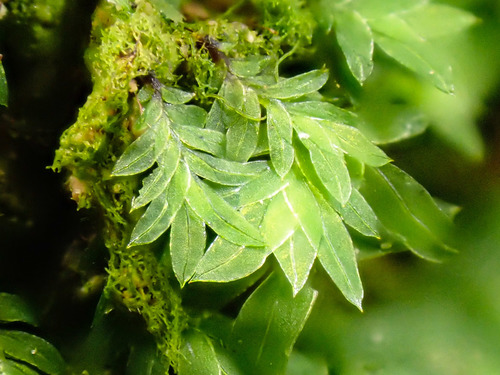
Bryoxiphiaceae is a small, highly distinctive, monogeneric family of mosses containing only the genus Bryoxiphium. Its most striking feature is the unique arrangement of leaves strictly in two opposite ranks (distichous) along the stem, giving the plants a flattened appearance reminiscent of a tiny fern frond or sword blade, hence the common name "Sword Moss". These rare mosses occupy specific shaded rock habitats.
Overview
The Bryoxiphiaceae family, with its single genus Bryoxiphium and only two species (B. norvegicum and B. madeirense), is remarkable for its unique morphology and highly disjunct global distribution. Bryoxiphium norvegicum occurs sporadically in eastern North America, Greenland, Iceland, Mexico, and the Dominican Republic, while B. madeirense is found only in Macaronesia. This pattern suggests an ancient lineage with subsequent fragmentation and extinction.
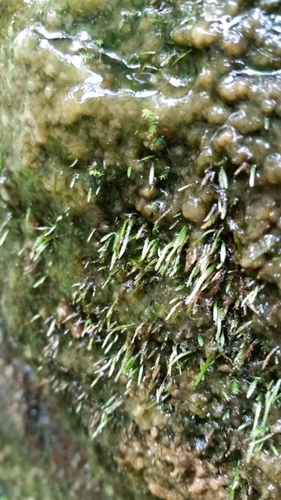
Sword mosses are small plants that form dense, often linear tufts or flattened strips tightly attached to their substrate. They are typically found in cool, moist, deeply shaded microhabitats, almost exclusively on vertical or overhanging, non-calcareous rock faces (like sandstone), often near streams, waterfalls, or seepage in ravines and gorges. Their flattened appearance due to the two-ranked leaves makes them unlike almost any other moss.
Sporophytes are extremely rare, particularly in the North American populations of B. norvegicum, suggesting that reproduction and dispersal rely heavily on vegetative means or fragmentation. The family's isolated phylogenetic position and unique features make it of considerable interest in bryophyte evolution.
Quick Facts
- Scientific Name: Bryoxiphiaceae
- Common Name: Sword Moss Family
- Number of Genera: 1 (Bryoxiphium)
- Number of Species: 2
- Distribution: Highly disjunct: E North America, Greenland, Iceland, Mexico, Dominican Republic; Macaronesia.
- Habitat: Cool, moist, shaded vertical non-calcareous rock faces.
- Evolutionary Group: Bryophytes - Mosses (Class: Bryopsida, Order: Uncertain - often Bryoxiphiales)
Key Characteristics
Growth Form and Habit
Plants are functionally acrocarpous (sporophytes terminal when produced, but often appear lateral due to innovations), but the growth form is unique. They form dense, linear tufts or flattened strips/cushions due to the strict leaf arrangement. Stems are erect to ascending, often simple or sparsely branched, appearing flattened.
Stems
Stems are somewhat flattened corresponding to the leaf arrangement.
Leaves
The most defining characteristic is the leaf arrangement: leaves are strictly distichous (arranged in two opposite rows along the stem), overlapping like scales. Individual leaves are erect-spreading, often asymmetric, lanceolate to ovate-lanceolate, with a broad, sheathing base that clasps the stem. The leaves are strongly keeled along the costa (folded like the keel of a boat). The costa is single and strong, usually percurrent (reaching the tip) or shortly excurrent. Leaf cells are typically smooth, relatively small, and quadrate to hexagonal or shortly rectangular. There is no distinct leaf border.
Asexual Reproduction
No specialized asexual propagules are known; reproduction likely occurs via fragmentation.
Sporophytes (Reproductive Structures)
Sporophytes are very rarely produced. When present, they often appear lateral due to growth of innovations. The capsule is elevated on a short, smooth seta. The capsule is small, erect, symmetric, ovoid to short-cylindric, and smooth-walled. The peristome is single, consisting of 16 short, often irregular or rudimentary teeth, sometimes resembling those of Pottiales or Dicranales. The operculum (lid) is conic or rostrate (beaked).
Habitat
Highly specific: requires cool, moist, deeply shaded conditions, typically found on vertical or overhanging, non-calcareous rock faces (e.g., sandstone, conglomerate, acidic gneiss) often near water seepage or streams in sheltered ravines or gorges.
Field Identification
Identifying Bryoxiphiaceae is usually straightforward due to its unique leaf arrangement and specific habitat, even though it is a rare moss.
Primary Identification Features
- Leaf Arrangement (Key Feature): Leaves strictly arranged in two opposite ranks (distichous), giving the plant a flattened, fern-like or sword-like appearance. This is highly distinctive among mosses.
- Habitat: Found exclusively in cool, moist, deeply shaded sites on vertical or overhanging non-calcareous rock faces.
- Growth Habit: Forms dense, often linear tufts or flattened strips tightly appressed to the rock.
Secondary Identification Features
- Leaf Shape: Keeled, lanceolate leaves with sheathing bases.
- Sporophytes (Very Rare): Small, erect, ovoid/cylindric capsules on short setae, appearing lateral.
Seasonal Identification Tips
- Year-round: The distinctive flattened gametophytes are visible year-round in their protected habitats.
- Sporophyte Timing: Sporophytes are so rare that seasonality is difficult to generalize; finding them at any time is noteworthy.
Common Confusion Points
Due to its unique appearance, Bryoxiphiaceae is rarely confused with other mosses once the distichous arrangement is observed.
- Fissidens species (Fissidentaceae): Also have leaves appearing somewhat 2-ranked, but the leaf structure is completely different (possessing a unique vaginant lamina). Fissidens often grows on soil or rock in various habitats, not typically the deeply shaded vertical faces required by Bryoxiphium.
- Distichium species (Ditrichaceae): Also have distichous leaves, but leaves are typically much finer, subulate (awl-shaped), and plants often grow in calcareous habitats.
- Liverworts / Small Ferns: Beginners might initially mistake the flattened appearance for a leafy liverwort or a tiny fern gametophyte or sporophyte, but closer inspection reveals the moss structure (keeled leaves with costa).
The strict two-ranked leaf arrangement combined with the specific shaded rock habitat is diagnostic.
Field Guide Quick Reference
Look For:
- Leaves strictly in 2 ranks (distichous)
- Flattened, fern-like appearance
- Habitat: Shaded, vertical, non-calcareous rock
- Dense, linear tufts/strips
- Leaves keeled, sheathing at base
Key Variations:
- Only 2 very similar species globally
- Sporophytes extremely rare
Notable Examples
The family contains only one genus with two species:

Bryoxiphium norvegicum
Sword Moss
The more widespread species, known for its highly disjunct distribution across eastern North America, Greenland, Iceland, Mexico, and the Caribbean. It perfectly exemplifies the family's characteristics: distichous, keeled leaves forming flattened tufts on shaded, non-calcareous rock faces. Sporophytes are exceedingly rare.
Phylogeny and Classification
The phylogenetic position of Bryoxiphiaceae within the class Bryopsida has long been uncertain due to its unique combination of morphological features. Traditionally, based on the rudimentary single peristome (when present), it was often tentatively placed near the orders Pottiales or Dicranales. However, it lacks clear affinities with core members of those groups.
Reflecting its distinctiveness and uncertain relationships, it is frequently placed in its own monotypic order, Bryoxiphiales. Molecular studies have confirmed its isolated position, potentially representing an early diverging lineage within the large Dicranidae subclass or perhaps related to Pottiales, but not clearly nested within any other existing order. Its ancient, relictual distribution pattern further supports its status as an evolutionarily isolated lineage.
Position in Plant Phylogeny
- Kingdom: Plantae
- Division: Bryophyta (Mosses)
- Class: Bryopsida
- Subclass: Dicranidae (?) / Bryidae (?)
- Order: Bryoxiphiales (often recognized) / or uncertain
- Family: Bryoxiphiaceae
Evolutionary Significance
Bryoxiphiaceae is evolutionarily significant because:
- Unique Morphology: The distichous leaf arrangement is rare in mosses and represents a distinct morphological pathway.
- Isolated Lineage: Its uncertain phylogenetic position highlights the diversity of early branching events within Bryopsida.
- Relictual Distribution: The highly disjunct global pattern suggests it is an ancient group that has suffered significant extinction, making it a 'living fossil' of sorts.
- Habitat Specialization: Its strict ecological requirements provide insights into niche conservatism and adaptation.