Pottiaceae
Wall Moss Family
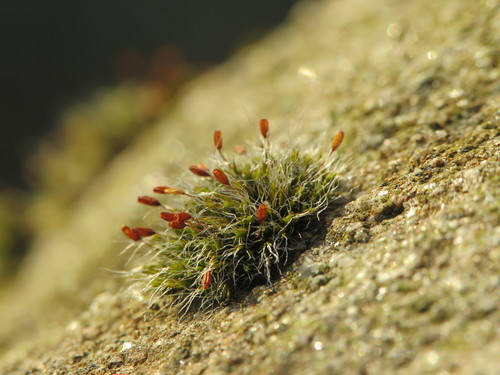
The Pottiaceae is one of the largest and most diverse families of mosses (Division Bryophyta), containing approximately 1,500 species in about 80-90 genera. This cosmopolitan family is particularly well-represented in arid, semi-arid, calcareous, and disturbed habitats, often colonizing bare soil, rock, and man-made structures like walls and roofs.
Overview
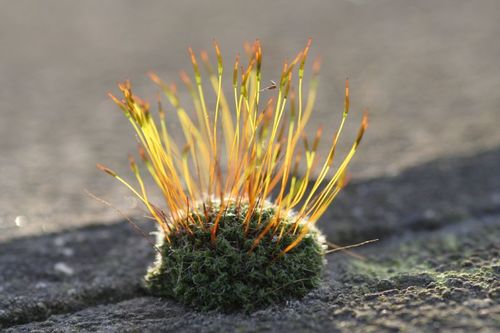
The Pottiaceae family consists primarily of small, acrocarpous mosses (meaning the sporophytes terminate the main stem or branches), typically forming tufts, cushions, or mats. They are renowned for their ability to survive in harsh, dry conditions and are often pioneers on exposed substrates. Many species exhibit remarkable desiccation tolerance, appearing shriveled and lifeless when dry but quickly reviving upon rehydration.
Pottiaceae are found worldwide, from polar regions to tropics, but they reach their greatest diversity in Mediterranean climates, deserts, and areas with calcareous (lime-rich) soils or rocks. Their ecological roles include stabilizing soil, contributing to biological soil crusts, and providing microhabitats for invertebrates.
While not having the direct economic significance of large plant families like Asteraceae, Pottiaceae are important ecological indicators and contribute significantly to biodiversity, especially in challenging environments. Their unique adaptations to stress make them subjects of physiological research.
Quick Facts
- Scientific Name: Pottiaceae
- Common Name: Wall Moss Family (less frequently used than scientific name)
- Number of Genera: Approximately 80-90
- Number of Species: Approximately 1,500
- Distribution: Cosmopolitan, particularly abundant in arid, semi-arid, calcareous, and disturbed environments.
- Evolutionary Group: Bryophytes - Mosses (Class Bryopsida, Order Pottiales)
Key Characteristics
Gametophyte (Vegetative Plant)
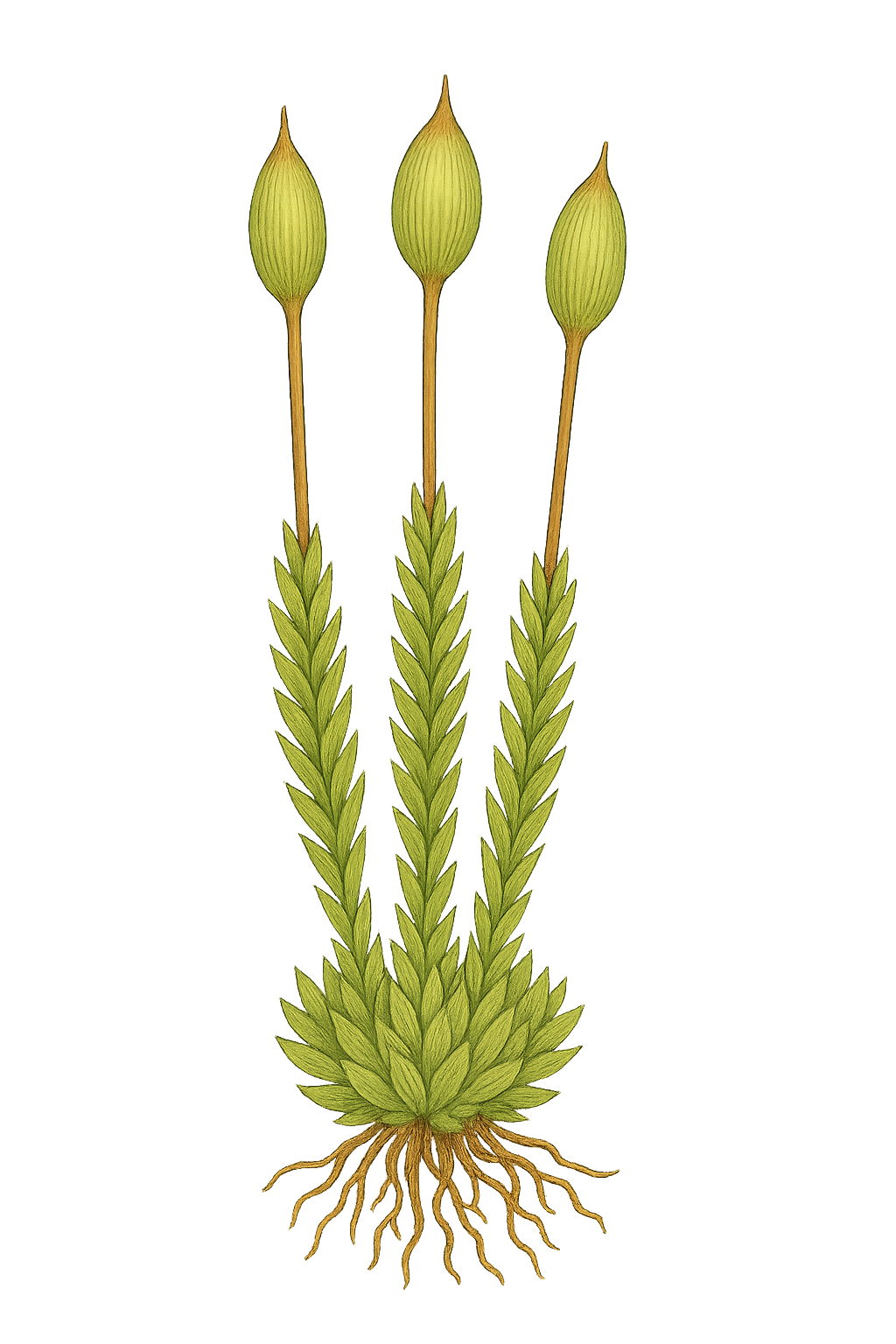
Pottiaceae are typically acrocarpous mosses, meaning they grow upright and produce their reproductive structures (archegonia and later sporophytes) at the tips of the main stems or branches. They generally form dense tufts, cushions, or turfs. Stems are usually simple or sparingly branched, with central strands often present.
Leaves
Leaves in Pottiaceae show considerable variation in shape (e.g., lanceolate, ovate, lingulate, spatulate) but are generally arranged spirally around the stem. A key feature is the typically strong costa (midrib), which often extends beyond the leaf apex (excurrent) as a point or hair-like awn (arista). The upper (adaxial) leaf cells are typically small, quadrate to hexagonal, thick-walled, and densely papillose (covered with small bumps), making the upper leaf surface appear opaque. Basal leaf cells are usually differentiated, being larger, rectangular, thin-walled, and hyaline (clear) or colored. Leaves are often strongly contorted, twisted, or crisped when dry, spreading outwards when moist. Leaf margins can be plane, recurved, or incurved, and entire or toothed near the apex.
Reproductive Structures (Sporophyte)
Mosses reproduce sexually via archegonia (female) and antheridia (male), often clustered at stem tips, sometimes surrounded by modified leaves (perichaetial or perigonial leaves). Fertilization requires water, leading to the development of the sporophyte.
The sporophyte consists of:
- Foot: Embedded in the gametophyte stem tip.
- Seta (Stalk): Usually elongated (but sometimes short or absent), typically straight and smooth.
- Capsule (Sporangium): Typically erect and symmetrical, cylindrical to ovoid or ellipsoid, containing spores. The capsule lid (operculum) is often conical or distinctly beaked (rostrate).
- Peristome: A ring of teeth around the capsule mouth, revealed when the operculum falls off. Highly variable in Pottiaceae: may consist of 16 or 32 teeth, be rudimentary, or absent altogether. Teeth shape (e.g., filiform, lanceolate) and ornamentation are important taxonomic characters. When present, teeth often twist together.
- Calyptra: A protective covering derived from the archegonium that sits atop the developing capsule. In Pottiaceae, it is typically cucullate (hood-shaped, split up one side) and smooth.
Spores
The fruit-equivalent in mosses is the capsule, which produces numerous small, typically spherical spores (not seeds). Spores are usually released through the capsule mouth, regulated by the peristome (if present), and primarily dispersed by wind. Spore surface ornamentation can vary.
Field Identification
Identifying Pottiaceae in the field often relies on a combination of habitat, gametophyte features (especially leaf details), and sometimes sporophyte characteristics. A hand lens is essential, and microscopic examination is often needed for definitive species identification.
Primary Identification Features
- Habitat: Look on bare soil, rocks, walls, mortar, concrete, especially in open, sunny, dry, or calcareous sites. Many are common in disturbed areas like pathsides and quarries.
- Growth Form: Small, acrocarpous mosses forming tufts or cushions.
- Dry vs. Moist Appearance: Observe the dramatic change: leaves often strongly twisted, crisped, or curled inwards when dry, spreading out when moist.
- Leaf Costa: A strong midrib, often appearing as a distinct ridge, frequently extending beyond the leaf tip (excurrent), sometimes as a long hair-point.
- Papillose Upper Leaf Cells: Leaves often appear opaque or dull green due to dense papillae on the upper cells (requires a good hand lens or microscope).
Secondary Identification Features
- Leaf Margins: Check if margins are flat, recurved (rolled downwards/backwards), or incurved (rolled upwards/inwards).
- Leaf Shape: Note the overall shape (e.g., tongue-shaped, strap-shaped, pointed).
- Capsule and Seta: If present, note the erect capsule, often cylindrical, on a straight seta.
- Peristome Teeth: If visible (capsule mature, operculum shed), note presence/absence and form (e.g., long and twisted, short, absent).
- Operculum Shape: A beaked lid is common in many genera.
- Basal Leaf Cells: Contrast between small, opaque upper cells and larger, clearer basal cells (best seen microscopically but sometimes hinted at with a lens).
Seasonal Identification Tips
- Year-round: Gametophytes are usually present year-round, though may be dormant/shriveled during dry periods. Identification based on vegetative features is often possible anytime.
- Sporophyte Season: Capsules often mature in spring or early summer in temperate regions, but timing varies greatly by species and climate. The presence of sporophytes can aid identification.
- Moisture is Key: Identification is much easier when plants are moist and leaves are expanded. Carry a small spray bottle with water to hydrate samples in the field.
Common Confusion Points
Pottiaceae can be confused with other acrocarpous moss families:
- Grimmiaceae (Grimmia family): Often grow in similar rocky habitats. Grimmiaceae typically have more complex leaf cross-sections (multiple cell layers), often sinuous (wavy) cell walls, and frequently possess prominent hyaline hair points, but usually lack the dense papillae typical of many Pottiaceae.
- Bryaceae (Bryum family): Usually have larger, smoother (non-papillose), rhomboidal or hexagonal leaf cells. Capsules are often nodding or pendent (not erect), and peristomes are typically double and well-developed.
- Encalyptaceae (Extinguisher moss family): Have large, distinctive calyptrae that completely cover the capsule like a candle snuffer. Leaves often tongue-shaped but cell structure differs.
- Ditrichaceae (Ditrichum family): Often found on soil, have narrower, subulate (awl-shaped) leaves, and different peristome structure.
Field Guide Quick Reference
Look For:
- Small, tufted acrocarps
- Habitat: Soil, rock, walls (often dry, sunny, calcareous)
- Leaves twisted/crisped when dry
- Strong costa, often excurrent (may form hair point)
- Opaque/dull look (papillose cells)
- Erect, cylindrical capsules (if present)
- Beaked operculum common
Key Variations:
- Leaf margins: Recurved, plane, or incurved
- Costa: Ending in leaf, shortly excurrent, or long hair point
- Peristome: Present (often twisted), rudimentary, or absent
- Plant color: Green, brownish, reddish
- Habitat preference: Some specialists (e.g., gypsum soil)
Notable Examples
The Pottiaceae family includes many common and widespread genera. Here are some notable examples:

Tortula muralis
Wall Screw-moss
An extremely common, cosmopolitan moss found on walls, mortar, concrete, and calcareous rocks. Recognizable by its tongue-shaped leaves with recurved margins and a distinct white hair-point (excurrent costa). Forms small, dense green cushions. Peristome teeth are long and twisted.

Syntrichia ruralis (syn. Tortula ruralis)
Hairy Screw-moss / Roof Moss
Common in dry, sunny habitats like dunes, grasslands, rocks, and roofs. Forms looser tufts than T. muralis. Leaves are strongly recurved when dry, spatulate (spoon-shaped), with very long, often jagged, hyaline hair points. Tolerant of high light and drought.

Barbula unguiculata
Bird's-claw Beard-moss
Very common on disturbed, bare, often calcareous soil along paths, fields, and roadsides. Forms low, dense, yellow-green to green patches. Leaves are tongue-shaped with a short point (apiculus), margins recurved below. Capsules are common, cylindrical, with twisted peristome teeth.

Didymodon fallax
Fallacious Beard-moss
Common on soil, walls, and rocks, often in base-rich conditions. Forms dense, dark green to reddish-brown tufts. Leaves are lanceolate, gradually tapering to a point, with strongly recurved margins. Capsules are frequent, erect, cylindrical; peristome teeth are short or rudimentary.

Weissia controversa
Controversial Weissia Moss
A common pioneer moss on bare soil in lawns, fields, banks, and roadsides. Forms low, bright green tufts. Leaves are linear-lanceolate, strongly curled inwards (crisped) when dry, with distinctively incurved upper margins. Capsules are common, ovoid, often lacking a peristome (gymnostomous) or having rudimentary teeth.

Bryoerythrophyllum recurvirostrum
Red Beard-moss
Widespread on soil, rocks, and walls, particularly in calcareous areas. Distinctive for its reddish-brown coloration, especially on the lower stem and leaves. Leaves are lanceolate with recurved margins and an acute apex. Capsules are erect, cylindrical, with a short, often oblique beak on the operculum.
Phylogeny and Classification
Pottiaceae belongs to the order Pottiales within the subclass Dicranidae, one of the major lineages of the class Bryopsida (true mosses). It is considered one of the most species-rich moss families, reflecting a successful evolutionary radiation, particularly into dry and calcareous environments. The family likely originated and diversified significantly during periods of increasing aridity in the Cenozoic era.
Molecular phylogenetic studies continue to refine the understanding of relationships within Pottiaceae and its placement within the Dicranidae. The family's boundaries and internal classification (subfamilies and tribes) have undergone revisions based on combined morphological and molecular data. Key evolutionary innovations include physiological and morphological adaptations to desiccation tolerance, variations in peristome structure related to spore dispersal in different environments, and colonization of mineral-rich substrates.
Position in Plant Phylogeny
- Kingdom: Plantae
- Division: Bryophyta (Mosses)
- Class: Bryopsida
- Subclass: Dicranidae
- Order: Pottiales
- Family: Pottiaceae
Evolutionary Significance
The Pottiaceae family showcases remarkable evolutionary success in colonizing terrestrial habitats, especially challenging ones. Key aspects include:
- Adaptations to Aridity: Sophisticated desiccation tolerance mechanisms allow survival in dry environments where vascular plants struggle.
- Substrate Specialization: Many species are adapted to specific substrates, particularly calcareous rock and soil, contributing to niche partitioning.
- Pioneer Role: Pottiaceae are often among the first colonizers of disturbed ground and bare rock, initiating ecological succession.
- Peristome Diversity: The wide variation in peristome structure (from complex and twisted to simple or absent) reflects diverse strategies for spore dispersal adapted to different microclimates and conditions.
- Contribution to Soil Crusts: In arid and semi-arid regions, Pottiaceae are important components of biological soil crusts, which reduce erosion and influence water infiltration.