Aytoniaceae
Aytoniaceae Liverworts
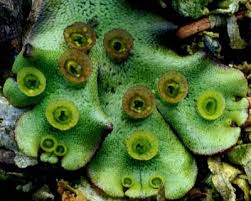
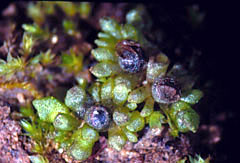
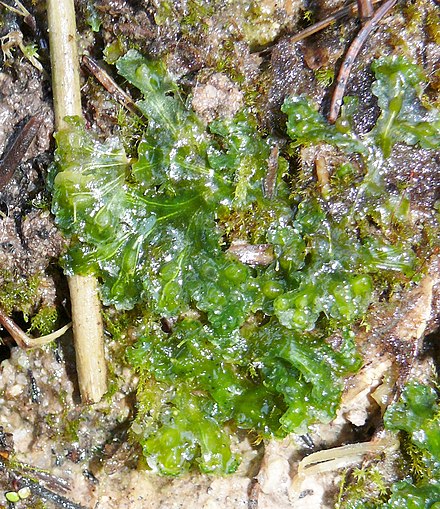
Aytoniaceae is a significant family of complex thalloid liverworts within the order Marchantiales (class Marchantiopsida). Members are characterized by their internally differentiated thalli containing air chambers opened by simple pores, conspicuous ventral scales, and typically stalked, lobed female reproductive structures (archegoniophores). Many species are aromatic when crushed.
Overview
The Aytoniaceae family encompasses several well-known genera of complex thalloid liverworts, including Asterella, Mannia, Plagiochasma, Reboulia, and Cryptomitrium, totaling approximately 80-100 species. These liverworts typically form prostrate, dichotomously branching thalli, often creating rosettes or mats on soil or rocks. They exhibit significant internal complexity, with a distinct upper layer containing air chambers filled with photosynthetic filaments, connected to the outside via simple air pores.
Aytoniaceae species are found worldwide, inhabiting diverse environments from moist temperate forests to arid and semi-arid regions. Many species show adaptations to drought. The family is readily recognized by its reproductive structures: female plants typically produce stalked archegoniophores with lobed heads (often star-shaped or hemispherical), while male structures (antheridia) are often grouped in sessile pads or cushions on the thallus surface. Many species release a noticeable aroma when bruised due to the presence of terpenoid compounds.
Asexual reproduction through specialized gemmae is generally rare or absent in this family, unlike the related Marchantiaceae. Their distinctive morphology and ecological diversity make them an important group within the Marchantiales.
Quick Facts
- Scientific Name: Aytoniaceae
- Common Name: Aytoniaceae Liverworts
- Number of Genera: Approximately 5-8 (e.g., Asterella, Mannia, Plagiochasma, Reboulia, Cryptomitrium)
- Number of Species: Approximately 80-100
- Distribution: Widespread globally in temperate and tropical regions; on soil or rocks, some adapted to xeric conditions.
- Evolutionary Group: Bryophytes - Liverworts (Marchantiophyta) - Class Marchantiopsida - Order Marchantiales
Key Characteristics
Growth Form and Habit
Plants are thalloid gametophytes, typically medium-sized, growing prostrate and branching dichotomously, often forming rosettes or extensive patches. The thallus texture can range from somewhat fleshy to leathery. Most species grow on soil or rock surfaces.
Thallus Structure
The thallus exhibits complex internal differentiation. The dorsal (upper) epidermis contains numerous simple air pores (lacking concentric rings of cells like barrel pores) that open into underlying air chambers. These chambers contain erect filaments of photosynthetic cells. The ventral (lower) surface bears numerous rhizoids (both smooth and pegged) and typically conspicuous ventral scales, usually arranged in two or more rows, which are often large and pigmented (e.g., purple, reddish) or hyaline.
Reproductive Structures
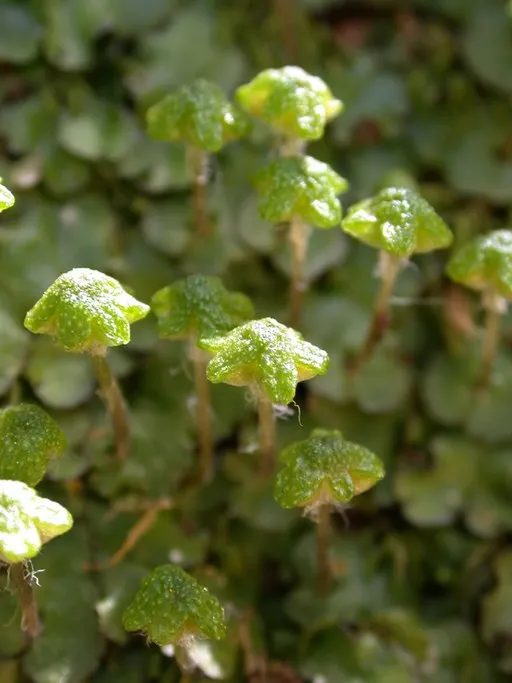
Sexual condition varies; species can be monoicous or dioicous. Antheridia (male organs) are typically aggregated in defined, sessile cushions or patches on the dorsal thallus surface, sometimes slightly raised, or rarely on short stalks. Archegonia (female organs) are borne on specialized, stalked receptacles known as archegoniophores. The archegoniophore consists of a stalk (short or long) and a terminal head (capitulum) which is typically distinctly lobed (often 4-10 lobes), appearing star-shaped or hemispherical. Archegonia, and later sporophytes, develop on the underside of these lobes, usually protected by membranous involucres or pseudoperianths. Asexual reproduction via gemmae is generally absent.
Sporophyte and Spores
The sporophyte develops attached to the underside of the archegoniophore lobes. It consists of a foot, a short seta, and a spherical to ovoid capsule. The capsule wall is typically unistratose (one cell layer thick). Dehiscence (opening) usually occurs by the capsule wall splitting irregularly from the apex or shedding a distinct apical lid (operculum). The capsule contains spores and functional elaters, which are elongated cells with spiral thickenings that aid in spore dispersal via hygroscopic movements. Spores are released singly.
Chemical Characteristics
Many species in Aytoniaceae produce volatile terpenoid compounds, resulting in a distinct aromatic scent when the thallus is crushed or bruised. Chemical composition can vary and may play roles in defense or environmental adaptation. Some species exhibit physiological adaptations to drought tolerance.
Field Identification
Identifying members of Aytoniaceae involves observing the thallus structure and, crucially, the reproductive structures:
Primary Identification Features
- Complex thallus with simple pores: Look for a thallus with internal air chambers visible through the surface as faint outlines, opening via simple pores (use hand lens; pores lack concentric rings of cells).
- Stalked, lobed archegoniophores: The female receptacles are raised on stalks and have distinctly lobed heads (often star-like or hemispherical). This is a key family characteristic.
- Conspicuous ventral scales: Check the underside for prominent scales, often colored purple or reddish, usually in multiple rows.
- Aromatic scent: Often noticeable when the thallus is crushed.
- Absence of gemma cups: Unlike Marchantia, specialized cups for asexual gemmae are typically absent.
Secondary Identification Features
- Sessile antheridial pads: Male structures are often indistinct cushions or patches on the thallus surface.
- Habitat: Commonly found on soil banks, rock crevices, or disturbed ground.
- Dichotomous branching pattern.
Seasonal Identification Tips
- Gametophyte: Often perennial and visible year-round when conditions are suitable.
- Archegoniophores/Antheridiophores: Development is typically seasonal (often spring or after rains). The presence and morphology of mature archegoniophores are critical for identification to genus and species level.
Common Confusion Points
- Marchantiaceae (e.g., Marchantia): Distinguished by barrel-shaped air pores (visible with strong lens), often prominent gemma cups, and differently shaped archegoniophores (often umbrella-like with finger-like rays) and antheridiophores (often flat-topped discs on stalks).
- Ricciaceae (e.g., Riccia): Mostly lack stalked archegoniophores (sporophytes are embedded within the thallus). Air pores, if present, are simple but thallus structure differs.
- Conocephalaceae (e.g., Conocephalum): Has simple pores but a very different, cone-shaped archegoniophore and typically much larger thalli with a very strong scent.
- Simple thalloid liverworts (e.g., Pellia, Metzgeriales): Lack air pores, air chambers, complex ventral scales, and stalked archegoniophores.
Field Guide Quick Reference
Look For:
- Complex thallus structure
- Simple air pores (hand lens)
- Stalked, lobed female receptacles
- Prominent ventral scales (often colored)
- Often aromatic when crushed
- No gemma cups
Key Distinctions:
- Simple pores distinguish from Marchantiaceae (barrel pores).
- Stalked/lobed receptacles distinguish from Ricciaceae & simple thalloids.
- Lack of gemma cups distinguishes from Marchantia.
Notable Examples
Aytoniaceae includes several widespread and recognizable genera:

Reboulia hemisphaerica
Hemispheric Liverwort
A very common and cosmopolitan species found on soil and rocks. It is characterized by its relatively broad thallus, purplish ventral scales, and archegoniophores with hemispherical heads bearing 4-7 short lobes. Often dioicous.

Asterella ludwigii
Star Liverwort (use cautiously)
A species often found in montane or alpine regions in the Northern Hemisphere. The genus Asterella is characterized by archegoniophores that are distinctly star-shaped (conical or bell-shaped head with radiating lobes) and often have conspicuous white, scale-like pseudoperianths protecting the sporophytes.

Plagiochasma rupestre
(Rock Liverwort - generic)
Species of Plagiochasma are often found on rock surfaces, sometimes in drier habitats. They typically have sessile, cushion-like antheridial pads and relatively short-stalked archegoniophores with variable lobe numbers. Ventral scales are usually prominent.
Phylogeny and Classification
Aytoniaceae is a core family within the large and diverse order Marchantiales, belonging to the subclass Marchantiidae in the class Marchantiopsida. It represents a major lineage of complex thalloid liverworts characterized by simple air pores and typically stalked, lobed archegoniophores.
Molecular phylogenetics has confirmed Aytoniaceae as a distinct family, closely related to other families within the Marchantiales such as Cleveaceae, Conocephalaceae, Marchantiaceae, and Ricciaceae. The exact relationships among these families are continually being refined, but Aytoniaceae is distinguished by its unique combination of morphological features, particularly the simple pore structure and the typical form of the archegoniophore. The family showcases considerable diversity in habitat preference, ranging from mesic environments to xeric-adapted species.
Position in Plant Phylogeny
- Kingdom: Plantae
- Clade: Embryophytes (Land plants)
- Division: Marchantiophyta (Liverworts)
- Class: Marchantiopsida
- Order: Marchantiales
- Family: Aytoniaceae
Evolutionary Significance
Aytoniaceae is evolutionarily significant due to:
- Diversity within Marchantiales: Represents a major radiation of complex thalloid liverworts with simple pores.
- Adaptations to Diverse Habitats: Includes species adapted to a wide range of moisture conditions, including xeric environments.
- Characteristic Reproductive Structures: The evolution of the stalked, lobed archegoniophore is a key feature of this lineage.
- Phylogenetic Insights: Helps understand the relationships and character evolution within the large and ecologically important Marchantiales order.