Aizoaceae
Ice Plant / Fig-Marigold Family
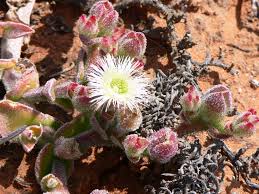
Aizoaceae is a large family of flowering plants, predominantly consisting of leaf succulents adapted to arid and semi-arid environments. Famous for genera like Lithops (Living Stones) and Mesembryanthemum (Ice Plants), the family exhibits remarkable diversity in succulent forms, particularly in its center of diversity in Southern Africa. They typically have showy, daisy-like flowers where the "petals" are actually modified stamens (staminodes).
Overview
The Aizoaceae family is substantial, containing roughly 120-140 genera and over 2,000 species. While found in arid regions of Australia and the Americas, and along coasts worldwide, the family's heartland and overwhelming center of diversity is Southern Africa, especially the Succulent Karoo and Namaqualand regions. These areas host an extraordinary radiation of succulent forms found nowhere else.
Members are typically annual or perennial herbs or subshrubs, highly adapted to drought conditions through succulence. Leaf forms vary dramatically, from flat blades to cylindrical, triangular, or highly reduced and fused structures mimicking pebbles (Lithops, Conophytum). Many possess specialized epidermal bladder cells that store water and give a glistening appearance, hence the common name "ice plants". Flowers are often brightly colored and open during sunny conditions.
Aizoaceae have significant horticultural importance, particularly the highly derived succulent genera ('mesembs') prized by collectors (Lithops, Conophytum, Faucaria, etc.) and more robust genera used as groundcover or ornamentals (Lampranthus, Delosperma, Carpobrotus). However, some species like Carpobrotus edulis have become highly invasive outside their native range, altering coastal ecosystems. Tetragonia tetragonioides (New Zealand Spinach) is cultivated as a leafy vegetable.
Quick Facts
- Scientific Name: Aizoaceae
- Common Name: Ice Plant family, Fig-Marigold family, Stone Plant family
- Number of Genera: Approximately 120-140
- Number of Species: Approximately 2000-2500
- Distribution: Primarily Southern Africa; also Australia, Americas, coastal regions globally. Arid/saline habitats.
- Evolutionary Group: Eudicots - Core Eudicots - Caryophyllales
Key Characteristics
Growth Form and Habit
The vast majority are succulent herbs or subshrubs, adapted to dry conditions. Habits range from prostrate, mat-forming annuals or perennials to small, cushion-forming plants or more erect subshrubs. Extreme succulence leads to unique forms like the "living stones" (Lithops) where the plant body is reduced to a pair of fused leaves.
Leaves
Leaves are typically opposite (sometimes alternate), simple, and usually fleshy/succulent. Their shape is highly variable: flat, cylindrical, three-angled (triquetrous), club-shaped, or reduced to fused pairs forming globose or conical bodies, sometimes with translucent 'windows' (Fenestraria). Epidermal bladder cells (idioblasts) that store water and glisten are common. Stipules are usually absent, but sometimes present and small/membranous.
Inflorescence
Flowers are often solitary and terminal or appearing axillary. They can also be arranged in simple or complex cymose inflorescences. Flowers are often large and showy relative to the plant size.
Flowers
Flowers are usually bisexual and actinomorphic (radially symmetrical), resembling daisies but structurally different. They are often brightly colored (yellow, pink, purple, magenta, orange, white) and typically open only in bright sunlight.
- Perianth: Generally considered to consist of a single whorl of 4-5 (up to 8) sepal-like lobes (tepals), often fleshy, fused below into a floral tube (hypanthium) which is often fused to the ovary wall.
- Petaloid Staminodes: The numerous, conspicuous "petals" are actually derived from sterile stamens (staminodes) which have become flattened and petal-like. They arise in several series from the rim of the hypanthium. True petals are considered absent.
- Androecium: Stamens are numerous (from few to hundreds), arising inside the petaloid staminodes from the hypanthium rim. Filaments are distinct; anthers dehisce via longitudinal slits.
- Gynoecium: The ovary is typically partly to wholly inferior (sometimes superior, e.g., Tetragonia), composed of (2-)5(-many) fused carpels. Locules usually equal the number of carpels, containing numerous ovules on axile or parietal placentae. Styles are distinct or fused basally, with linear or feathery stigmas.
Fruits and Seeds
The most characteristic fruit is a loculicidal capsule that exhibits hygrochasy: it opens when wet (often via complex mechanisms involving expanding keels) and closes when dry. This allows seeds to be dispersed by raindrops splashing them out (ombrohydrochory). Capsule structure is often complex and important for classification. Less commonly, the fruit can be a berry, nut, or circumscissile capsule (pyxis).
Seeds are typically small, numerous, kidney-shaped or rounded, with a curved embryo surrounding starchy perisperm.
Chemical Characteristics
Aizoaceae produce betalain pigments (red and yellow), characteristic of many Caryophyllales families. Many species are halophytes (salt-tolerant) and accumulate salts in their tissues, particularly in the bladder cells. Crassulacean acid metabolism (CAM photosynthesis) is common as an adaptation to arid environments. Calcium oxalate crystals are present.
Field Identification
Identifying Aizoaceae often relies on recognizing their succulent nature, distinctive flower structure, and habitat preferences:
Primary Identification Features
- Succulent Habit: Most members are clearly fleshy herbs or subshrubs.
- Opposite Leaves (Often): Many common genera have opposite leaf arrangement.
- Epidermal Bladder Cells: Look for glistening, bubble-like cells on the leaf surface of many species ("ice plants").
- Daisy-like Flowers: Showy flowers with numerous, narrow "petals".
- Petaloid Staminodes: Recognize that the apparent petals are modified sterile stamens.
- Numerous True Stamens: Look inside the petaloid structures for many functional stamens.
- Inferior/Half-Inferior Ovary (Usually): Check the position of the ovary relative to the base of the floral tube/staminodes.
- Hygrochastic Capsule: If fruits are present, look for woody capsules that open into distinct valves/compartments, especially when moist.
- Habitat: Often found in arid, semi-arid, or coastal saline environments, especially in Southern Africa.
Secondary Identification Features
- Leaf Forms: Note highly specialized forms like pebbles (Lithops), cones (Conophytum), windowed leaves (Fenestraria), or triangular leaves (Faucaria).
- Betalain Pigments: Bright yellow, magenta, pink flower colors are typical.
- Absence of Stipules (Usually).
Seasonal Identification Tips
- Year-round: Succulent leaves and growth forms are persistent identification features.
- Flowering Season: Highly variable, depends on species and climate (often spring or after rains in arid zones). Flowers are key for identification due to their structure.
- Fruiting Season: Capsules often persist on the plant for long periods, sometimes opening and closing repeatedly with moisture changes.
Common Confusion Points
- Asteraceae (Daisy family): True daisies have composite flower heads (capitula) made of many tiny individual florets (ray and disc), bracts forming an involucre below the head, and an inferior ovary typically producing an achene (cypsela) often with a pappus. Aizoaceae flowers are single flowers, albeit with many parts resembling petals/stamens.
- Cactaceae (Cactus family): Also succulent Caryophyllales. Cacti are typically stem succulents (leaves reduced or absent, spines produced from areoles), flowers usually have a perianth of many tepals grading from sepal-like to petal-like, and fruit is typically a berry.
- Portulacaceae sensu lato (Purslane family complex): Some members are succulent herbs with showy flowers (e.g., Portulaca, Lewisia). Flowers often have fewer petals (true petals, usually 4-6) and stamens, and fruit is often a circumscissile capsule (pyxis) or other types. Ovary can be superior or inferior.
- Crassulaceae (Stonecrop family): Also leaf succulents (Sedum, Echeveria, etc.). Flowers typically have parts in 4s or 5s (sepals, petals, stamens often equal or double petals), distinct carpels often only basally fused (superior ovary), and fruit usually follicles. Lack betalains (have anthocyanins).
Field Guide Quick Reference
Look For:
- Succulent herbs/subshrubs
- Opposite leaves (often), fleshy
- Glistening bladder cells (sometimes)
- Daisy-like flowers
- Numerous petaloid staminodes
- Numerous true stamens
- Ovary inferior/half-inferior (usually)
- Hygrochastic capsule (often)
Key Variations:
- Extreme leaf forms (pebbles, cones, windows)
- Flower color (yellow, pink, purple, white, etc.)
- Fruit type (capsule, berry, nut)
- Habit (mat-forming, cushion, shrubby)
- Presence/prominence of bladder cells
Notable Examples
Aizoaceae boasts incredible diversity, especially among its succulent members, alongside some widely known invasive species and a leafy vegetable:

Lithops sp.
Living Stones
Remarkable stemless succulents from Southern Africa where the plant body is reduced to a pair of fused, succulent leaves mimicking surrounding pebbles. The top surface often has patterned 'windows'. Brightly colored, daisy-like flowers emerge from the fissure between the leaves. Highly prized by succulent collectors.

Carpobrotus edulis
Hottentot Fig / Pigface / Ice Plant
A robust, mat-forming perennial succulent native to South Africa's Cape region. It has thick, three-sided leaves and large yellow or light pink flowers. Widely introduced globally for groundcover and soil stabilization, it has become a major invasive species in coastal ecosystems (e.g., California, Mediterranean).

Mesembryanthemum crystallinum
Common Ice Plant
An annual or biennial succulent native to Africa, Sinai and southern Europe, naturalized elsewhere. Famous for the prominent, glistening epidermal bladder cells covering its flat, wavy leaves, giving it an icy appearance. Often found in saline coastal or disturbed areas.

Conophytum sp.
Cone Plants / Button Plants
Another genus of highly miniaturized succulents from Southern Africa, related to Lithops. The fused leaf pairs typically form small globose, conical, or button-like bodies, often clustering densely. Flowers emerge from a central fissure. Like Lithops, they are popular among specialist collectors.

Delosperma cooperi
Hardy Ice Plant / Cooper's Ice Plant
A low-growing, mat-forming perennial succulent native to South Africa. Known for its resilience to cold compared to many other ice plants, making it popular in temperate rock gardens. Produces abundant, showy, bright purplish-pink flowers over a long season.

Tetragonia tetragonioides
New Zealand Spinach / Warrigal Greens
An annual or perennial trailing plant with triangular, somewhat fleshy leaves, native to New Zealand, Australia, and eastern Asia. Unlike most Aizoaceae, its flowers are inconspicuous and greenish-yellow, and the ovary is superior. Cultivated as a heat-tolerant substitute for spinach.
Phylogeny and Classification
Aizoaceae is firmly placed within the order Caryophyllales, a large and diverse group within the core eudicots known for adaptations to extreme environments and the presence of betalain pigments (in the core group). Within the Caryophyllales, Aizoaceae belongs to the core clade, often grouping with families like Phytolaccaceae, Nyctaginaceae, Cactaceae, and the Portulacineae clade (Portulacaceae sensu lato, Molluginaceae, etc.).
The internal classification of Aizoaceae is complex due to its large size and rapid diversification, particularly within the highly succulent 'mesemb' group (subfamily Ruschioideae). Traditionally, it was split into fewer subfamilies, but molecular data supports recognizing several subfamilies (e.g., Aizooideae, Mesembryanthemoideae, Ruschioideae, Sesuvioideae). The Ruschioideae subfamily contains the vast majority of species and the spectacular succulent diversity, including Lithops, Conophytum, and most horticulturally significant genera.
Position in Plant Phylogeny
- Kingdom: Plantae
- Clade: Angiosperms (Flowering plants)
- Clade: Eudicots
- Clade: Core Eudicots
- Order: Caryophyllales
- Family: Aizoaceae
Evolutionary Significance
Aizoaceae is highly significant for studying adaptation and diversification:
- Adaptive Radiation: Represents one of the most spectacular examples of adaptive radiation in plants, particularly the diversification of succulent forms in Southern Africa in response to aridification.
- Evolution of Succulence: Offers diverse examples of leaf succulence strategies, from simple fleshy leaves to highly derived structures like 'living stones'.
- Flower Evolution: Demonstrates the evolution of petal-like structures from stamens (staminodes), a parallel to similar developments in families like Cactaceae.
- Specialized Dispersal: The hygrochastic capsule is a remarkable adaptation for seed dispersal timed with rainfall in arid environments.
- CAM Photosynthesis: Widespread use of Crassulacean Acid Metabolism highlights physiological adaptations to water scarcity.