Trimeniaceae
(No common name / Trimenia Family)
Trimeniaceae is a small family of flowering plants belonging to the order Austrobaileyales, one of the earliest diverging lineages of extant angiosperms (often grouped within the basal ANITA grade). It contains only a single genus, Trimenia, with about 5-8 species of evergreen trees, shrubs, and lianas. The family has a disjunct distribution in eastern Australia, New Guinea, and nearby Pacific islands. Plants possess ethereal oils and flowers with relatively primitive features, such as numerous, spirally arranged tepals and stamens, and typically a single carpel.
Overview
Trimeniaceae represents a window into the early evolution of flowering plants. As part of the Austrobaileyales order, it sits near the base of the angiosperm phylogenetic tree, sister to the vast majority of living flowering plants (the Mesangiospermae). Its single genus, Trimenia, is found in rainforests, often at higher elevations, scattered across eastern Australia, New Guinea, New Caledonia, Fiji, Samoa, and the Marquesas Islands, indicating an ancient lineage with a fragmented distribution.
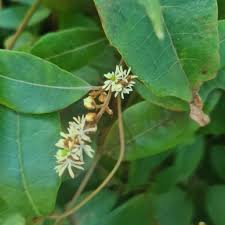
The plants are characterized by simple, usually opposite leaves and the presence of ethereal oil cells, making the foliage aromatic when crushed. Their flowers are small and possess features considered ancestral among angiosperms: numerous floral parts (tepals and stamens) that are often spirally arranged rather than in fixed whorls, undifferentiated perianth parts (tepals instead of distinct sepals and petals), and a simple gynoecium typically consisting of just a single carpel.
The family has no significant economic uses but is of great scientific importance for understanding the morphology, evolution, and biogeography of early angiosperms.
Quick Facts
- Scientific Name: Trimeniaceae
- Common Name: None widely accepted (sometimes Trimenia family)
- Number of Genera: 1 (Trimenia)
- Number of Species: Approximately 5-8
- Distribution: Disjunct: E. Australia, New Guinea, Pacific Islands (New Caledonia, Fiji, Samoa, Marquesas); rainforests.
- Evolutionary Group: Basal Angiosperms (ANITA grade) - Austrobaileyales
Key Characteristics
Habit
Plants are evergreen trees, shrubs, or lianas (woody vines). Tissues contain ethereal oil cells, often making them aromatic when crushed. Wood possesses vessels with scalariform perforation plates (considered a primitive feature).
Leaves
Leaves are simple, arranged oppositely or suboppositely on the stem. Leaf margins are entire (smooth) or toothed (serrate/dentate). Leaves often appear gland-dotted due to the ethereal oil cells. Stipules are absent (exstipulate).
Inflorescence
Flowers are borne in terminal or axillary branched inflorescences, typically panicles or cymes.
Flowers
Flowers are generally small, actinomorphic (radially symmetrical), and can be bisexual or unisexual (plants then dioecious or polygamous). They exhibit several features considered ancestral among flowering plants:
- Perianth: Composed of (2-) numerous (up to ~30+) tepals that are undifferentiated (not distinct sepals and petals) or weakly differentiated. Tepals are typically scale-like to somewhat petal-like, often greenish, whitish, or yellowish, and arranged spirally or in indistinct whorls.
- Androecium: Contains numerous (6 to ~25+) distinct (free) stamens, also often arranged spirally or in weak whorls. Filaments are typically short and stout; anthers are basifixed and dehisce via longitudinal slits.
- Gynoecium: The ovary is superior. It typically consists of only a single carpel (monocarpous), or rarely 2 fused carpels. The ovary is unilocular (single chamber) containing a single ovule that is pendulous from the apex. There is a single short style topped by a stigma that is often brush-like (penicillate) or lobed.
Fruits and Seeds
The fruit is a small, fleshy, single-seeded drupe or berry, often reddish or purplish-black when mature.
The seed contains copious oily or starchy endosperm and a small embryo.
Field Identification
Identifying Trimeniaceae involves recognizing its combination of vegetative features and primitive floral characteristics, along with its specific geographic distribution:
Primary Identification Features
- Numerous, Spirally Arranged Tepals & Stamens: Flowers have many parts not arranged in clear whorls (unlike most eudicots/monocots).
- Superior Ovary with Single Carpel (Usually): A simple pistil formed from one carpel is typical.
- Opposite, Simple Leaves: Leaves paired at nodes, undivided, often toothed or gland-dotted.
- Exstipulate: No stipules at the base of the petiole.
- Habit: Trees, shrubs, or lianas with aromatic tissues (when crushed).
- Fruit a Small Drupe/Berry: Single-seeded fleshy fruit.
- Geographic Location: Restricted to E. Australia, New Guinea, and certain Pacific Islands.
Secondary Identification Features
- Small Flowers in Panicles/Cymes: Inflorescence type.
- Scalariform Vessel Perforations: Wood anatomy feature (requires microscopy).
Seasonal Identification Tips
- Flowering Season: Flowers are needed to observe the key primitive features (numerous spiral parts, single carpel).
- Fruiting Season: Small drupes/berries aid identification.
- Vegetative State: Opposite, simple, exstipulate leaves, often aromatic, combined with location, are useful clues.
Common Confusion Points
- Other Austrobaileyales (Schisandraceae, Austrobaileyaceae): Share primitive features but differ in details. Schisandraceae (incl. Illiciaceae) often have alternate leaves and flowers with distinct carpels often arranged spirally; Austrobaileyaceae has alternate leaves and unique inner staminodes.
- Magnoliids (e.g., Magnoliaceae, Annonaceae, Lauraceae, Monimiaceae): Also possess ethereal oils and sometimes numerous floral parts. However, Magnoliaceae/Annonaceae typically have alternate leaves and flowers with numerous separate carpels on an elongated receptacle; Lauraceae have alternate leaves (usually), perianth typically 3-merous, and a single carpel but different stamen structure (valvular dehiscence); Monimiaceae often have opposite leaves but flowers develop within a cup-like receptacle (hypanthium) and have different carpel/stamen features.
- Some Eudicots with Opposite Leaves (e.g., Rubiaceae, some Cornaceae): Distinguished by having floral parts in definite whorls and numbers (e.g., 4- or 5-merous), usually distinct sepals and petals, syncarpous gynoecium with multiple carpels (often inferior in these examples), and lack numerous spirally arranged parts.
Field Guide Quick Reference
Look For:
- Tree/shrub/liana (E Aus/NG/Pacific)
- Aromatic tissues
- Opposite, simple leaves (entire/toothed)
- Exstipulate
- Small flowers in panicles/cymes
- Numerous spiral tepals
- Numerous spiral stamens
- Superior ovary, usually 1 carpel
- Fruit a small drupe/berry
Key Distinctions:
- vs. Most Angiosperms: Trimeniaceae has numerous spiral parts, often 1 carpel.
- vs. Magnoliids: Differ in leaf arrangement, carpel number/arrangement, stamen details.
- vs. Schisandraceae: Differ in leaf arrangement, carpel arrangement.
Notable Examples
The family consists of a single genus, Trimenia:

Trimenia moorei
(No common name)
A species found in rainforests of eastern Australia (Queensland, New South Wales). It grows as a shrub or small tree with opposite, often toothed leaves and panicles of small whitish flowers exhibiting the family's characteristic numerous tepals and stamens.

Trimenia papuana
(No common name)
Native to New Guinea and nearby islands. This species, often a tree or liana, showcases the family features, including opposite simple leaves and small flowers with numerous parts. Studies on its wood anatomy or chemistry contribute to understanding basal angiosperms.

Other Trimenia Species
(Pacific Islands)
Several other species are found on Pacific islands like New Caledonia, Fiji, Samoa, and the Marquesas. These species contribute to the family's disjunct distribution pattern and are crucial for biogeographic studies of early angiosperm lineages in the Pacific region.
Phylogeny and Classification
Trimeniaceae belongs to the order Austrobaileyales, which is one of the three orders comprising the "ANITA grade" (Amborellales, Nymphaeales, Austrobaileyales). These three orders represent the earliest diverging lineages of extant flowering plants (angiosperms), collectively sister to all other living angiosperms (the Mesangiospermae).
Within the Austrobaileyales, Trimeniaceae is sister to a clade containing the other two families in the order: Austrobaileyaceae (one species in Australia) and Schisandraceae (including Illiciaceae - Star Anise family, widespread). The order as a whole exhibits many features considered ancestral or "primitive" among angiosperms, such as ethereal oil cells, flowers with variable numbers of parts often arranged spirally, and relatively simple carpel structures.
Position in Plant Phylogeny
- Kingdom: Plantae
- Clade: Angiosperms (Flowering plants)
- Grade: Basal Angiosperms (ANITA grade)
- Order: Austrobaileyales
- Family: Trimeniaceae
Evolutionary Significance
Trimeniaceae is highly significant for understanding the early evolution of flowering plants:
- Basal Angiosperm Lineage: As part of the ANITA grade, it provides critical insights into the characteristics of early angiosperms, including floral structure, wood anatomy, and chemical composition.
- "Primitive" Traits: Exhibits features like numerous, spirally arranged floral parts, undifferentiated tepals, and simple carpel structure, which are considered ancestral states compared to the more fixed, whorled structures of most later-diverging angiosperms.
- Phylogenetic Position: Its placement within Austrobaileyales helps reconstruct the relationships among the earliest flowering plant lineages.
- Biogeography: Its fragmented distribution across the Southwest Pacific points to ancient origins and provides data for understanding Gondwanan biogeography and the dispersal of early angiosperms.