Schizaeaceae
Curlygrass Fern Family
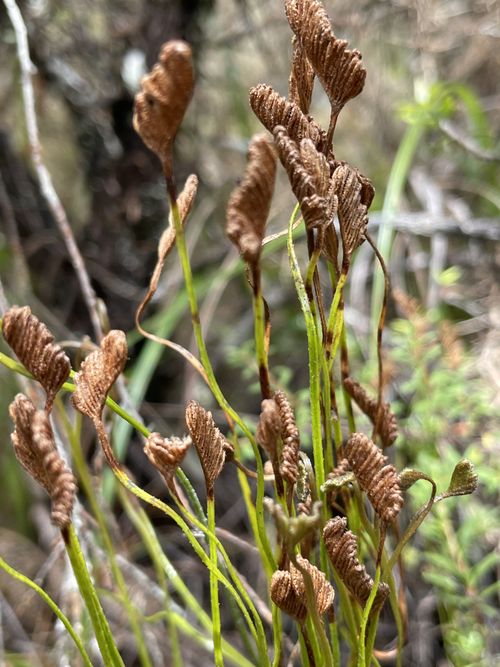
The Schizaeaceae is a unique and ancient family of ferns, often characterized by their unusual frond structures and sporangia borne on specialized pinnae or segments. Though small, the family exhibits significant morphological diversity, including climbing ferns (Lygodium) and diminutive, grass-like ferns (Schizaea).
Overview
The Schizaeaceae family belongs to the order Schizaeales, a basal lineage within the leptosporangiate ferns (Polypodiopsida). These ferns are primarily found in tropical and subtropical regions, with some species extending into temperate zones. They often grow in nutrient-poor, acidic soils, bogs, or as epiphytes.
Members of this family are notable for their distinctive reproductive structures. Unlike many ferns where sporangia are clustered in sori on the underside of vegetative fronds, Schizaeaceae typically bear their sporangia singly (not in sori) on specialized fertile segments or pinnae, which often look very different from the sterile portions of the frond. The sporangia themselves are also characteristic, often large and lacking a well-defined annulus or having an apical/subapical one.
The family includes genera with vastly different appearances. Lygodium species are climbing ferns with indeterminate frond growth, allowing them to twine and reach significant heights. In contrast, Schizaea species are often small, with highly reduced, grass-like or fan-shaped fronds. Anemia is known for its dimorphic fronds where the fertile pinnae are erect and distinct from the sterile ones. This morphological diversity highlights the long evolutionary history of the family.
Quick Facts
- Scientific Name: Schizaeaceae
- Common Name: Curlygrass fern family, Comb fern family
- Number of Genera: Approximately 4 (Schizaea, Lygodium, Anemia, Mohria)
- Number of Species: Around 150-200
- Distribution: Primarily tropical and subtropical, with some temperate species. Found worldwide but often localized.
- Evolutionary Group: Polypodiopsida (Leptosporangiate Ferns) - Schizaeales
Key Characteristics
Growth Form and Habit
Schizaeaceae exhibit diverse habits. Most are terrestrial ferns growing from creeping or erect rhizomes, which are often covered in hairs (not scales, unlike many other ferns). Lygodium species are unique climbers with fronds of indeterminate growth, while Schizaea species are typically small, sometimes diminutive, herbs. Anemia and Mohria are more typical terrestrial ferns in overall form.
Fronds (Leaves)
Fronds vary dramatically across the family. They can be:
- Dimorphic: Sterile and fertile fronds look different (common in Anemia, Schizaea).
- Monomorphic: Sterile and fertile fronds look similar (some Lygodium, Mohria).
- Highly modified: In Schizaea, sterile fronds can be simple and grass-like (filiform) or fan-shaped (flabellate), while fertile segments are digitate or pinnate projections.
- Indeterminate growth: In Lygodium, the rachis (main frond axis) twines and grows indefinitely, with determinate pinnae branching off.
Sporangia and Fertile Structures
This is a key diagnostic feature. Sporangia are not typically grouped into sori. Instead, they are borne singly or in rows along the veins of specialized fertile segments or pinnae. These fertile portions are often highly modified and distinct from the vegetative parts of the frond.
- In Schizaea, sporangia are borne on small, pinnately arranged segments at the apex of the fertile frond.
- In Lygodium, sporangia occur on small lobes (sorophores) along the margins of fertile pinnae.
- In Anemia, the two lowermost pinnae are typically modified into erect, paniculate fertile structures bearing the sporangia, while the rest of the frond is sterile and leaf-like.
- In Mohria, sporangia are borne on the underside of relatively unmodified pinnae, sometimes appearing sorus-like but lacking true indusia.
The sporangia themselves are relatively large, sessile or short-stalked, and possess an annulus that is apical or subapical (transverse) and composed of a single row of thickened cells, or the annulus may be indistinct.
Spores
Spores are typically monolete (bilateral) or trilete (tetrahedral), depending on the genus. Spore ornamentation varies and can be useful for species identification. For example, Anemia spores are often ridged or tuberculate, while Schizaea spores can be smooth or striate.
Gametophytes
The gametophytes (prothalli) of Schizaeaceae can also be unusual. Some are subterranean and mycorrhizal (associated with fungi), while others are filamentous or thalloid surface-dwelling structures.
Chemical Characteristics
Less is known about the specific secondary metabolites compared to flowering plants. However, like other ferns, they possess various phenolic compounds and terpenoids. Some species may contain compounds with traditional medicinal uses or potential bioactivity.
Field Identification
Identifying members of the Schizaeaceae family often relies on observing their unique frond morphology and the arrangement of sporangia. Here are key features to look for:
Primary Identification Features
- Sporangia placement: Look for sporangia borne singly (not in sori) on highly modified, specialized fertile segments or pinnae, often distinct from the sterile parts of the frond (e.g., apical spikes in Schizaea, erect fertile pinnae in Anemia, marginal lobes in Lygodium).
- Frond structure: Note unusual frond forms like the climbing, indeterminate fronds of Lygodium, or the grass-like or fan-shaped fronds of Schizaea. Check for strongly dimorphic fronds.
- Rhizome covering: Observe hairs on the rhizome and stipe bases, rather than scales.
- Sporangia structure: If magnification is possible, look for large sporangia with an apical/subapical transverse annulus.
Secondary Identification Features
- Habit: Is it a climbing fern (likely Lygodium) or a small, terrestrial, grass-like fern (likely Schizaea)?
- Frond dissection: Note the pattern of division in sterile fronds (simple, pinnate, palmate).
- Habitat: Many species prefer specific habitats like bogs, swamps, or nutrient-poor soils.
Seasonal Identification Tips
Identification typically requires mature fronds with fertile structures:
- Growing Season: Look for developing and mature fronds. Fertile structures are usually most apparent during the main growing season (often summer or wet season in the tropics).
- Dry Season/Winter: Persistent dead fronds might retain some identifiable features, especially the hardened fertile segments of some species. Rhizomes are perennial.
Common Confusion Points
- Other ferns with dimorphic fronds: Some Osmundaceae (e.g., Osmunda) or Blechnaceae have dimorphic fronds, but their sporangia arrangement and structure differ (e.g., sori along midrib in Blechnum, different sporangia in Osmunda).
- Grasses or Sedges: Sterile, grass-like Schizaea species can be easily overlooked or mistaken for monocots until fertile fronds are found.
- Climbing Vines: Sterile Lygodium might be confused with other climbing plants, but the pinnately compound structure arising from a twining rachis is characteristic of ferns.
Field Guide Quick Reference
Look For:
- Sporangia on specialized fertile segments/pinnae, not in typical sori
- Hairs on rhizomes/stipes (not scales)
- Unusual frond forms (climbing, grass-like, fan-shaped)
- Dimorphic fronds (distinct sterile/fertile parts)
- Large sporangia with apical/transverse annulus (if visible)
Key Variations (Genera):
- Schizaea: Small, grass-like or fan-shaped fronds; sporangia on apical fertile spikes.
- Lygodium: Climbing ferns with indeterminate rachis; sporangia on marginal lobes of pinnae.
- Anemia: Terrestrial; sterile fronds pinnate; 2 erect, distinct fertile pinnae.
- Mohria: Terrestrial; fronds pinnately compound, somewhat scaly/hairy; sporangia on underside of less modified pinnae.
Notable Examples
The Schizaeaceae family includes several fascinating genera with distinct characteristics:

Schizaea
Curlygrass Fern
This genus includes small, often inconspicuous ferns. Sterile fronds can be simple and grass-like (e.g., S. pusilla) or fan-shaped (e.g., S. elegans). The fertile fronds bear sporangia on distinct, digitate or pinnately arranged segments at the apex. They often grow in bogs, sandy soils, or on tree fern trunks.

Lygodium
Climbing Fern
These are unique ferns with a climbing habit. The frond's rachis twines around supporting vegetation and exhibits indeterminate growth. Pinnately compound pinnae branch off the main rachis. Sporangia are borne on small lobes (sorophores) on the margins of fertile pinnae. Some species, like L. japonicum and L. microphyllum, can become invasive outside their native range.

Anemia
Flowering Fern (misnomer)
Often called "flowering ferns" due to their erect, distinct fertile pinnae that can resemble flower stalks. Typically terrestrial ferns with pinnately divided sterile fronds arising from a hairy rhizome. The two lowermost pinnae are modified into long-stalked, highly divided fertile structures bearing rows of sporangia. Found mainly in the American tropics and subtropics.

Mohria
Scented Fern
This genus is primarily found in Africa and islands in the Indian Ocean. They are terrestrial ferns with pinnately compound, somewhat leathery fronds that are often aromatic when crushed. Unlike Anemia, the fertile pinnae are less modified, with sporangia borne on the underside, sometimes appearing sorus-like but lacking true indusia. Often found in rocky habitats or grasslands.
Phylogeny and Classification
Schizaeaceae is placed within the order Schizaeales, which represents an early diverging lineage among the leptosporangiate ferns (Polypodiopsida). This order also includes the families Lygodiaceae and Anemiaceae, which were previously often included within a broader Schizaeaceae but are now typically treated as distinct families by many classifications (like PPG I). In the context used here (following older, broader classifications or for simplicity), Schizaeaceae includes these diverse genera.
Molecular phylogenetic studies confirm the Schizaeales as a monophyletic group, sister to the core leptosporangiate ferns. The distinct morphology of the sporangia (large, sessile/subsessile, with transverse apical annulus) and the unique fertile structures are key characteristics of this ancient lineage, whose fossil record extends back to the Mesozoic era.
Position in Plant Phylogeny
- Kingdom: Plantae
- Clade: Tracheophytes (Vascular plants)
- Class: Polypodiopsida (Leptosporangiate ferns)
- Order: Schizaeales
- Family: Schizaeaceae (sensu lato, including Lygodium, Anemia, Mohria)
Evolutionary Significance
The Schizaeaceae (and the order Schizaeales) are significant for understanding fern evolution:
- Basal Lineage: They represent an early branch within the leptosporangiate ferns, retaining some potentially ancestral traits.
- Morphological Diversity: The wide range of forms (climbers, grass-like, typical ferns) within a relatively small family highlights evolutionary experimentation.
- Unique Reproductive Structures: The specialized fertile segments and sporangia structure differ markedly from the more common soral arrangements in derived ferns.
- Ancient Fossil Record: Fossils related to Schizaeales date back to the Mesozoic, providing insights into the early evolution of modern ferns.