Gleicheniaceae
Forking Fern Family / Coral Fern Family
Gleicheniaceae is a family of leptosporangiate ferns belonging to the order Gleicheniales, easily recognized by their unique pseudodichotomous ("forking") frond architecture. These terrestrial ferns typically have long-creeping rhizomes covered in scales or hairs, often forming dense, scrambling thickets. Their sori (spore clusters) are circular, lack indusia (protective coverings), and contain relatively few, large sporangia. Gleicheniaceae are often pioneer species, colonizing open, disturbed, or nutrient-poor sites in tropical, subtropical, and some temperate regions worldwide.
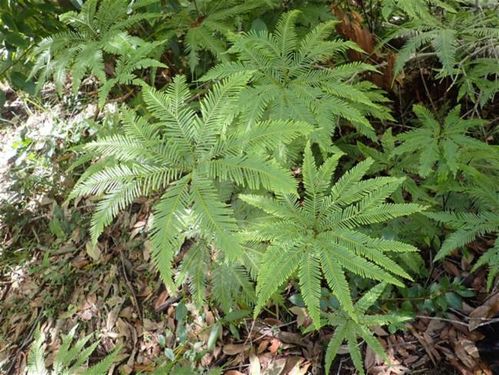
Overview
The Gleicheniaceae family, commonly known as forking ferns, represents an early diverging lineage within the leptosporangiate ferns (Polypodiidae). Their most striking characteristic is the unique way their fronds branch. Instead of continuous growth along a central axis, the apical bud typically aborts or becomes dormant, while pairs of lateral buds below it develop, resulting in a repeated pseudodichotomous or forked appearance. In some species, this pattern allows for indeterminate growth, leading to the formation of extensive, tangled thickets that can cover large areas.
These ferns are primarily terrestrial and possess long-creeping rhizomes, which contribute to their ability to spread and form dense colonies. They are often found in sunny, open habitats, road cuts, landslides, or areas with poor soil, acting as pioneer species. The family is distinguished reproductively by its simple, circular sori that lack indusia and contain only a small number of relatively large sporangia for a leptosporangiate fern.
Quick Facts
- Scientific Name: Gleicheniaceae
- Common Name: Forking Fern Family, Coral Fern Family
- Number of Genera: Approximately 6
- Number of Species: Approximately 150-160
- Distribution: Pantropical, extending into subtropical and temperate regions; often in open/disturbed habitats.
- Evolutionary Group: Ferns (Division Pteridophyta / Monilophyta, Class Polypodiopsida, Subclass Polypodiidae, Order Gleicheniales, Type: Leptosporangiate)
Key Characteristics
Rhizome and Habit
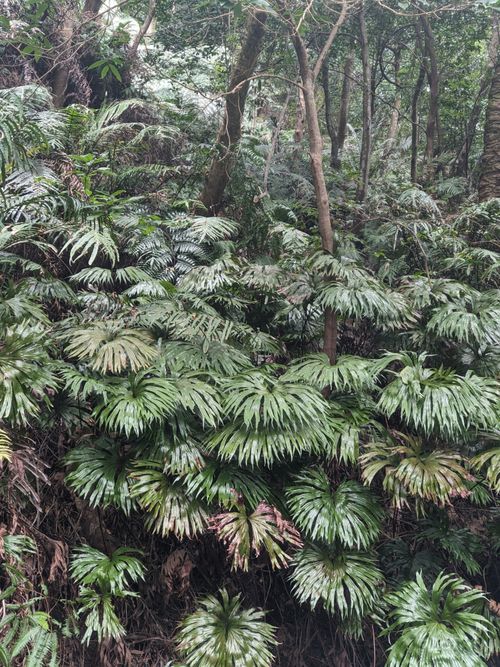
Plants are terrestrial ferns with long-creeping, often dichotomously branching rhizomes. Rhizomes are protostelic (having a simple, solid core of vascular tissue) and covered with conspicuous scales or multicellular hairs/bristles. They typically form dense, often scrambling or climbing thickets, sometimes meters high, due to the indeterminate growth of fronds in some species.
Fronds (Leaves)
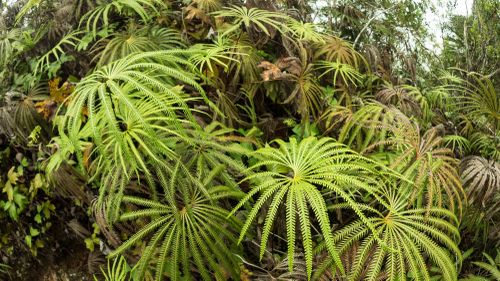
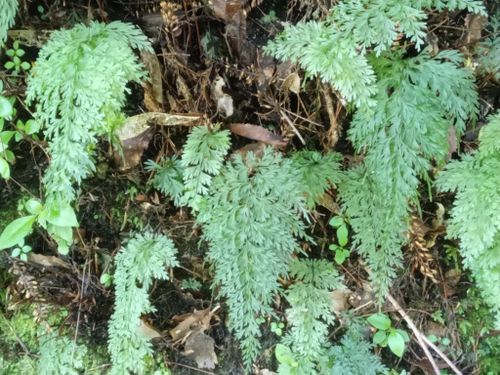
Fronds exhibit a highly characteristic architecture based on pseudodichotomous branching. The apical bud of the rachis (main axis) or lower pinna axes typically aborts or becomes dormant (often protected by scales/hairs), while a pair of lateral axes below it develop equally, creating a fork. This pattern may be repeated multiple times. Fronds can be determinate or indeterminate in growth. The ultimate segments (pinnules) are usually small, often roundish, oblong, or linear, and typically pectinate (comb-like) or lobed. Venation is free. Young fronds show circinate vernation. Petioles are often wiry.
Reproductive Structures (Sori and Sporangia)
Reproduction is via spores produced in leptosporangia. The sporangia are grouped into round sori located on the abaxial (lower) surface of the pinnules, away from the margin (superficial), often arranged in a single row on either side of the costule (midvein of the segment). A defining feature is the complete lack of an indusium (sori are exindusiate).
Each sorus contains relatively few sporangia (typically 2-15), which are large compared to those of many other leptosporangiate ferns. The sporangia mature simultaneously within a sorus and possess a complete, transverse or slightly oblique annulus that facilitates dehiscence.
Spores can be monolete or trilete, depending on the genus, and are typically non-green. The gametophyte generation is surface-dwelling, green, thalloid, and often strap-shaped or lobed.
Field Identification
Identifying Gleicheniaceae is usually straightforward due to their unique forking frond structure and growth habit. Confirming features include the sorus characteristics.
Primary Identification Features
- Pseudodichotomous Frond Branching: The repeated forking pattern is the most distinctive characteristic. Look for dormant buds in the axils of the forks.
- Thicket-Forming Habit: Plants often form dense, scrambling colonies via long-creeping rhizomes.
- Circular, Superficial Sori: Sori are round and located on the underside of segments, away from the margin.
- Exindusiate Sori: Sori lack any protective indusium.
- Scaly or Hairy Rhizomes: Rhizomes are covered with scales or bristly hairs.
Secondary Identification Features
- Small Ultimate Segments: The final leaflets (pinnules) are typically small and often lobed or pectinate.
- Pioneer Habitat: Frequently found in open, sunny, disturbed areas or on poor soils.
- Relatively Few, Large Sporangia per Sorus: Visible with a good hand lens.
Seasonal Identification Tips
- Year-Round Visibility: The distinctive frond structure and often persistent fronds make identification possible year-round.
- Fiddleheads: Young, coiled fronds show circinate vernation.
- Fertile Fronds: Look for the characteristic round, naked sori on the underside of pinnules to confirm identification.
Common Confusion Points
- Other Ferns with Highly Divided Fronds: Some ferns (e.g., Bracken - Pteridium in Dennstaedtiaceae) form thickets but lack the regular pseudodichotomous branching and have different sorus structures (marginal, linear, with indusia).
- Lygodium (Lygodiaceae): Climbing ferns with indeterminate frond growth, but the branching pattern is different (typically pinnate off a climbing rachis), and sporangia are borne differently (on marginal lobes).
- Staghorn Ferns (Platycerium - Polypodiaceae): Epiphytic ferns with forking fronds, but structure, habit, and sporangial patches are very different.
Field Guide Quick Reference
Look For:
- Terrestrial fern forming thickets
- Forking frond structure (pseudodichotomous)
- Long-creeping rhizome with scales or hairs
- Small ultimate segments (pinnules)
- Round sori on underside, away from margin
- No indusium (exindusiate)
- Often in open, sunny, or disturbed habitats
Key Variations:
- Rhizome covering (scales vs. hairs)
- Degree of frond dissection
- Determinate vs. indeterminate frond growth
- Pinnule shape and lobing
Notable Examples
The family includes several genera distinguished by rhizome coverings, pinnule shape, and spore type.

Gleichenia Sm.
Coral Fern (Genus; species include G. polypodioides, G. microphylla)
Characterized by rhizomes covered in scales (not hairs) and ultimate segments (pinnules) that are typically rounded or oblong and pouch-like below. Spores are monolete. Found mainly in the Southern Hemisphere.

Dicranopteris Bernh.
Umbrella Fern (Genus; species include D. linearis, D. flexuosa)
Distinguished by rhizomes covered primarily in hairs (not scales). Fronds fork repeatedly, often with accessory branches at the forks. Pinnules are typically linear and pectinate. Spores are trilete. Widespread in tropical and subtropical regions, often forming large roadside thickets.

Sticherus C.Presl
Shield Fern / Umbrella Fern (Genus; species include S. cunninghamii, S. flabellatus)
Similar to Gleichenia with rhizomes covered in scales, but differs in having ultimate segments that are typically flat or only slightly convex below, not pouch-like. Spores are monolete. Widely distributed, especially diverse in the Neotropics and Australasia.
Phylogeny and Classification
Gleicheniaceae is the largest family in the order Gleicheniales, an early diverging lineage within the subclass Polypodiidae (leptosporangiate ferns). This order represents one of the basal branches in the phylogeny of modern ferns, separating before the diversification of the vast majority of families within the Polypodiales.
The unique pseudodichotomous frond architecture is a key synapomorphy (shared derived trait) for the order. Related families sometimes included in or near Gleicheniales are Dipteridaceae and Matoniaceae, which share some primitive characteristics. The order Gleicheniales stands distinct from other early leptosporangiate lineages like Hymenophyllales and Schizaeales.
Position in Plant Phylogeny
- Kingdom: Plantae
- Division: Pteridophyta / Monilophyta (Ferns and Allies)
- Class: Polypodiopsida
- Subclass: Polypodiidae (Leptosporangiate Ferns)
- Order: Gleicheniales
- Family: Gleicheniaceae
Evolutionary Significance
Gleicheniaceae offers important insights into fern evolution:
- Basal Leptosporangiate Lineage: Represents an early branch in the evolution of leptosporangiate ferns, retaining some potentially ancestral features (e.g., relatively large sporangia, simple sorus structure).
- Unique Frond Architecture: The pseudodichotomous branching with dormant apical buds is a highly specialized and successful growth strategy, particularly for forming dense colonies and scrambling growth.
- Pioneer Ecology: Their ability to colonize open, disturbed, or nutrient-poor habitats highlights adaptations for stress tolerance and competitive ability in certain environments.
- Fossil Record: The Gleicheniales lineage has a long fossil history, helping to trace the evolution of ferns through geological time.