Scapaniaceae
Earwort Family
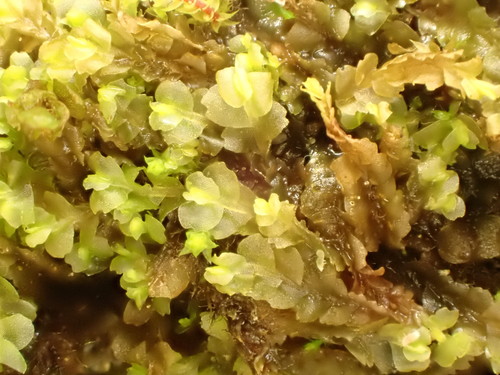
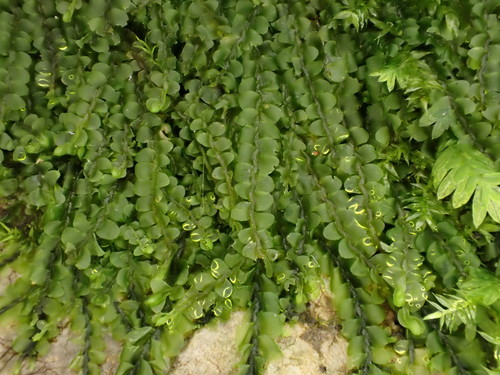
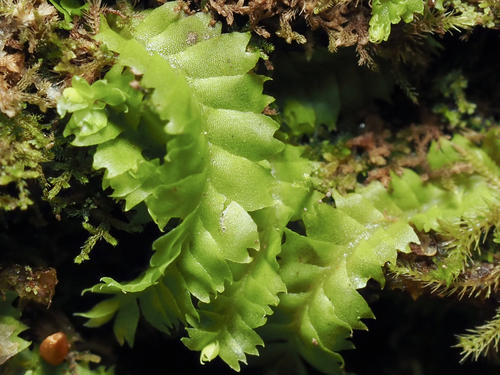
Scapaniaceae is a large and primarily Northern Hemisphere family of leafy liverworts, commonly known as earworts. Its most distinctive feature is the complicate-bilobed leaf structure, where each leaf is folded along a keel into a smaller dorsal lobe and a larger ventral lobe, resembling a pair of ears. They typically lack underleaves and often reproduce asexually via gemmae.
Overview
The Scapaniaceae, or Earwort family, is a major group of liverworts, particularly diverse in temperate, boreal, arctic, and alpine regions of the Northern Hemisphere. The family, dominated by the large genus Scapania, is readily recognized by its unique complicate-bilobed leaves. Each leaf is sharply folded along a central line (the keel), forming two distinct lobes: a smaller upper (dorsal) lobe and a larger lower (ventral) lobe. This structure is thought to enhance water retention or optimize light capture.
Scapaniaceae species inhabit a wide range of environments, commonly growing on moist soil banks, rocks, cliffs, decaying logs, tree bases, and peatlands. They vary in size from small to quite large and often exhibit characteristic coloration, including green, yellow-brown, reddish, or purplish hues. Underleaves are typically absent or reduced to tiny scales, further emphasizing the paired appearance of the leaf lobes. Asexual reproduction through gemmae, often produced along leaf margins, is very common in many species.
Phylogenetically placed in the suborder Jungermanniineae, Scapaniaceae represents a significant evolutionary radiation characterized by the specialized complicate-bilobed leaf form. They are ecologically important components of many Northern Hemisphere ecosystems.
Quick Facts
- Scientific Name: Scapaniaceae
- Common Name: Earwort Family
- Number of Genera: Approximately 5-6 (e.g., Scapania, Diplophyllum)
- Number of Species: Approximately 100+
- Distribution: Primarily Northern Hemisphere (temperate, boreal, arctic, alpine); some in S. Hemisphere mountains
- Evolutionary Group: Liverworts (Marchantiophyta) - Jungermanniopsida - Jungermanniineae
Key Characteristics
Gametophyte Form and Habit
Plants are small to large, typically forming mats, turfs, or growing as individual shoots. Color varies widely: green, yellowish-green, reddish-brown, purplish, or nearly black. Stems are prostrate to ascending or erect, with branching often lateral (Frullania-type) or terminal (forking).
Leaves and Underleaves
Leaves are arranged succubously. The defining feature is that they are complicate-bilobed: folded sharply or sometimes roundly along a keel into two distinct lobes. The dorsal (upper) lobe is typically smaller than the ventral (lower) lobe. The size, shape, orientation, and marginal dentition (teeth/cilia) of these lobes are crucial for species identification. Underleaves are characteristically absent or rudimentary (reduced to small scales or slime papillae), very rarely larger.
Rhizoids
Rhizoids are usually colorless or brownish, typically scattered along the ventral side of the stem or sometimes arising from ridges or leaf bases.
Cellular Structure
Leaf cells are typically isodiametric to slightly elongated, usually with distinct, sometimes bulging trigones. Cell walls may be thin or evenly thickened. Oil bodies are present, varying in number, size, and structure among species. The cuticle can be smooth or papillose.
Asexual Reproduction
Asexual reproduction via gemmae is very common in many species, especially in the genus Scapania. Gemmae are typically 1-2 celled, often angular or polyhedral, and usually produced in clusters along the margins of the upper leaves or on specialized gemmiferous shoots.
Reproductive Structures
Plants are mostly dioicous, less commonly monoicous.
- Antheridia are borne in the axils of saccate bracts, typically forming intercalary spikes on main stems or branches. Bracts often resemble vegetative leaves but may be more inflated.
- Archegonia are terminal on main shoots or leading branches, surrounded by several pairs of bracts that are usually larger and sometimes differently shaped than vegetative leaves.
- A prominent perianth is present. It is characteristically strongly flattened dorsiventrally (compressed parallel to the stem/substrate), often appearing wide and truncate at the mouth. The mouth is typically broad, often bilabiate or entire, and usually ciliate or dentate. Marsupia are absent.
Sporophytes and Spores
The sporophyte develops within the flattened perianth. The seta is relatively long. The capsule is typically ovoid, with a wall composed of multiple (3-6) layers of cells. Dehiscence occurs via four valves.
Field Identification
Identifying Scapaniaceae relies heavily on recognizing the unique complicate-bilobed leaf structure. A hand lens is usually sufficient to see this key feature.
Primary Identification Features
- Leaves: Distinctly complicate-bilobed - folded along a keel into a smaller dorsal lobe and a larger ventral lobe. Arrangement is succubous.
- Underleaves: Effectively absent or rudimentary. Shoots appear 2-ranked due to the prominent lateral leaves.
- Perianth (if fertile): Strongly flattened dorsiventrally, often wide-mouthed.
- Gemmae: Often present as clusters (sometimes colored) along the margins of upper leaves.
- Habitat: Diverse, but common on soil banks, rocks, logs in temperate to arctic/alpine zones.
Secondary Identification Features
- Leaf Margins: Often toothed or ciliate (check lobe margins).
- Color: Frequently with reddish, purplish, or brownish pigmentation.
- Cell Walls (Microscopic): Usually with trigones.
Seasonal Identification Tips
Scapaniaceae gametophytes are perennial and identifiable year-round:
- Year-Round: The complicate-bilobed leaf structure is the constant, key identifier.
- Growth Periods: Gemmae production may be more prolific during favorable conditions (moisture, light).
- Reproduction: Perianths and sporophytes are most likely found after periods of growth, but identification usually relies on vegetative features.
Common Confusion Points
The complicate-bilobed leaf is quite distinctive, but confusion can occur:
- Radulaceae (Radula): Also has complicate-bilobed leaves (dorsal lobe, smaller ventral lobule), but leaves are incubous, plants lack underleaves entirely, rhizoids arise only from the lobule, and the perianth is different (flattened but tubular below).
- Porellaceae/Frullaniaceae/Lejeuneaceae: Have complicate-bilobed leaves (lobe and lobule), but leaves are incubous, underleaves are usually present (though sometimes small), and perianth structures differ.
- Lophoziaceae: Have succubous leaves and often lack underleaves, but leaves are simply lobed or unlobed, NOT complicate-bilobed. Perianth usually not strongly flattened.
- Jungermanniaceae: Leaves usually entire or shallowly bilobed, not complicate-bilobed; underleaves absent.
Field Guide Quick Reference
Look For:
- Complicate-bilobed leaves (folded into dorsal & ventral lobes)
- Succubous leaf arrangement
- Underleaves absent/rudimentary
- Often toothed leaf margins
- Flattened perianth (if fertile)
- Gemmae often on leaf margins
- Terrestrial/epilithic habitats common
Key Distinctions:
- Complicate-bilobed leaves (vs. simple lobes/entire leaves)
- Succubous insertion (vs. incubous in Radula, Porellales)
- Underleaves absent/tiny (vs. present/large in Geocalycaceae)
- Flattened perianth (vs. trigonous/cylindrical)
Notable Examples
The family is dominated by Scapania, with Diplophyllum also being common:

Scapania spp. (e.g., S. nemorea, S. undulata)
Earworts
The largest genus, with many species varying in size, color, and habitat. Found on soil, rocks, logs. All share the characteristic complicate-bilobed leaves with a distinct keel. Leaf lobe margins are often toothed or ciliate. Gemmae are frequently produced, often reddish or brown.

Diplophyllum spp. (e.g., D. albicans, D. taxifolium)
Double-leaf Earworts
Similar to Scapania with complicate-bilobed leaves and lack of underleaves. Often distinguished by the dorsal lobe being nearly as long as the ventral lobe (though narrower) and often pointing more upwards. D. albicans is very common on acidic soil banks and has a distinctive whitish nerve-like band (vitta) of elongated cells in the leaves.
Phylogeny and Classification
Scapaniaceae is classified within the liverwort division Marchantiophyta, class Jungermanniopsida, and order Jungermanniales. It is a core member of the suborder Jungermanniineae. Molecular phylogenetics strongly supports the monophyly of the family and its placement within this suborder, closely related to families like Lophoziaceae and Jungermanniaceae.
The evolution of the distinctive complicate-bilobed leaf is the defining feature of this lineage. This structure has likely arisen independently in other liverwort groups (like Radulaceae and Porellales), representing a case of convergent evolution. Within Scapaniaceae, variations in lobe shape, size, marginal dentition, and keel structure reflect diversification across numerous species adapted to different ecological niches.
Position in Plant Phylogeny
- Kingdom: Plantae
- Clade: Embryophytes (Land Plants)
- Division: Marchantiophyta (Liverworts)
- Class: Jungermanniopsida
- Order: Jungermanniales
- Suborder: Jungermanniineae
- Family: Scapaniaceae
Evolutionary Significance
Scapaniaceae is significant for:
- Complicate-Bilobed Leaves: Represents a major evolutionary innovation in leaf structure within Jungermanniales, likely conferring ecological advantages.
- Northern Hemisphere Diversity: A highly successful and diverse family, particularly prominent in temperate, boreal, and arctic/alpine ecosystems of the Northern Hemisphere.
- Asexual Reproduction: Widespread reliance on gemmae contributes to their ecological success and presents taxonomic challenges.
- Ecological Roles: Important colonizers and components of bryophyte communities on soil, rock, and wood.