Geocalycaceae
Pouchwort / Crestwort Family
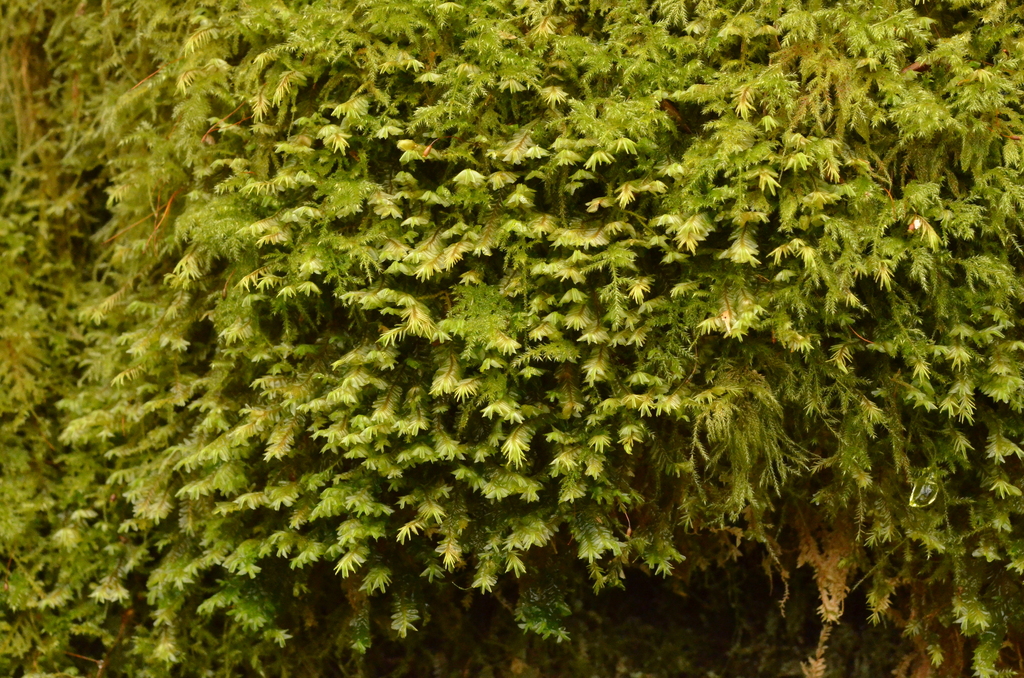
Geocalycaceae is a large and diverse family of leafy liverworts within the order Jungermanniales, often encompassing the formerly separate family Lophocoleaceae. Found worldwide in various habitats, its members are characterized by succubous leaves, typically large and bifid underleaves, and reproductive structures protected by either a perianth or a specialized subterranean pouch called a marsupium.
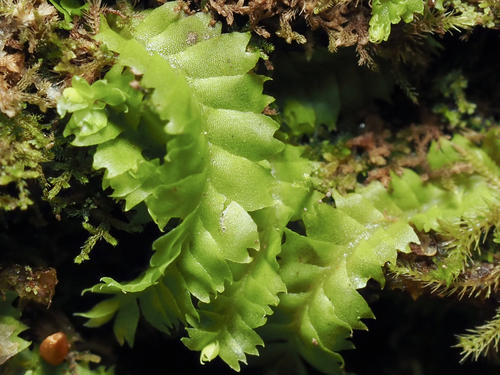
Overview
The Geocalycaceae family (often including Lophocoleaceae) represents a significant component of bryophyte diversity across the globe. With several hundred species in numerous genera like Lophocolea, Chiloscyphus, and Geocalyx, this family exhibits considerable morphological variation and occupies a wide range of ecological niches, from soil and rocks to decaying wood and tree bark.
Key unifying features include the succubous arrangement of leaves, which are often bilobed, and the presence of typically large, bifid underleaves that are frequently fused (connate) with the lateral leaves. Rhizoids are characteristically restricted to the base of these underleaves. The family is particularly interesting for its variation in structures protecting the developing sporophyte: many genera possess a typical tubular perianth, while others, like Geocalyx and Saccogyna, develop a marsupium – a fleshy pouch that grows downwards into the substrate, protecting the archegonia and later the sporophyte.
Geocalycaceae are ecologically important as primary colonizers, soil stabilizers, and contributors to nutrient cycling in various ecosystems. Their diversity and range make them a significant group for studies in bryophyte taxonomy, evolution, and ecology.
Quick Facts
- Scientific Name: Geocalycaceae (incl. Lophocoleaceae)
- Common Name: Pouchwort Family / Crestwort Family
- Number of Genera: Approximately 15-20
- Number of Species: Several hundred
- Distribution: Cosmopolitan (worldwide), diverse in temperate and tropical regions
- Evolutionary Group: Liverworts (Marchantiophyta) - Jungermanniopsida - Lophocoleineae
Key Characteristics
Gametophyte Form and Habit
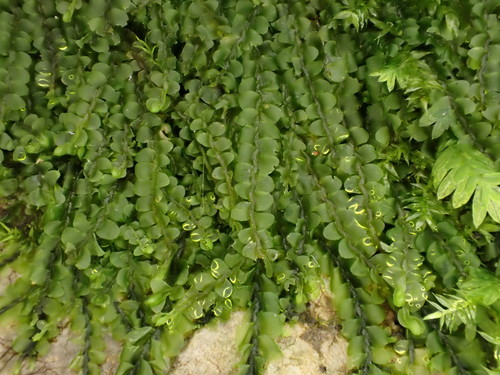
Plants range from small to medium-sized, typically forming creeping or ascending mats or patches. Colors vary from pale or whitish-green to yellowish-green, olive-green, or brownish. Stems are prostrate to ascending, with branching frequently ventral-intercalary (originating from ventral stem segments) or sometimes lateral (Frullania-type). They grow on diverse substrates like soil, humus, decaying wood, rocks, and tree bases/trunks.
Leaves and Underleaves
Leaves are arranged succubously. Leaf shape is variable, commonly bilobed (often shallowly), but can also be entire or occasionally multi-lobed or toothed. Underleaves are almost always present and are typically large and conspicuous relative to the stem width. They are usually deeply bifid (split into two lobes), though sometimes entire or multi-lobed. A key feature is that underleaves are often connate (fused) at their base with the lateral leaves on one or both sides.
Rhizoids
Rhizoids, which anchor the plant, are typically colorless and arise in distinct fascicles (bundles) only from the base of the underleaves, not scattered along the ventral stem surface.
Cellular Structure
Leaf cells are generally isodiametric to slightly elongated, usually thin-walled, but sometimes with trigones (corner thickenings). Oil bodies are present in the cells, varying in number, size, shape (e.g., granular, segmented, homogeneous), and persistence, providing important taxonomic characters.
Reproductive Structures
Plants may be dioicous (separate male and female plants) or monoicous (both sexes on the same plant).
- Antheridia are usually located in the axils of modified dorsal leaves (bracts), forming intercalary spike-like structures (androecia) along the stem or branches.
- Archegonia are terminal on main shoots or branches, surrounded by protective bracts and bracteoles (female involucre) that often resemble larger versions of the vegetative leaves and underleaves.
- Protection for the developing sporophyte varies:
- Perianth: Many genera (e.g., Lophocolea, Chiloscyphus) have a well-developed, typically tubular or inflated perianth, often 3-keeled (trigonous) and contracted towards the mouth.
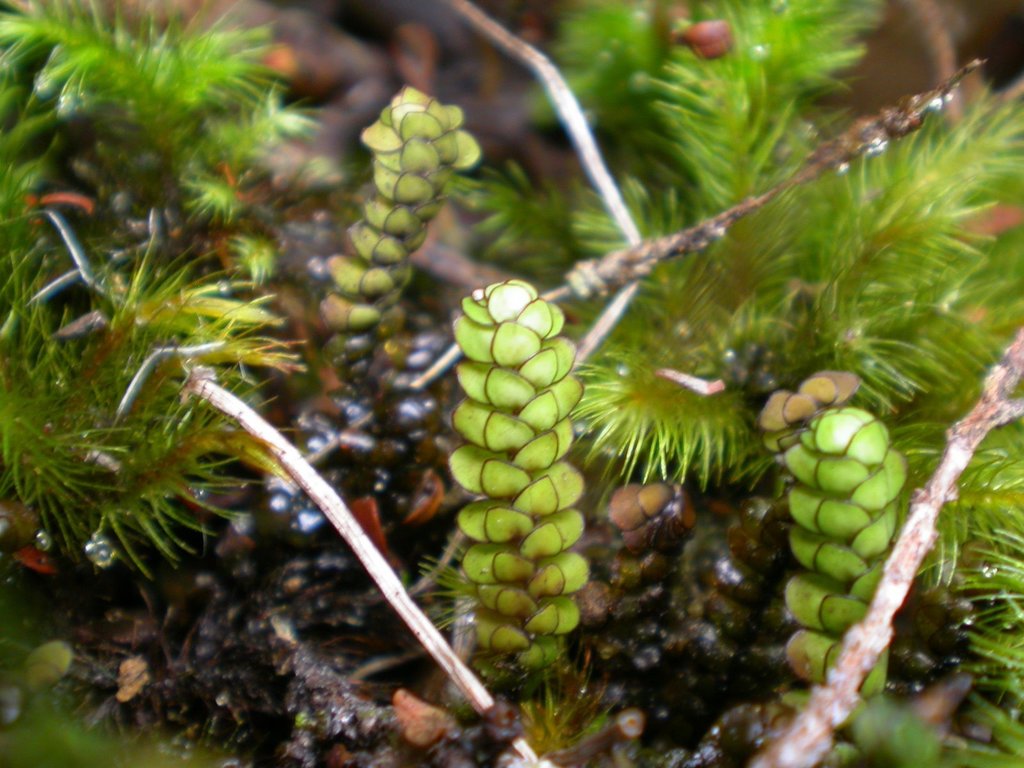
- Marsupium: Some genera (e.g., Geocalyx, Saccogyna, Harpanthus) lack a perianth and instead develop a marsupium. This is a fleshy, subterranean pouch formed by stem tissue that grows downwards, enclosing the archegonia and later the developing sporophyte.
Sporophytes and Spores
The sporophyte develops within either the perianth or the marsupium. It consists of a foot, a hyaline (clear) seta that elongates rapidly at maturity, and an ovoid to cylindrical capsule. The capsule wall is multi-layered. Dehiscence is typically via four valves, releasing haploid spores and diploid, spiral-banded elaters.
Field Identification
Identifying members of Geocalycaceae involves looking for leafy liverworts with a combination of succubous leaves and prominent underleaves, often in moist habitats worldwide. A hand lens is usually necessary.
Primary Identification Features
- Leaf Arrangement: Consistently succubous.
- Underleaves: Usually present, large relative to stem width, typically bifid, and often visibly connate (fused) with the base of lateral leaves.
- Rhizoid Origin: Rhizoids arise in tufts from the base of the underleaves only.
- Leaf Shape: Often bilobed, but can be entire or toothed depending on the genus/species.
- Habitat: Diverse - check soil, logs, rocks, tree bases in moist areas.
- Reproductive Structures: Look for terminal perianths (often 3-angled) or evidence of subterranean marsupia (may require careful excavation).
Secondary Identification Features
- Branching Pattern: Often ventral-intercalary branching.
- Color: Frequently pale green, yellowish, or olive, sometimes brownish.
- Scent: Some species (e.g., Geocalyx graveolens, Lophocolea bidentata) have distinctive scents when crushed.
- Cellular Details: Oil body characteristics (requires microscope).
Seasonal Identification Tips
Geocalycaceae gametophytes are perennial and generally identifiable year-round:
- Year-Round: Key vegetative features (leaf arrangement, underleaf size/shape/connation, rhizoid origin) are always present.
- Wet Seasons: Plants are more easily observed; reproductive structures (perianths, androecia) may be more developed.
- Sporophyte Maturity: Sporophytes emerge from perianths or marsupia following fertilization, often after periods of sustained moisture (timing varies by climate and species).
Common Confusion Points
Geocalycaceae can be confused with other families having succubous leaves:
- Plagiochilaceae: Often larger, leaves frequently strongly asymmetrical and decurrent down the stem, underleaves typically absent or very small (not large and bifid).
- Jungermanniaceae/Scapaniaceae: Many have succubous leaves, but typically lack large, bifid underleaves (underleaves often absent or small/lanceolate). Perianths present, but marsupia absent.
- Acrobolbaceae: Some have marsupia, but differ in other vegetative features (e.g., leaf insertion, cell structure).
- Cephaloziaceae: Generally smaller, often with more deeply bilobed leaves, underleaves absent or small and not connate, rhizoids often scattered.
Field Guide Quick Reference
Look For:
- Succubous leaves (often bilobed)
- Large, bifid underleaves
- Underleaves often connate with leaves
- Rhizoids only at underleaf base
- Perianth (often 3-angled) OR Marsupium
- Diverse habitats (soil, wood, rock)
Key Distinctions:
- Large, bifid, connate underleaves (vs. absent/small in Plagiochilaceae, Jungermanniaceae)
- Rhizoid origin restricted (vs. scattered)
- Succubous leaves (vs. incubous in Lejeuneaceae, etc.)
- Presence of Marsupium (in some genera)
Notable Examples
This large family includes many common and widespread genera:

Lophocolea spp. (e.g., L. bidentata, L. heterophylla)
Crestworts
A large genus with many common species found on soil, logs, and tree bases worldwide. Characterized by pale green color, distinctly bilobed leaves (often with sharp teeth), large bifid underleaves connate on one side, and a prominent, often 3-angled perianth. L. bidentata often has a characteristic scent.

Chiloscyphus spp. (e.g., C. polyanthos, C. pallescens)
(No common name)
Another large genus, often found in wet habitats, on rocks in streams, or wet soil. Leaves are often rounded or shallowly notched (retuse) rather than deeply bilobed. Underleaves are large and bifid. Possesses a perianth similar to Lophocolea. Often has a more robust, sometimes darker green appearance.

Geocalyx graveolens
Turpentine Pouchwort
Found in northern temperate regions on soil and humus. Notable for having a fleshy, subterranean marsupium instead of a perianth. Leaves are rounded-quadrate, shallowly bilobed or retuse. Underleaves are large and bifid. Often has a distinctive turpentine-like scent when fresh.

Harpanthus spp. (e.g., H. scutatus)
(No common name)
Small liverworts often found on soil banks or sandstone in temperate regions. Leaves are ovate, typically unlobed or shallowly notched. Underleaves are smaller than in Lophocolea but still distinct and bifid. Develops a rudimentary marsupium (sometimes called a perigynium) at the base of the archegonial branch.

Saccogyna viticulosa
Pouchwort
A robust species found in Atlantic Europe and Macaronesia, often on shaded rocks or banks. Characterized by entire (unlobed), rounded leaves and large, bifid underleaves. Forms a prominent, pendant, fleshy marsupium for the sporophyte.
Phylogeny and Classification
Geocalycaceae is a major family within the liverwort division Marchantiophyta, class Jungermanniopsida, order Jungermanniales. It belongs to the suborder Lophocoleineae. The circumscription of the family has evolved, with molecular data strongly supporting the inclusion of the formerly separate family Lophocoleaceae within a broader Geocalycaceae sensu lato (s.l.). This combined family represents a large, diverse lineage characterized by succubous leaves and prominent underleaves.
The development of a marsupium in some genera (like Geocalyx, Saccogyna) versus a perianth in others (like Lophocolea, Chiloscyphus) represents a key evolutionary divergence in reproductive strategy within the family. Geocalycaceae s.l. is considered closely related to other major families in the Lophocoleineae, such as Plagiochilaceae.
Position in Plant Phylogeny
- Kingdom: Plantae
- Clade: Embryophytes (Land Plants)
- Division: Marchantiophyta (Liverworts)
- Class: Jungermanniopsida
- Order: Jungermanniales
- Suborder: Lophocoleineae
- Family: Geocalycaceae (s.l., incl. Lophocoleaceae)
Evolutionary Significance
Geocalycaceae is significant for:
- Diversity and Distribution: Represents a major, globally distributed radiation of leafy liverworts.
- Morphological Variation: Shows considerable diversity in leaf shape, underleaf form, and especially in the evolution of sporophyte protection (perianth vs. marsupium).
- Ecological Roles: Important members of bryophyte communities on various substrates worldwide.
- Taxonomic Complexity: The merging of Lophocoleaceae and Geocalycaceae highlights the impact of molecular data on refining bryophyte classification.