Saururaceae
Lizard's Tail Family
The Saururaceae, commonly known as the Lizard's Tail family, is a small family of herbaceous perennial flowering plants belonging to the order Piperales. It comprises only about 4 genera and 6-7 species, primarily found in wetland habitats of North America and East Asia. They are characterized by their aromatic foliage and distinctive, often drooping, spike-like inflorescences that lack petals and sepals.
Overview
The Saururaceae family consists of aromatic, rhizomatous perennial herbs adapted to moist or wet environments like marshes, swamps, and stream banks. Though small in terms of species diversity, the family is notable for its unique floral structure and its position as an early-diverging lineage within the angiosperms, belonging to the Magnoliid clade.
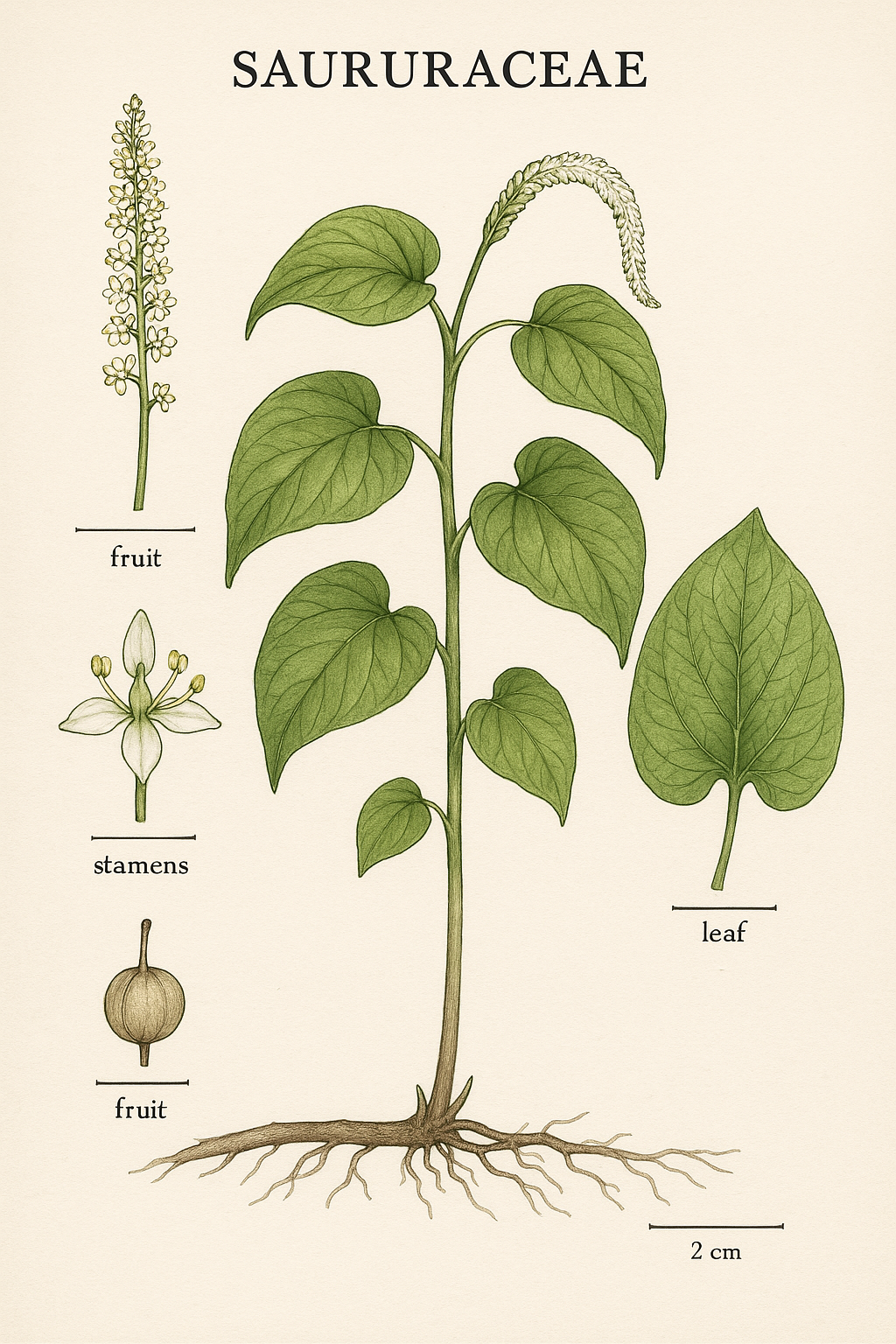
Plants in this family typically possess simple, alternate leaves, often heart-shaped, and produce dense, terminal spikes or racemes of small flowers that lack a true perianth (petals and sepals). In some genera, like Houttuynia and Anemopsis, the inflorescence is subtended by showy, petal-like bracts. The common name "Lizard's Tail" refers to the characteristic drooping, tail-like flower spike of Saururus cernuus.
Economically, the family is of minor importance globally, though some species are cultivated as ornamentals (especially Houttuynia cordata cultivars) or used in traditional medicine and cuisine, particularly in Asia (Houttuynia) and by Native Americans (Anemopsis).
Quick Facts
- Scientific Name: Saururaceae
- Common Name: Lizard's Tail family
- Number of Genera: Approximately 4
- Number of Species: Approximately 6-7
- Distribution: North America and East Asia
- Evolutionary Group: Magnoliids - Piperales
Key Characteristics
Growth Form and Habit
Members of Saururaceae are typically herbaceous perennials that spread via rhizomes, often forming colonies in wet, shady habitats. The stems are generally erect or ascending, and the entire plant often possesses a distinct, sometimes pungent, aroma when crushed due to essential oils.
Leaves
Leaves are simple, alternate, and entire (smooth-edged). They are often heart-shaped (cordate) at the base and possess petioles (leaf stalks). A key feature is the presence of stipules, small leaf-like appendages at the base of the petiole, which are often fused to the petiole or sheath the stem.
Inflorescence
The inflorescence is highly characteristic: a dense, many-flowered spike or raceme located at the tip of the stem (terminal). This spike is often slender and may be erect, nodding, or distinctly drooping (as in Saururus). In Anemopsis and Houttuynia, the inflorescence is subtended by several large, white, petal-like bracts, making it appear like a single, large flower.
Flowers
Individual flowers are small, inconspicuous, and densely packed on the spike. They lack a true perianth (no petals or sepals). Key floral features include:
- Symmetry: Usually radially symmetrical (actinomorphic).
- Sex: Bisexual (possessing both male and female parts).
- Androecium: Typically 3-8 stamens, often 6, with distinct filaments and anthers.
- Gynoecium: Composed of 3-4 carpels, which may be fused only at the base or nearly free. The ovary is generally superior or semi-inferior. Each carpel contains a few ovules.
- Bracts: Each flower is typically subtended by a small bract.
Fruits and Seeds
The fruit is typically a follicle or capsule-like structure, somewhat fleshy or leathery, which may split open (dehiscent) or remain closed (indehiscent). Each fruit contains one to a few small seeds. Dispersal mechanisms are not well-studied but likely involve gravity, water, or possibly adhesion.
Chemical Characteristics
Plants in the Saururaceae family are known for producing various essential oils and aromatic compounds, contributing to their characteristic scents (e.g., the "fishy" smell of Houttuynia or the spicy aroma of Anemopsis). These compounds likely play roles in defense and pollinator attraction.
Field Identification
Identifying members of the Saururaceae family in the field relies on recognizing a combination of vegetative and floral characteristics, particularly their habitat and unique inflorescence structure:
Primary Identification Features
- Habitat: Look in wetlands, marshes, swamps, stream edges, or other consistently moist areas.
- Inflorescence: Identify the dense, terminal spike or raceme of tiny flowers lacking petals and sepals. Note if it is drooping (Saururus) or subtended by large white bracts (Houttuynia, Anemopsis).
- Leaves: Observe the alternate, simple, entire, often heart-shaped leaves.
- Aroma: Crush a leaf or stem to detect a characteristic aromatic scent.
- Habit: Note the rhizomatous perennial herb growth form, often forming colonies.
Secondary Identification Features
- Stipules: Check for stipules at the base of the petiole, often fused to it.
- Flower details: If possible, examine the tiny flowers for the absence of perianth and the number of stamens (usually 6) and carpels (usually 3-4).
- Fruit: Look for the small, capsule-like fruits clustered on the spike later in the season.
Seasonal Identification Tips
- Spring: Emerging vegetative growth from rhizomes, distinctive heart-shaped leaves become apparent.
- Summer: Peak flowering season. Look for the characteristic spikes/racemes, with or without showy bracts.
- Fall: Fruits develop on the persistent spikes. Foliage may change color or senesce.
- Winter: Dried, persistent flower/fruit spikes may remain visible. Rhizomes are dormant underground.
Common Confusion Points
- Araceae (Arum family): Some Arums (e.g., Peltandra - Arrow Arum) grow in similar wet habitats and have spike-like inflorescences (spadix), but these are typically enclosed or subtended by a large bract called a spathe, and their flower structure is different.
- Piperaceae (Pepper family): Closely related, also possessing flower spikes and often aromatic. However, Piperaceae typically lack the prominent stipules of Saururaceae and have different leaf shapes and floral details.
- Polygonaceae (Buckwheat family): Some members (e.g., Persicaria) have spike-like inflorescences and grow in wet areas, but they have a distinct papery sheath (ocrea) derived from stipules encircling the stem at the nodes, and their flowers possess a petal-like perianth.
Field Guide Quick Reference
Look For:
- Wetland/marsh habitat
- Rhizomatous perennial herb
- Alternate, simple, often cordate leaves
- Stipules present (often fused to petiole)
- Dense terminal spike/raceme
- Flowers lacking petals/sepals
- Aromatic scent when crushed
Key Variations:
- Drooping spike (Saururus)
- Spike with showy white bracts below (Houttuynia, Anemopsis)
- Leaves heart-shaped or ovate
- Scent varies (peppery, fishy, spicy)
Notable Examples
While a small family, Saururaceae includes several well-known species, particularly in their native regions:

Saururus cernuus
Lizard's Tail
Native to eastern North America, this species gives the family its common name. It's recognized by its distinctive, slender, white flower spike that droops or nods at the tip, resembling a lizard's tail. It grows in swamps, marshes, and along stream banks, forming dense colonies from its rhizomes. The leaves are distinctly heart-shaped.

Houttuynia cordata
Chameleon Plant, Fish Mint, Dokudami
Native to East Asia, this highly variable species is known for its pungent, somewhat fishy aroma. It features heart-shaped leaves and a short, dense flower spike subtended by four prominent white bracts. Cultivars with colorful variegated foliage ('Chameleon') are popular ornamentals, though they can be invasive. It's also used in traditional medicine and cuisine in Asia.

Anemopsis californica
Yerba Mansa
Found in moist, often alkaline soils in the southwestern United States and Mexico. Yerba Mansa has mostly basal leaves and an erect, conical flower spike surrounded by large white bracts, resembling a single large flower. The plant has a distinctive spicy fragrance and a long history of medicinal use by Native Americans and in traditional Southwestern herbalism.
Phylogeny and Classification
Saururaceae belongs to the order Piperales, which is part of the Magnoliid clade. Magnoliids represent one of the earliest diverging lineages of flowering plants (angiosperms), distinct from the monocots and eudicots. This placement highlights the family's ancient origins and retention of some potentially ancestral floral characteristics, such as the lack of distinct petals and sepals.
Molecular phylogenetic studies confirm the monophyly of Saururaceae and its close relationship to the Piperaceae (Pepper family), which also features dense flower spikes and aromatic compounds. The Piperales order also includes the Aristolochiaceae (Birthwort family).
Position in Plant Phylogeny
- Kingdom: Plantae
- Clade: Angiosperms (Flowering plants)
- Clade: Magnoliids
- Order: Piperales
- Family: Saururaceae
Evolutionary Significance
The Saururaceae family is significant for several evolutionary reasons:
- Early-Diverging Lineage: As part of the Magnoliids and Piperales, it provides insights into the early evolution of flowering plants and floral structures.
- Simple Flower Structure: The absence of a typical perianth may represent a retained ancestral trait or a secondary reduction.
- Specialized Inflorescence: The dense spike, sometimes combined with showy bracts, represents a specialized pollination syndrome within the order.
- Biogeography: Its disjunct distribution between North America and East Asia reflects ancient connections and subsequent diversification patterns.
- Habitat Specialization: Adaptation to wetland environments is a key feature of the family.