Aristolochiaceae
Birthwort / Pipevine Family
Aristolochiaceae is a family of flowering plants in the basal angiosperm order Piperales, primarily known for the large genus Aristolochia (pipevines) with its often bizarrely shaped flowers adapted for fly pollination, and the genus Asarum (wild ginger). The family includes herbs, lianas, and rarely shrubs, characterized by often heart-shaped leaves, flowers lacking true petals (usually), and stamens fused with the style into a gynostemium. Many species contain toxic aristolochic acids.
Overview
The Aristolochiaceae family comprises about 4-7 genera and 500-600 species, with the vast majority belonging to the genus Aristolochia. The family has a wide distribution, primarily in tropical and subtropical regions, but also extending into temperate zones of the Northern Hemisphere (Asarum, Aristolochia) and Southern Hemisphere. Members range from perennial herbs (often rhizomatous) to woody or herbaceous vines (lianas), and rarely shrubs.
Plants in this family often possess distinct chemical compounds, including essential oils giving some (Asarum) an aromatic quality, and notably, aristolochic acids, which are toxic and carcinogenic nephrotoxins found in many Aristolochia species. Flowers are highly variable but often display adaptations for pollination by flies (sapromyiophily), including dark colors (brown, purple), fetid odors, and temporary trapping mechanisms within modified tubular calyces (Aristolochia). A key floral feature is the fusion of stamens and styles into a central structure called a gynostemium.
Some species are cultivated as ornamentals, particularly Aristolochia species for their large, curious pipe-shaped flowers and as host plants for pipevine swallowtail butterflies, and Asarum species as groundcover for shady areas. Historically, Aristolochia species were used in traditional medicine (hence "birthwort"), but this is now strongly discouraged due to the severe toxicity of aristolochic acids. Asarum canadense (wild ginger) roots were used as a ginger substitute, although it is unrelated to true ginger (Zingiberaceae).
Quick Facts
- Scientific Name: Aristolochiaceae
- Common Name: Birthwort family, Pipevine family
- Number of Genera: Approximately 4-7
- Number of Species: Approximately 500-600
- Distribution: Widespread, mainly tropical/subtropical, also temperate regions.
- Evolutionary Group: Angiosperms - Magnoliids - Piperales
- Current Date: March 29, 2025
Key Characteristics
Growth Form and Habit
Perennial herbs (often rhizomatous), lianas (woody or herbaceous vines, often twining), or rarely shrubs. Plants often aromatic.
Leaves
Leaves are alternate, simple, petiolate, and typically heart-shaped (cordate) or kidney-shaped (reniform), though other shapes occur. Margins are usually entire. Venation is often palmate. True stipules are absent, but some Aristolochia have leaf-like structures (pseudostipules) at the base of the petiole.
Inflorescence
Flowers are often solitary and axillary or terminal. Sometimes arranged in racemes or cymes. Flowers are frequently borne near the ground (Asarum) or on older woody stems (cauliflorous in some Aristolochia).
Flowers
Flowers are usually bisexual, highly variable in size (tiny to very large), and often show complex structures related to pollination. Typically 3-merous, zygomorphic (bilaterally symmetrical, esp. Aristolochia) or actinomorphic (radially symmetrical, esp. Asarum, Saruma).
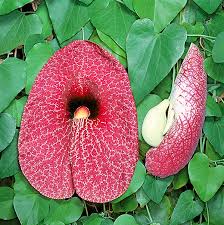
- Perianth: Consists of a single whorl, interpreted as a calyx (sepals fused, at least at base). True petals are absent (except in Saruma which has 3 small petals). The calyx is often petaloid (colored), highly modified, and tubular. In Aristolochia, it forms a distinctive 'Dutchman's pipe' shape with a basal inflated chamber (utricle), a tube, and an expanded limb, adapted for trapping flies. In Asarum, it's often bell-shaped or urn-shaped with 3 lobes, near ground level.
- Androecium and Gynoecium Fusion: Stamens (usually 6 or 12, sometimes more or fewer) and styles are typically fused together into a central structure called a gynostemium. Anthers are sessile or subsessile on this column, usually extrorse.
- Ovary Position and Structure: Ovary is usually inferior (sometimes half-inferior or rarely superior), composed of (4-)6 fused carpels forming (4-)6 locules (sometimes appearing unilocular above). Placentation is typically axile with numerous ovules per locule. The stigmas (usually 6 lobes) are typically located on the top surface of the gynostemium.
Fruits and Seeds
The most common fruit type is a septicidally dehiscent capsule (splitting along the septa between locules), which in many Aristolochia species opens distinctively from the base upwards while remaining attached at the apex, forming a basket-like structure ('parachute fruit'). Less commonly, the fruit may be a follicle or fleshy and indehiscent.
Seeds are numerous, often flattened or triangular, sometimes winged or arillate. They contain copious, oily endosperm and a minute embryo.
Chemical Characteristics
The family is characterized by the presence of aristolochic acids and their derivatives (especially in Aristolochia). These compounds are toxic (nephrotoxic) and carcinogenic. Other constituents include various alkaloids (e.g., aporphines), essential oils (terpenoids, phenylpropanoids - responsible for scents), and lignans.
Field Identification
Identifying Aristolochiaceae often relies on recognizing their distinctive leaves, unique flower shapes (especially pipevines), the characteristic gynostemium, and fruit structure:
Primary Identification Features
- Habit: Perennial herbs (often rhizomatous) or climbing vines/lianas.
- Alternate, Simple, Cordate Leaves (Often): Leaves usually heart-shaped or kidney-shaped with entire margins.
- No True Stipules.
- Bizarre Flower Shapes (esp. Aristolochia): Look for pipe-shaped, S-shaped, or uniquely structured flowers, often dark-colored (purple/brown) or mottled, sometimes with fetid odor. Or, low-growing, 3-lobed bell-shaped flowers (Asarum).
- No True Petals (Except Saruma): Perianth is a single whorl (calyx), often petal-like.
- Gynostemium: Stamens and styles fused into a central column (critical feature, requires close look at flower center).
- Inferior Ovary (Usually): Ovary located below the perianth attachment, typically 6-carpellate.
- Capsule Fruit (Often): Fruit typically a capsule splitting septicidally, often from the base upwards in Aristolochia.
- Presence of Aristolochic Acids: (Caution - toxic!) Implies handling unfamiliar species with care.
Secondary Identification Features
- Aromatic Quality: Some species (esp. Asarum) have aromatic rhizomes/leaves.
- Palmate Venation: Often visible on broad leaves.
- Fly Pollination Syndrome: Dark colors, fetid odors, trapping mechanisms suggest this family.
Seasonal Identification Tips
- Growing Season: Identify by habit (herb/vine) and the characteristic alternate, simple, often cordate leaves.
- Flowering Season: Variable, spring to summer in temperate zones. The unique flowers are the most diagnostic feature.
- Fruiting Season: Following flowering. Look for the developing inferior ovary and the mature capsules, especially the 'parachute' type in Aristolochia.
Common Confusion Points
The unique flowers of Aristolochia are hard to mistake. Asarum might be confused vegetatively with other forest herbs:
- Violaceae (Viola): Violets often have heart-shaped leaves but flowers are distinctly zygomorphic with 5 sepals, 5 petals (lower one spurred), 5 stamens, and a superior ovary producing a capsule.
- Ranunculaceae (Hepatica, Anemone): Some have similar leaf shapes, but flowers typically have distinct sepals and/or petals, numerous stamens, and numerous distinct superior carpels (apocarpous) forming achenes or follicles. Lack gynostemium.
- Dioscoreaceae (Dioscorea - Yams): These monocot vines often have heart-shaped, alternate leaves, but possess parallel/palmate venation characteristic of monocots, small unisexual flowers (6 tepals, superior/inferior ovary depending on sex), and different fruit types (capsules/samaras).
- Menispermaceae (Moonseed family): Often vines with alternate, simple, sometimes cordate leaves. Flowers are small, usually unisexual (dioecious), typically 6 sepals, 6 petals, 6 stamens, distinct superior carpels, fruit usually drupes. Lack gynostemium.
Key distinguishing features for Aristolochiaceae are the gynostemium, usually absent petals, typically inferior ovary (6 carpels), and characteristic flower shapes / capsule fruits. Remember the toxicity.
Field Guide Quick Reference
Look For:
- Herbs or vines/lianas
- Alternate, simple, often heart-shaped leaves
- No true stipules
- Unique flowers (pipe-shaped or bell-shaped)
- Perianth usually calyx only (3 lobes/parts)
- Gynostemium (fused stamens/styles)
- Ovary usually inferior, 6 carpels
- Fruit typically a capsule (often opening from base)
- Aristolochic acids (TOXIC)
Key Variations:
- Habit: Herb vs. Vine
- Flower shape: Pipe vs. Bell
- Flower symmetry: Zygomorphic vs. Actinomorphic
- Presence/absence of petals (Saruma has petals)
- Stamen number (usually 6 or 12)
Notable Examples
This family includes well-known pipevines and wild gingers, famous for their unusual flowers and sometimes their toxicity:

Aristolochia macrophylla (syn. A. durior)
Dutchman's Pipe / Pipevine
A large deciduous woody vine native to the eastern United States. Known for its very large, heart-shaped leaves and distinctive pipe-shaped, yellowish-green flowers with a purplish-brown limb. Often grown ornamentally on trellises and is a host plant for pipevine swallowtail butterflies.

Aristolochia grandiflora
Pelican Flower
A tropical vine native to Central and South America and the Caribbean, famous for producing some of the largest flowers in the world. The enormous, mottled purple-brown flower has a very long "tail" and emits a fetid odor to attract fly pollinators.

Asarum canadense
Canadian Wild Ginger
A low-growing perennial herb native to eastern North America, forming colonies in woodlands via rhizomes. Has two distinctive large, heart-shaped basal leaves per shoot. The single, bell-shaped, brownish-purple flower (3 calyx lobes) is borne near the ground level, often hidden by leaves. Rhizome is aromatic.

Saruma henryi
Upright Wild Ginger
An herbaceous perennial native to China. Unlike most members of the family, it has upright stems, actinomorphic flowers with 3 yellowish, persistent calyx lobes, AND 3 distinct, heart-shaped, yellow petals. It retains the gynostemium typical of the family. Grown as an ornamental shade plant.
Phylogeny and Classification
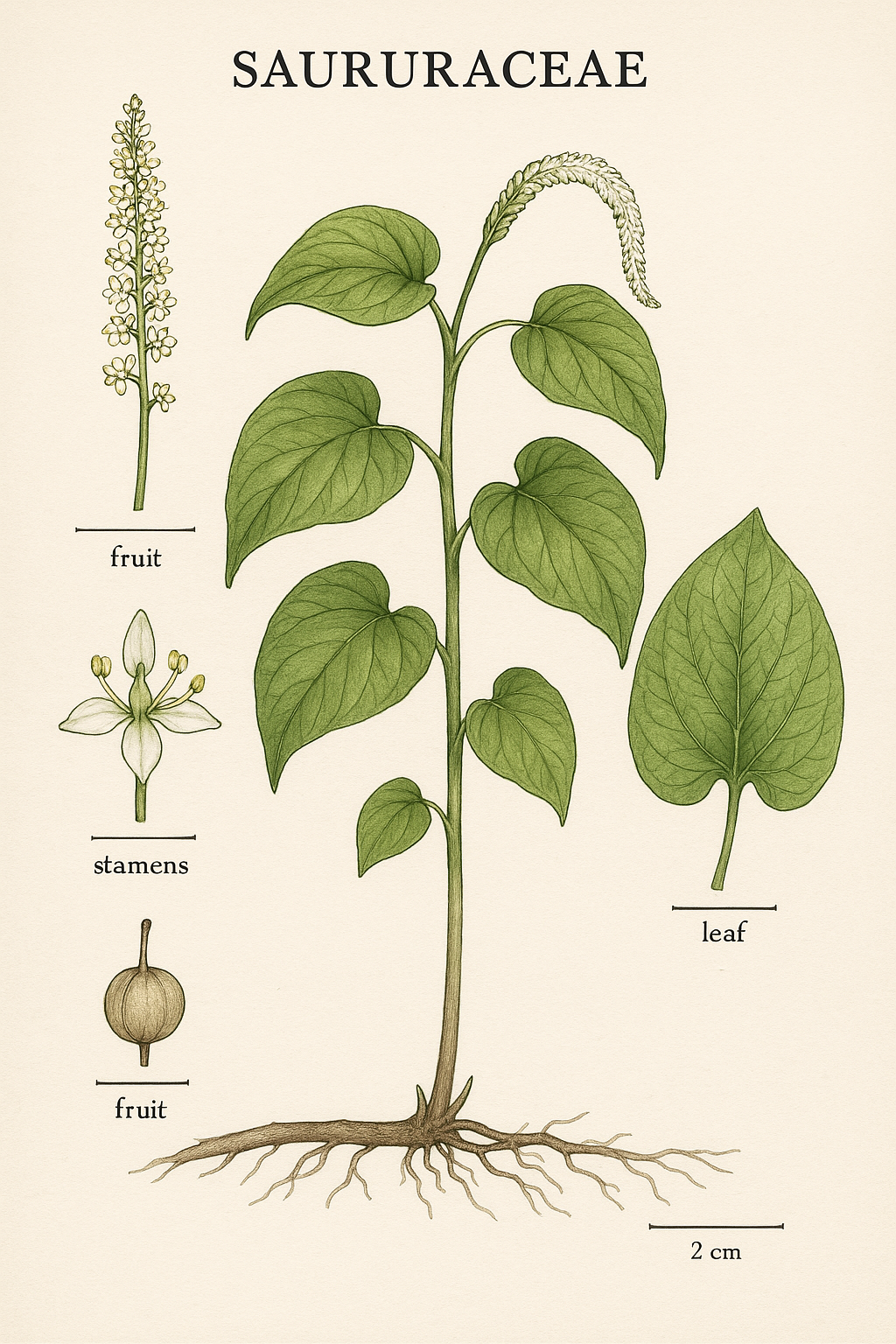
Aristolochiaceae belongs to the order Piperales, which is part of the Magnoliids clade. Magnoliids represent one of the major early-diverging lineages of angiosperms, separate from monocots and eudicots. Piperales also includes families like Piperaceae (pepper family), Saururaceae (lizard's tail family), and the parasitic Hydnoraceae.
Within the Piperales, Aristolochiaceae is well-supported as monophyletic (if including Lactorpidaceae, sometimes recognized separately). It is typically resolved as sister to the rest of the Piperales order (excluding the highly specialized Hydnoraceae whose position is sometimes debated). This basal position within the order highlights its ancient origins. The family is often divided into two main subfamilies: Asaroideae (Asarum, Saruma) characterized by actinomorphic flowers and often superior/half-inferior ovaries, and Aristolochioideae (Aristolochia, Thottea) characterized by often zygomorphic flowers (esp. Aristolochia) and usually inferior ovaries.
Position in Plant Phylogeny
- Kingdom: Plantae
- Clade: Angiosperms (Flowering plants)
- Clade: Magnoliids
- Order: Piperales
- Family: Aristolochiaceae
Evolutionary Significance
Aristolochiaceae offers important perspectives on early angiosperm evolution and specialized adaptations:
- Basal Angiosperm Lineage: As part of the Magnoliids/Piperales, it helps understand the characteristics of early flowering plants, including floral structure evolution (e.g., origin of perianth whorls, apetalous condition).
- Floral Diversification: Shows remarkable variation in floral form, from relatively simple actinomorphic flowers (Asarum) to highly complex, zygomorphic trapping structures (Aristolochia), illustrating adaptive radiation related to pollinators.
- Pollination Biology: Provides classic examples of sapromyiophily (fly pollination mimicking decaying matter), including intricate temporary trapping mechanisms.
- Gynostemium Evolution: The fusion of stamens and styles into a gynostemium is a specialized feature that has evolved independently in other groups (like Orchidaceae) but is characteristic here.
- Chemical Evolution: The production of aristolochic acids represents a potent chemical defense with significant toxicological implications and evolutionary interest.