Samydaceae
Casearia Family
Samydaceae is a family of tropical and subtropical woody plants in the order Malpighiales, containing approximately 10 genera and 250 species. These trees and shrubs are characterized by their alternate leaves with distinctive pellucid-punctations or lines (translucent dots or lines visible when held to light), deciduous leaf teeth, and minute flowers with a hypanthium. Distributed primarily in tropical regions worldwide, with the largest genus Casearia being pantropical. The family has had a complex taxonomic history, previously included in Flacourtiaceae, and now sometimes placed within Salicaceae in modern classification systems. Samydaceae plants are recognized by their introrse anther dehiscence, parietal placentation, and arillate seeds.
Overview
Samydaceae is a family of flowering plants that has undergone significant taxonomic revisions over the years. Traditionally, it was either recognized as a distinct family or included within the now-dismantled Flacourtiaceae. Modern molecular phylogenetic studies have shown that Samydaceae forms a monophyletic group closely related to Salicaceae, and in some classification systems, including the APG IV (Angiosperm Phylogeny Group), it is treated as part of an expanded Salicaceae family.
Despite these taxonomic changes, Samydaceae remains a distinctive group with characteristic morphological features that make it recognizable in the field. The family is primarily distributed in tropical and subtropical regions worldwide, with the largest genus, Casearia, having a pantropical distribution. Other genera have more restricted ranges, with some endemic to specific regions such as tropical Africa or the Neotropics.
The family includes approximately 10 genera and 250 species, with Casearia being the largest genus containing more than 180 species. Most members of the family have small, inconspicuous flowers, which has contributed to the group being relatively understudied despite its widespread distribution and ecological importance in tropical forests.
Samydaceae plants are often components of tropical forest understories and edges, and some species have economic importance as sources of timber, traditional medicines, or other products. The family is also ecologically significant, with many species providing food and habitat for various animals, particularly through their arillate seeds, which are often dispersed by birds.
Quick Facts
- Scientific Name: Samydaceae
- Common Name: Casearia Family
- Number of Genera: Approximately 10
- Number of Species: Approximately 250
- Distribution: Tropical and subtropical regions worldwide
- Evolutionary Group: Eudicots - Rosids - Fabids - Malpighiales
Key Characteristics
Growth Form and Habit
Members of Samydaceae are woody plants, ranging from:
- Shrubs of various sizes
- Small to medium-sized trees
- Rarely large canopy trees
They typically have a branching growth habit and are often components of forest understories or edges. Most species are evergreen, though some may be deciduous in seasonally dry habitats.
Leaves
The leaves of Samydaceae have several distinctive characteristics:
- Arrangement: Alternate, rarely acrodromous (with main veins arising from the base and converging at the apex) as in Lunania
- Type: Simple, pinnately veined
- Margins: Typically with deciduous conical teeth (theoid teeth), sometimes entire, rarely spinose (Casearia section Casearia group Ilicifoliae)
- Special features: Most distinctively, the leaves often have pellucid-punctations or -lines (translucent dots or lines visible when the leaf is held up to light)
- Pubescence: Glabrous to pubescent, rarely with stellate hairs (Ryania)
- Stipules: Present or absent, depending on the genus
The pellucid-punctations or -lines in the leaves are one of the most useful field characteristics for identifying members of this family. These translucent areas are often glands containing essential oils or other compounds.
Flowers
The flowers of Samydaceae are typically small and inconspicuous, with the following characteristics:
- Size: Usually minute, wider than 2 cm only in Ryania and Samyda
- Arrangement: Usually in axillary fascicles or glomerules, sometimes reduced to single axillary flowers, less commonly in corymbs, racemes, or panicles
- Sexual system: Mostly hermaphroditic, some genera dioecious (Euceraea, Neoptychocarpus, Osmelia, Pseudosmelia), rarely monoecious (Trichostephanus) or polygamous (Ophiobotrys)
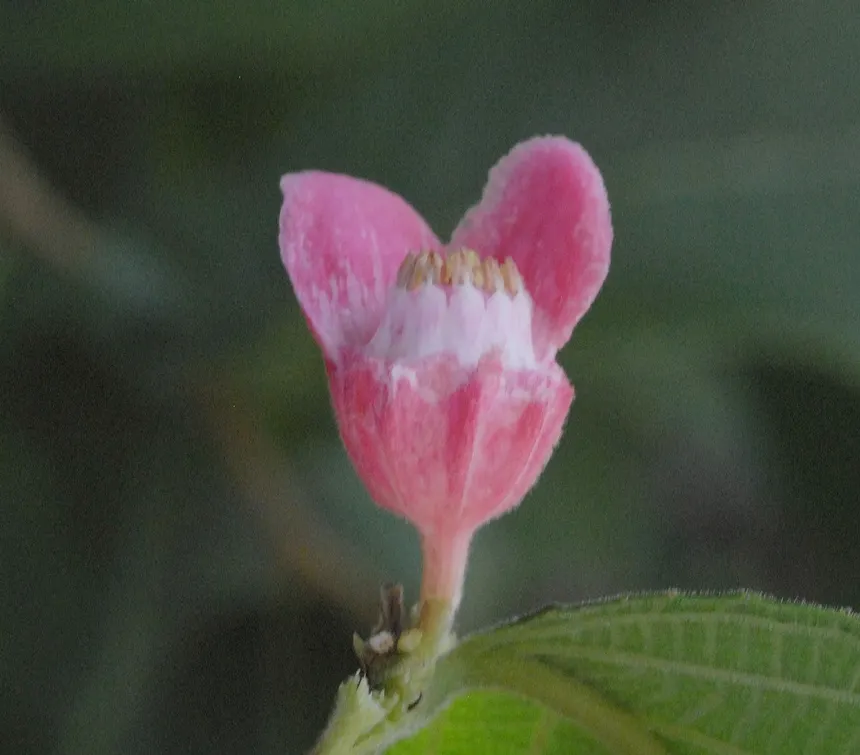
- Structure: Typically with a hypanthium (floral tube), though sometimes reduced or absent
- Sepals: 4-7, imbricate
- Petals: Absent
- Disk: Usually present, adnate to the calyx, alternating with or inside the whorl of stamens, sometimes appearing like staminodes or a fleshy corona
- Stamens: 4 to numerous, typically inserted in 1-3 whorls, sometimes connate to various degrees
- Anther dehiscence: Introrse (opening inward) or rarely latrorse (Lunania)
The floral structure, particularly the absence of petals and the presence of a hypanthium, is characteristic of the family and helps distinguish it from related groups.
Gynoecium and Fruits
The female reproductive structures and resulting fruits in Samydaceae include:
- Gynoecium: Consists of one pistil with a superior ovary
- Ovary: Unilocular (single-chambered)
- Placentation: Parietal (placentas on the wall of the ovary)
- Ovules: Few to numerous
- Styles: Usually 1 or distally 3(-5)-branched, 3 separate styles in Osmelia and Pseudosmelia
- Stigma: Usually capitate, rarely sessile
- Fruit types: Either fleshy or dry 3-valved capsules, occasionally indehiscent
The parietal placentation is a characteristic feature shared with several related families in the Malpighiales order.
Seeds
The seeds of Samydaceae have distinctive features:
- Arils: Seeds typically arillate (with a fleshy outgrowth from the funicle), except in Tetrathylacium
- Special adaptations: Some species of Casearia (section Gossypiospermum) have seeds with long, cottony hairs instead of arils
The arillate seeds are an important feature for seed dispersal, often attracting birds and other animals that consume the nutritious aril and disperse the seeds.
Distinguishing Features
Samydaceae can be distinguished from other plant families by a combination of:
- Pellucid-punctations or -lines in the leaves (translucent dots or lines visible when held to light)
- Deciduous leaf teeth (theoid type)
- Flowers typically with a hypanthium and lacking petals
- Introrse anther dehiscence
- Parietal placentation
- Arillate seeds (in most genera)
These features, particularly the pellucid-punctations in the leaves and the floral structure, make Samydaceae relatively easy to recognize in the field despite the small size of the flowers in most species.

Leaf of a Casearia species showing the characteristic pellucid-punctations (translucent dots) that are visible when the leaf is held up to light.
Identification
Field Identification Tips
Identifying members of the Samydaceae family in the field can be facilitated by looking for:
- Habit: Woody shrubs or trees, typically in tropical or subtropical forest understories or edges.
- Leaves: Alternate, simple leaves that, when held up to light, show distinctive pellucid-punctations or -lines (translucent dots or lines). The leaf margins often have deciduous teeth.
- Flowers: Usually small and inconspicuous, lacking petals, and often arranged in axillary clusters.
- Fruits: Capsules that typically split into three valves, or occasionally fleshy and indehiscent.
- Seeds: Usually with a fleshy aril, or sometimes with cottony hairs.
The pellucid-punctations in the leaves are perhaps the most useful field characteristic, as they can be observed with a hand lens or even the naked eye by holding a leaf up to the light.
Similar Families
Samydaceae may be confused with several related families:
- Salicaceae (Willow Family): In its modern circumscription, includes many former Flacourtiaceae genera and is closely related to Samydaceae. Some classification systems even include Samydaceae within Salicaceae. Can be distinguished by often lacking pellucid-punctations in the leaves and having different floral structures.
- Achariaceae: Similar in some respects but typically has petals and different floral structures.
- Passifloraceae (Passion Flower Family): Often has tendrils and more complex floral structures, including a distinctive corona of filaments.
- Euphorbiaceae (Spurge Family): Some members may have pellucid-punctations in the leaves, but typically have latex and very different floral structures, often with a distinctive three-lobed fruit (schizocarp).
Distinguishing Features
The most reliable features for distinguishing Samydaceae from similar families include:
- Leaf characteristics: The combination of pellucid-punctations or -lines and deciduous theoid teeth is distinctive.
- Floral structure: Flowers lacking petals, with a hypanthium, and with stamens often arranged in distinct whorls.
- Fruit and seed characteristics: Typically 3-valved capsules with arillate seeds or seeds with cottony hairs.
For definitive identification, examination of both vegetative and reproductive features is often necessary, particularly in regions with high plant diversity where multiple similar families co-occur.
Notable Examples
The Samydaceae family contains approximately 10 genera and 250 species. Here are some notable representatives:

Casearia sylvestris
Wild Coffee or Sãvoeiro
A widespread species found throughout tropical and subtropical regions of the Americas, from Mexico and the Caribbean to Argentina. It is a small tree or shrub growing to about 4-6 meters tall, with glossy, alternate leaves that show the characteristic pellucid-punctations when held to light.
The flowers are small, greenish-white, and arranged in axillary clusters. The fruits are small capsules that split to reveal seeds with red arils. C. sylvestris has numerous traditional medicinal uses throughout its range, including treatments for snake bites, wounds, and various ailments. It also has potential pharmacological applications, with studies showing antimicrobial, anti-inflammatory, and antitumor properties.

Casearia corymbosa
Cerito or Wild Coffee
A shrub or small tree native to Central America and northern South America, growing to about 3-8 meters tall. It has distinctive corymbose inflorescences (flat-topped or convex flower clusters), which give it its specific epithet.
The leaves are alternate, simple, and show the characteristic pellucid-punctations of the family. The fruits are orange to red capsules that split to reveal seeds with colorful arils, which are attractive to birds that disperse the seeds. C. corymbosa is sometimes used in traditional medicine and is occasionally grown as an ornamental plant in tropical regions.

Ryania speciosa
Ryania
A shrub or small tree native to tropical South America, particularly the Amazon basin. Unlike most members of the family, Ryania speciosa has relatively large flowers, exceeding 2 cm in width.
The plant is notable for containing ryanodine, a complex alkaloid that affects calcium channels in muscles and has been used as a natural insecticide. Extracts from the roots and stems have been used traditionally by indigenous peoples for fishing (as a fish poison) and for medicinal purposes. The genus is named after John Ryan, an Irish physician and naturalist who studied the flora of the Caribbean in the 18th century.
Related Families
Samydaceae belongs to the order Malpighiales and is closely related to several other families. Based on molecular phylogenetic studies, its closest relatives include:

Salicaceae
Willow Family

Achariaceae
Acharia Family

Passifloraceae
Passion Flower Family

Lacistemataceae
Lacistema Family
Phylogenetic Note
The phylogenetic position of Samydaceae has been the subject of considerable revision in recent decades. Traditionally, many of the genera now placed in Samydaceae were included in the family Flacourtiaceae, which has since been dismantled based on molecular evidence showing it to be polyphyletic (derived from multiple ancestral lineages).
Molecular phylogenetic studies have shown that Samydaceae forms a monophyletic group (descended from a common ancestor) that is closely related to Salicaceae. In fact, the relationship is so close that some classification systems, including the APG IV (Angiosperm Phylogeny Group) system, include Samydaceae within an expanded Salicaceae family.
However, many botanists continue to recognize Samydaceae as a distinct family due to its distinctive morphological features, particularly the pellucid-punctations in the leaves, the deciduous theoid teeth, and certain floral characteristics. The family is considered monothetic, meaning it can be defined by a unique combination of characters not found in other families.
Within the order Malpighiales, Samydaceae is part of a clade that includes Salicaceae, Achariaceae, Lacistemataceae, and several other families. This clade is characterized by parietal placentation, introrse anther dehiscence, and often arillate seeds, features that reflect their common evolutionary history.
The geographic distribution of Samydaceae, with representatives in tropical regions worldwide, suggests an ancient origin for the family, possibly dating back to when the continents were still joined in the supercontinent Gondwana. The pantropical distribution of the largest genus, Casearia, is particularly notable and has been the subject of biogeographic studies exploring patterns of diversification and dispersal across tropical regions.