Passifloraceae
Passion Flower Family
Passifloraceae, the passion flower family, belongs to the order Malpighiales and comprises about 27-30 genera and nearly 1000 species. While including some herbs, shrubs, and trees, the family is best known for its numerous species of vines and lianas, typically climbing with axillary tendrils. They are renowned for their often large, intricate, and showy flowers featuring a distinctive corona. The family has a pantropical and subtropical distribution, with major diversity centers in the Neotropics, Africa, and Malesia. It now includes the former families Turneraceae and Malesherbiaceae.
Overview
The Passifloraceae family is most famous for the genus Passiflora, which includes both the stunningly complex passion flowers, admired ornamentally, and the commercially important passion fruit (Passiflora edulis). The intricate structure of the passion flower, particularly the corona (a fringe or series of appendages between the petals and stamens), fascinated early botanists and was interpreted symbolically by missionaries.
Most members are climbers, using tendrils that arise from the leaf axils (representing modified inflorescences) to support themselves. Leaves are typically alternate and often palmately lobed, frequently bearing nectar glands on the petiole or blade that attract ants, potentially for defense. The family, in its current broad sense (APG IV), incorporates two other groups, formerly treated as separate families: Turneraceae (mostly herbs and shrubs like Turnera, often with yellow flowers) and Malesherbiaceae (herbs and subshrubs from South America). This expanded circumscription reflects strong molecular evidence of their close relationship.
Economically, besides passion fruit, the family is significant for its many ornamental species of Passiflora. Some species are used in traditional medicine, containing compounds like cyanogenic glycosides and alkaloids (e.g., harman alkaloids in some Passiflora).
Quick Facts
- Scientific Name: Passifloraceae Juss. ex Roussel
- Common Name: Passion Flower Family
- Number of Genera: Approximately 27-30 (incl. former Turneraceae, Malesherbiaceae)
- Number of Species: Approximately 900-1000
- Distribution: Pantropical and subtropical, extending into some temperate regions; centers of diversity in Neotropics, Africa, Malesia.
- Evolutionary Group: Eudicots - Rosids - Fabids - Malpighiales
Key Characteristics
Growth Form and Habit
Mostly perennial vines or lianas climbing by means of axillary tendrils (modified inflorescences or shoots). Also includes herbs, shrubs, and small trees (especially in subfamily Turneroideae).
Leaves
Leaves are usually alternate (rarely opposite), simple or compound (palmately or pinnately), often palmately lobed (3-9 lobes). Stipules are typically present, varying from small and thread-like to large and leaf-like. Petioles or leaf blades frequently bear conspicuous extrafloral nectar glands.
Inflorescence
Flowers are often solitary in leaf axils or arranged in cymes or racemes. Tendrils often arise from the same axil as the inflorescence.
Flowers
Flowers are usually bisexual (sometimes unisexual), actinomorphic (radially symmetrical), often large, showy, and complex. A hypanthium (floral cup or tube) is typically present. Stamens and/or ovary are often elevated on a stalk (androgynophore or gynophore).
- Sepals: Usually 5, distinct or fused at the base, often persistent and sometimes petal-like in color.
- Petals: Usually 5, distinct, alternating with the sepals, arising from the rim of the hypanthium. Sometimes absent.
- Corona: A highly characteristic structure typically present inside the petals, arising from the hypanthium. It consists of one or more whorls of diverse appendages: filaments, threads, membranes, scales, or tubercles. Its form is highly variable and diagnostic for species/groups.
- Androecium: Stamens typically 5 (sometimes 3-many), often borne on an androgynophore. Filaments are usually fused at the base, forming a tube around the gynophore. Anthers are often large and versatile (attached near the middle, movable).
- Gynoecium: Ovary is superior, typically borne on a gynophore (or androgynophore). It is composed of 3 (rarely 4-5) fused carpels forming a single locule (unilocular) with parietal placentation (ovules attached to the ovary wall). Ovules are numerous. Styles are usually 3 (matching carpel number), distinct or fused at the base; stigmas are often large and capitate (head-like) or discoid.
- (Note: Subfamilies Turneroideae and Malesherbioideae have variations, e.g., Turneroideae often lack a prominent corona and gynophore, may show heterostyly).
Fruits and Seeds
The fruit is typically a many-seeded berry (e.g., passion fruit) or a capsule that dehisces loculicidally or septicidally. Seeds are flattened, often pitted or reticulated, and characteristically enclosed in a fleshy, often brightly colored aril derived from the funiculus (seed stalk).
Chemical Characteristics
Many species produce cyanogenic glycosides as a defense mechanism. Flavonoids are common. Some Passiflora species contain harman-type alkaloids, which have sedative properties and contribute to the traditional use of some species (like P. incarnata) for anxiety and insomnia.
Field Identification
Identifying Passifloraceae, especially the genus Passiflora, often relies on recognizing their climbing habit and unique flower structure:
Primary Identification Features
- Habit: Mostly vines/lianas climbing with axillary tendrils.
- Leaves: Usually alternate, often palmately lobed, frequently with glands on the petiole or blade.
- Flowers: Distinctive and complex; typically 5 sepals, 5 petals, a prominent corona (filamentous or membranous appendages inside petals), usually 5 stamens often fused around a stalk (androgynophore/gynophore) supporting the superior ovary with usually 3 styles/stigmas.
- Fruit: A berry or capsule containing numerous seeds, each typically covered by a fleshy aril.
Secondary Identification Features
- Stipules: Present, variable in size and shape.
- Flower Stalk: Presence of an androgynophore or gynophore elevating the stamens/ovary.
- Placentation: Parietal (ovules on the ovary wall).
- Subfamily Turneroideae (e.g., Turnera): Often herbs/shrubs (not vines), flowers simpler (lacking prominent corona/gynophore), often yellow, sometimes heterostylous.
Seasonal Identification Tips
- Flowering Period: Varies greatly by species and climate, but flowers are essential for identification, especially the corona structure. Many tropical species flower year-round or intermittently.
- Fruiting Period: Berries (passion fruits) or capsules develop after flowering. The arillate seeds inside are characteristic.
- Vegetative State: The combination of climbing habit with tendrils and alternate, often lobed leaves with petiolar glands strongly suggests Passifloraceae.
Common Confusion Points
- Cucurbitaceae (Gourd Family): Also often vines with tendrils and lobed leaves. However, Cucurbitaceae tendrils are typically branched and arise near the petiole base (not truly axillary), flowers are usually unisexual, lack a corona, have an inferior ovary, and fruits are pepos (modified berries like cucumbers, melons).
- Vitaceae (Grape Family): Vines with tendrils, but tendrils are typically opposite the leaves, flowers are small and inconspicuous in panicles, lack a corona, and fruit is a simple berry (grape).
- Other climbing plants: Check for the presence of axillary tendrils, characteristic leaf shape/glands, and especially the unique flower structure (corona, gynophore).
Field Guide Quick Reference
Look For:
- Habit: Mostly vines with tendrils
- Leaves: Alternate, often lobed, petiolar glands common
- Flowers: Complex, showy, with corona
- Stamens/Ovary: Often on a stalk (gynophore)
- Ovary: Superior, 1-locular, parietal placentation
- Styles: Usually 3
- Fruit: Berry or capsule
- Seeds: With fleshy aril
Key Distinctions:
- Presence of corona
- Axillary tendrils
- Gynophore/Androgynophore common
- Arillate seeds
- Distinct from Cucurbitaceae (inferior ovary, pepo fruit) and Vitaceae (tendrils opposite leaves, simple flowers)
Notable Examples
Passifloraceae includes economically important fruits and widely grown ornamentals:

Passiflora edulis
Passion Fruit
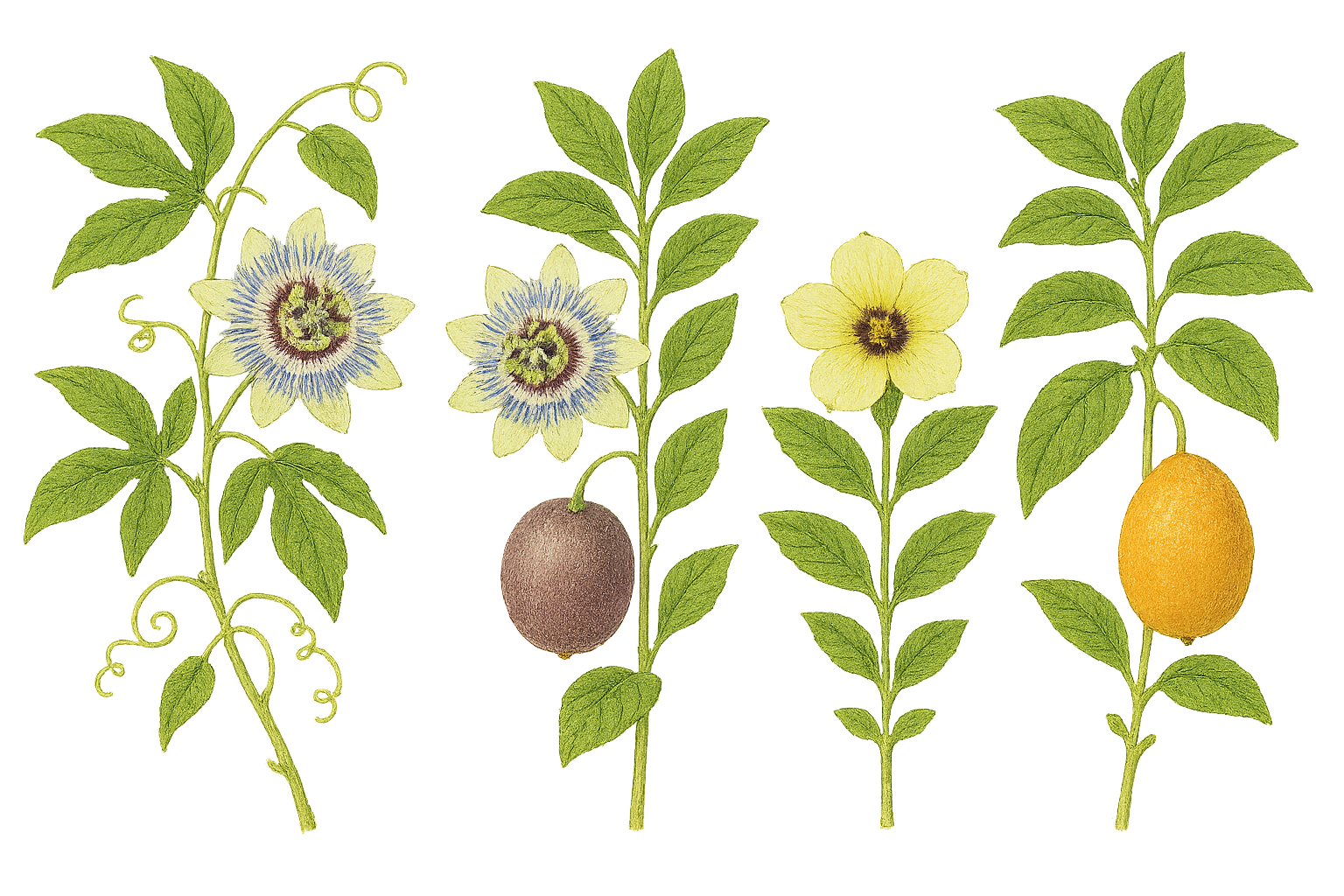
A vigorous vine native to South America, widely cultivated in tropical and subtropical regions for its edible fruit. Flowers are white with a purple-based corona. The fruit is a berry, either purple or yellow depending on the form (var. edulis or var. flavicarpa), containing numerous seeds embedded in aromatic, juicy arils.

Passiflora caerulea
Blue Passion Flower
A popular ornamental vine native to South America, known for its hardiness (compared to other species) and striking flowers with white/pale blue sepals/petals and a corona banded with blue, white, and purple. Produces an orange, egg-shaped berry, generally considered bland or inedible.

Passiflora incarnata
Maypop / Purple Passion Flower
An herbaceous perennial vine native to the southeastern United States. It dies back to the ground in winter. Flowers are intricate, lavender/purple with a prominent wavy corona. The fruit (maypop) is a yellowish berry that is edible when ripe. Traditionally used by Native Americans and later as an herbal remedy for anxiety and insomnia.

Turnera ulmifolia
Yellow Alder / Ramgoat Dashalong
Representing the subfamily Turneroideae (formerly Turneraceae). A fast-growing shrub or subshrub native to the Neotropics, widely cultivated and naturalized elsewhere. It has simple, alternate, toothed leaves (resembling elm leaves) and produces bright yellow, 5-petaled flowers that open in the morning and close by afternoon. Lacks tendrils and the complex corona of Passiflora.
Phylogeny and Classification
Passifloraceae is placed within the large order Malpighiales, part of the fabid clade of rosids. Molecular studies have significantly reshaped the understanding of this family's boundaries.
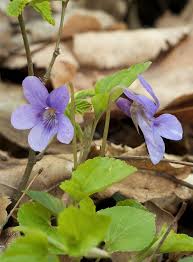
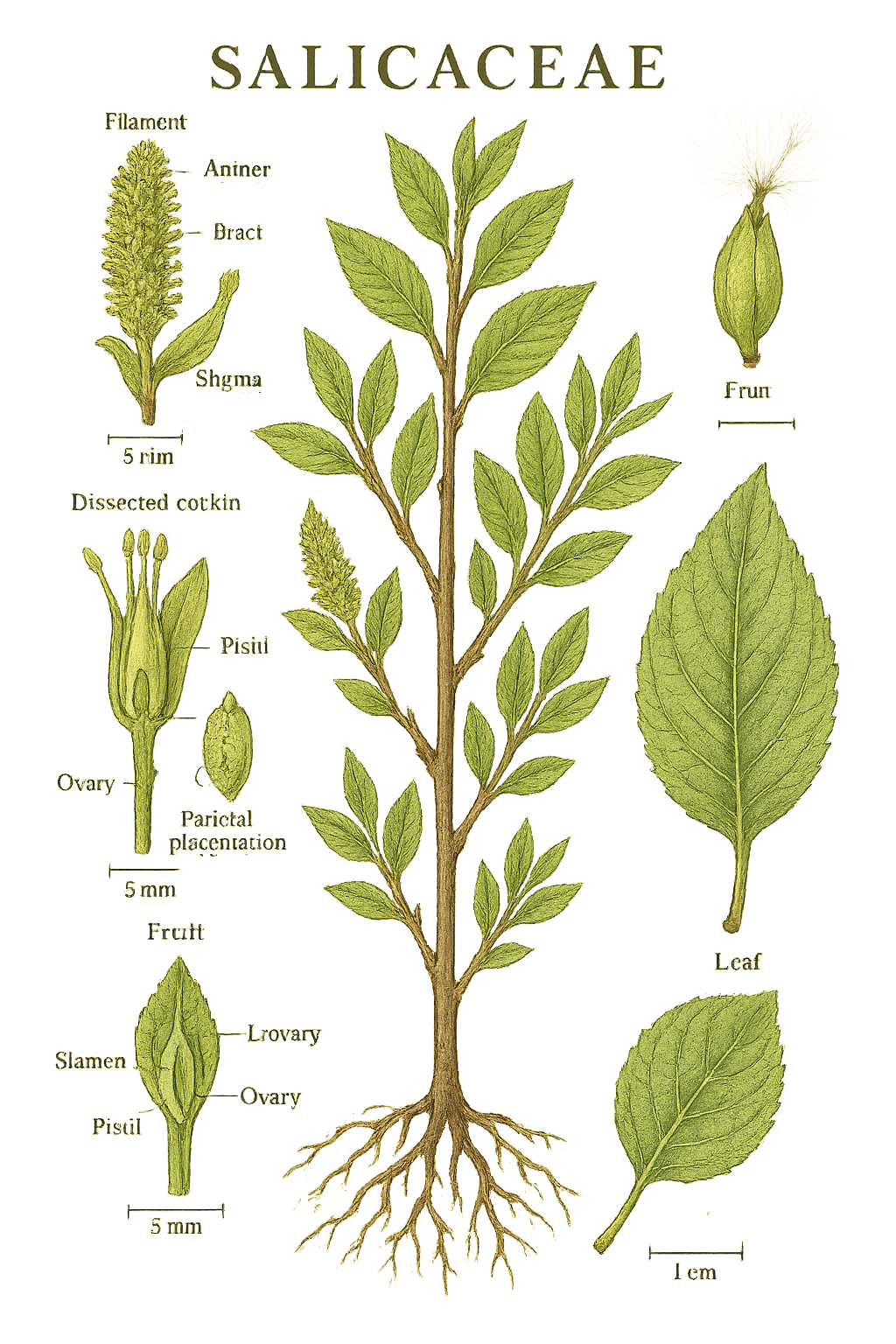
The APG system now recognizes Passifloraceae in a broad sense (sensu lato), including the genera formerly placed in Turneraceae and Malesherbiaceae. These three groups form a strongly supported monophyletic clade. Within this expanded family, they are often treated as subfamilies: Passifloroideae (containing Passiflora and relatives), Turneroideae (containing Turnera, Piriqueta, etc.), and Malesherbioideae (containing only Malesherbia). Within the Malpighiales order, the Passifloraceae clade is closely related to families like Violaceae (violets) and Salicaceae (willows).
Position in Plant Phylogeny (APG IV)
- Kingdom: Plantae
- Clade: Angiosperms (Flowering plants)
- Clade: Eudicots
- Clade: Rosids
- Clade: Fabids
- Order: Malpighiales
- Family: Passifloraceae (incl. Turneraceae, Malesherbiaceae)
Evolutionary Significance
Passifloraceae is notable for several evolutionary aspects:
- Floral Complexity and Pollination Syndromes: The highly specialized flowers, particularly the corona, are linked to specific pollinators (large bees, hummingbirds, bats). The family provides excellent examples of co-evolution between plants and pollinators.
- Evolution of Climbing Habit: The development of axillary tendrils facilitated the diversification of climbing forms, allowing exploitation of new ecological niches.
- Chemical Defenses: Widespread occurrence of cyanogenic glycosides and unique alkaloids represents diverse strategies against herbivores.
- Inclusion of Turneraceae/Malesherbiaceae: Demonstrates how molecular data can unite morphologically disparate groups, revealing deeper evolutionary connections (e.g., linking tendrilled vines with complex flowers to herbs/shrubs with simpler flowers).
- Rapid Diversification: The genus Passiflora, in particular, has undergone extensive and relatively recent diversification, especially in the Neotropics.