Primulaceae
Primrose Family (sensu lato)
Primulaceae, the primrose family, as broadly defined under the APG system (sensu lato), is a large and remarkably diverse family within the order Ericales, containing about 68 genera and over 2,700 species. This modern circumscription merges the traditional herbaceous Primulaceae (primroses, cyclamens, loosestrifes) with largely woody, tropical groups formerly placed in Myrsinaceae, Theophrastaceae, and Maesaceae. Shared features often include flowers with fused petals, stamens positioned opposite the corolla lobes, and a superior ovary frequently with free-central placentation, though morphological variation is immense across the different lineages.
Overview
The expanded Primulaceae is cosmopolitan, inhabiting nearly every biome from arctic tundra and alpine meadows to tropical rainforests and mangroves. This vast ecological range reflects the morphological diversity resulting from the merger of previously distinct families based on molecular evidence. The 'core' herbaceous group, Primuloideae, includes well-known temperate genera like Primula (primroses), Androsace (rock jasmines), Cyclamen, Lysimachia (loosestrifes), and Dodecatheon (shooting stars, now often in Primula), many of which are prized ornamentals.
The largely woody former Myrsinaceae clade (now subfamily Myrsinoideae) contributes numerous tropical and subtropical trees and shrubs, such as Ardisia and Myrsine, often characterized by gland dots on leaves and fleshy fruits (berries or drupes). The smaller former Theophrastaceae and Maesaceae clades add further woody diversity. Across this breadth, unifying features like stamens positioned opposite the petals (rather than alternating) and often free-central placentation in the ovary are key characteristics, though exceptions occur. Many species contain saponins or quinones (like primin in Primula, which can cause skin irritation).
In Oklahoma (current location as of March 27, 2025), native representatives include several species of Loosestrife (Lysimachia), the small Rock Jasmine (Androsace occidentalis), and Brookweed (Samolus species) found in wet areas.
Quick Facts
- Scientific Name: Primulaceae Batsch ex Borkh. (sensu lato)
- Common Name: Primrose family
- Number of Genera: Approximately 68
- Number of Species: Approximately 2,790
- Distribution: Cosmopolitan, all habitats from arctic to tropical.
- Evolutionary Group: Eudicots - Asterids
- Order: Ericales
Key Characteristics
Growth Form and Habit
Extremely diverse due to broad circumscription: includes annual or perennial herbs (often rhizomatous, stoloniferous, or tuberous), subshrubs, shrubs, trees, and lianas.
Leaves
Highly variable arrangement: alternate, opposite, or whorled along the stem, or forming a basal rosette (common in Primuloideae). Leaves are typically simple (rarely pinnately dissected), with margins usually entire or toothed, sometimes lobed. Glandular dots or lines are often present, especially in the Myrsinoideae subfamily. Stipules are absent.
Inflorescence
Highly variable: flowers can be solitary (axillary or terminal), or grouped into umbels (often on a leafless stalk/scape, e.g., Primula), racemes, panicles, spikes, or axillary clusters (fascicles).
Flowers
Flowers are usually bisexual and typically actinomorphic (radially symmetric), although slight zygomorphy occurs rarely. They are mostly 5-merous (parts in fives), but sometimes 4-merous or up to 9-merous.
- Calyx: Typically composed of 5 sepals (or as many as corolla lobes), usually fused at the base (synsepalous) into a tube with distinct lobes. Often persistent in fruit.
- Corolla: Typically composed of 5 petals (or as many as calyx lobes), fused together (sympetalous) to form a corolla tube and spreading lobes (limb). Corolla shape varies greatly: rotate (wheel-shaped, e.g., Lysimachia), salverform (narrow tube, flat limb, e.g., Primula), funnelform, campanulate (bell-shaped), or urceolate (urn-shaped). In Cyclamen and Dodecatheon (Primula section Dodecatheon), the corolla lobes are strongly reflexed (bent sharply backwards). Lobes are often convolute (twisted) in bud.
- Androecium: Stamens number as many as the corolla lobes (usually 5) and are characteristically positioned opposite the lobes (antisepalous). They are attached to the corolla tube (epipetalous). Filaments may be free or fused at the base forming a ring or tube. Anthers typically open via longitudinal slits, sometimes by pores. Staminodes (sterile stamens) are sometimes present, alternating with the fertile stamens (representing an ancestral outer whorl).
- Gynoecium: Ovary is usually superior, but sometimes half-inferior. Composed of typically 5 fused carpels, forming a single chamber (unilocular). Ovules are usually numerous (sometimes few or solitary) and attached to a prominent free-central placenta (a central column arising from the ovary base, not connected to the ovary wall above) or sometimes a basal placenta. A single terminal style is present, usually topped by a simple, capitate (head-like) or slightly lobed stigma.
Fruits and Seeds
Fruit type varies significantly between the major lineages. In the core herbaceous groups (Primuloideae), the fruit is most commonly a capsule that dehisces by valves (often 5) or circumscissilely (opening via a lid detaching around the circumference). In the largely woody Myrsinoideae group, the fruit is typically a fleshy, often globose, single-seeded berry or drupe. Seeds are usually numerous in capsules, fewer or single in fleshy fruits, often small and angled.
Chemical Characteristics
The family often contains saponins, tannins, and quinones (like primin, an allergen in some Primula). Lysigenous secretory cavities or canals producing yellowish or reddish resins or gums are common in the leaves and stems of the woody Myrsinoideae clade. Unlike many Asterid families, iridoid glycosides are generally absent.
Field Identification
Identifying the broadly defined Primulaceae requires recognizing features common to the herbaceous core group or the woody Myrsinoid group, with stamens opposite petals and free-central placentation being key (though sometimes hard to observe) unifying themes.
Primary Identification Features (Herbaceous 'Primuloid' Clade)
- Herbaceous Habit: Annual or perennial herbs, often with basal rosettes or opposite/whorled leaves.
- Actinomorphic Flowers (Usually 5-merous): Radially symmetric flowers with parts typically in fives.
- Sympetalous Corolla: Petals fused, forming a tube and limb (rotate, salverform, reflexed).
- Stamens Opposite Petals: 5 stamens positioned directly in front of (opposite) the corolla lobes, attached to the tube.
- Superior Ovary with Free-Central Placentation: Single-chambered ovary with ovules on a central column.
- Capsule Fruit: Fruit typically a dry capsule opening by valves or a lid.
Primary Identification Features (Woody 'Myrsinoid' Clade)
- Woody Habit: Shrubs or trees.
- Alternate Simple Leaves (Often): Leaves often alternate, simple, frequently with resinous dots or lines (use hand lens).
- Small Actinomorphic Flowers (Usually 5-merous): Flowers often small, radially symmetric.
- Stamens Opposite Petals: 5 stamens positioned opposite the corolla lobes.
- Superior Ovary (Often 1-locular, Basal/Free-Central): Ovary structure similar to herbaceous group.
- Berry or Drupe Fruit: Fruit typically fleshy and single-seeded.
Secondary Identification Features
- Reflexed Corolla Lobes: Cyclamen, Dodecatheon.
- Rotate Corolla (Wheel-shaped): Lysimachia.
- Scapose Umbel: Flowers in an umbel on a leafless stalk arising from a basal rosette (Primula, Androsace).
- Glandular Dots/Lines: Visible on leaves or petals (Myrsinoideae, Lysimachia).
- Heterostyly: Flowers with different style/stamen lengths on different plants (Primula).
Seasonal Identification Tips
- Spring/Summer: Peak flowering for most herbaceous temperate species (Primula, Lysimachia, Androsace, Samolus). Cyclamen often flowers fall/winter/spring depending on species.
- Year-round (Tropics/Indoors): Woody Myrsinoid species may flower/fruit year-round or seasonally. Houseplant Cyclamen follow specific bloom cycles.
- (Current Time Context: Late March in Oklahoma - Spring ephemerals like Androsace occidentalis might be flowering. Lysimachia species would be vegetative. Basal rosettes may be visible).
Common Confusion Points
- Caryophyllaceae (Pink Family): Often herbaceous with opposite leaves, superior ovary, 5 petals, capsule fruit. Key differences: Petals are distinct (free), not fused; placentation free-central but ovary structure differs; stamens typically 10 or 5 alternating with petals.
- Boraginaceae (Borage Family): Often herbaceous with sympetalous 5-merous flowers, superior ovary. Key differences: Leaves usually alternate and hairy; inflorescence often a scorpioid cyme; ovary typically 4-lobed; fruit 4 nutlets; stamens alternate petals.
- Ericaceae (Heath Family): Also in Ericales, often sympetalous flowers, superior (or inferior) ovary. Key differences: Often woody; flowers frequently urn-shaped; stamens usually twice petal number (10), often with porous anthers; placentation usually axile.
- Gentianaceae (Gentian Family): Often herbaceous with opposite leaves, sympetalous flowers, superior ovary, capsule fruit. Key differences: Stamens alternate with petals; placentation usually parietal.
- Myrsinaceae/Theophrastaceae (former families): No longer confusion points, as they are now included within Primulaceae. Distinguishing features mentioned above apply to these clades.
Focus on: Stamen position (opposite petals) and placentation (free-central) are key unifying (though sometimes difficult) features. Otherwise, recognize characteristic genera/groups (Primula umbel, Lysimachia rotate flower, Cyclamen reflexed petals, Ardisia gland-dotted shrub with berries).
Field Guide Quick Reference
Look For (Core Herbaceous):
- Herbaceous, often basal rosette
- Actinomorphic, 5-merous flowers
- Corolla sympetalous (rotate, salverform, reflexed)
- Stamens 5, opposite petals
- Ovary superior, free-central placentation
- Fruit a capsule
Look For (Woody Myrsinoid):
- Shrub or tree
- Leaves often alternate, gland-dotted
- Flowers small, 5-merous
- Stamens 5, opposite petals
- Ovary superior
- Fruit a berry or drupe
Notable Examples
The expanded Primrose family includes classic garden flowers, tropical shrubs, and widespread wildflowers.

Primula vulgaris
Common Primrose
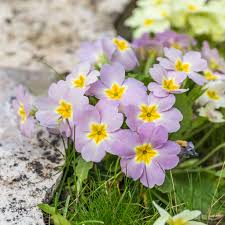
A perennial herb native to western and southern Europe, widely cultivated. Forms a basal rosette of wrinkled leaves. Produces characteristic pale yellow, salverform flowers borne singly on stalks arising directly from the rosette base in early spring. Exhibits heterostyly (pin and thrum flowers).

Cyclamen persicum
Florist's Cyclamen
A tuberous perennial herb native to the eastern Mediterranean. Parent species of numerous cultivars popular as houseplants. Features heart-shaped, often patterned basal leaves and distinctive flowers borne singly on long stalks. The 5 corolla lobes are strongly reflexed (bent upwards/backwards), often pink, red, or white.

Lysimachia ciliata
Fringed Loosestrife
A perennial herb native to much of North America, including Oklahoma, often found in moist woods and thickets. Features erect stems with opposite leaves whose petioles have distinct hairs (cilia). Produces nodding, yellow, star-shaped (rotate) flowers from upper leaf axils in summer. Stamens opposite the 5 corolla lobes.

Androsace occidentalis
Western Rock Jasmine
A tiny annual herb native to central and western North America, including Oklahoma, found in dry, open, often sandy or rocky ground. Forms a small basal rosette of leaves. Produces one or more leafless stalks (scapes) bearing umbels of very small white flowers with a yellow center. Fruit is a small capsule.

Ardisia crenata
Coral Berry / Spiceberry / Coral Ardisia
An evergreen shrub native to East Asia (formerly Myrsinaceae), widely cultivated as an ornamental and now invasive in humid subtropical regions (e.g., southeastern US). Features alternate, leathery leaves often with crenate margins and visible gland dots. Produces clusters of small white or pinkish flowers followed by persistent clusters of bright red berries (drupes).

Samolus valerandi
Brookweed / Seaside Brookweed
A perennial herb with a subcosmopolitan distribution, often found in wet, marshy, or brackish habitats (including parts of Oklahoma). Forms a basal rosette of simple leaves; stem leaves are alternate. Produces terminal racemes of small, white, 5-merous flowers with stamens opposite the petals and alternating staminodes. Ovary is half-inferior; fruit a capsule. Represents lineage formerly in Theophrastaceae.
Phylogeny and Classification
Primulaceae is a major family within the large and diverse order Ericales. Ericales belongs to the Asterid clade but is considered sister to the core Asterid groups (Lamiids and Campanulids). This order includes families with diverse habits and floral structures, such as Ericaceae (heaths), Sapotaceae (sapotes), Ebenaceae (ebonies), and Theaceae (camellias).
The modern concept of Primulaceae sensu lato (APG system) is a prime example of phylogenetic restructuring based on DNA evidence. Molecular data showed that the traditional herbaceous Primulaceae was paraphyletic unless it included the largely woody families Myrsinaceae, Theophrastaceae, and Maesaceae. Despite vast differences in morphology and habit (temperate herbs vs. tropical trees/shrubs), these groups form a strongly supported monophyletic clade united by underlying genetic similarity and subtle floral features like stamens positioned opposite the corolla lobes and often free-central placentation. This merger creates a morphologically heterogeneous but evolutionarily coherent family.
Position in Plant Phylogeny
- Kingdom: Plantae
- Clade: Angiosperms (Flowering plants)
- Clade: Eudicots
- Clade: Asterids
- Order: Ericales
- Family: Primulaceae (sensu lato)
Evolutionary Significance
The redefined Primulaceae highlights the power of molecular phylogenetics to uncover deep evolutionary relationships sometimes masked by extensive morphological divergence. It demonstrates that traits like herbaceous vs. woody habit and capsule vs. fleshy fruit can be evolutionarily labile within a single major lineage. Conserved features like the position of stamens opposite the petals (antisepalous) point to shared ancestry despite outward differences. The family showcases adaptation to an exceptionally wide range of environments, from arctic-alpine regions (Primula, Androsace) to tropical rainforests (Ardisia, Myrsine), illustrating the evolutionary flexibility within this clade of Ericales.


