Myristicaceae
Nutmeg Family
Myristicaceae is a family of evergreen trees, rarely shrubs, belonging to the order Magnoliales, an ancient lineage within the Magnoliids clade. Distributed pantropically, primarily in lowland rainforests, the family comprises about 20 genera and nearly 500 species. They are characterized by often aromatic tissues, frequently red sap, alternate simple leaves, small unisexual flowers lacking petals, fused stamens (synandrium), a single carpel, and distinctive fleshy fruits that dehisce to reveal a single large seed covered by a colorful aril (e.g., nutmeg and mace).
Overview
The Myristicaceae, or Nutmeg family, consists of about 20 genera and nearly 500 species of aromatic, evergreen trees found throughout the world's tropics. They represent an early diverging lineage of flowering plants within the Magnoliales order. Many species produce a characteristic red or watery sap when cut.
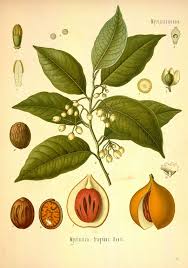
The family is most famous for Myristica fragrans, the source of two important spices: nutmeg (derived from the seed) and mace (derived from the brightly colored, net-like aril surrounding the seed). Several other genera, like Virola in South America, are known for producing timber or hallucinogenic compounds used traditionally by indigenous peoples.
Members of the family typically inhabit lowland tropical rainforests and play roles in forest ecosystems as canopy or understory trees. Their fleshy fruits with conspicuous arils are often dispersed by birds (especially pigeons and hornbills) and sometimes mammals.
Quick Facts
- Scientific Name: Myristicaceae R.Br.
- Common Name: Nutmeg family
- Number of Genera: Approximately 20
- Number of Species: Approximately 475-500
- Distribution: Pantropical (Americas, Africa, Asia, Australasia).
- Evolutionary Group: Magnoliids - Magnoliales
Key Characteristics
Growth Form and Habit
Evergreen trees, rarely shrubs. Often aromatic. Bark frequently exudes red or clear watery sap when cut.
Leaves
Leaves are alternate, simple, entire, usually leathery, and exstipulate (lacking stipules). Often gland-dotted. Undersides may be whitish or brownish.
Inflorescence
Inflorescences are typically axillary, sometimes ramiflorous (borne on older branches), usually cymose, paniculate, or fasciculate (clustered).
Flowers
Flowers are small, inconspicuous, actinomorphic (radially symmetrical), unisexual (plants usually dioecious), and typically 3-merous (sometimes 2- or 4-merous). Key features include:
- Perianth: Consists of a single whorl of 3 (rarely 2 or 4) fleshy, sepal-like tepals, fused basally to form a cup or tube (often called a calyx), with valvate lobes. Petals are absent (apetalous).
- Androecium (Male Flowers): Stamens 2 to many, filaments completely fused into a central column (synandrium). Anthers are extrorse, sessile, fused to the column or free only at the apex.
- Gynoecium (Female Flowers): Ovary is superior, composed of a single carpel (monocarpous), unilocular, containing a single basal, usually anatropous ovule. Stigma is sessile or on a very short style, often bilobed.
Fruits and Seeds
The fruit is distinctive: typically a fleshy or leathery drupe or capsule-like structure that dehisces (splits open), usually along 1 or 2 sutures, at maturity. It contains a single large seed. The seed is partially or completely covered by a conspicuous, often brightly colored (red, orange, yellow), fleshy or leathery, sometimes laciniate (deeply cut) aril. The endosperm is copious and often ruminate (mottled or labyrinthine in cross-section).
Chemical Characteristics
Characterized by the presence of aromatic essential oils, phenolic compounds, lignans, and often alkaloids. The red sap contains tannins and related compounds.
Field Identification
Identifying Myristicaceae involves recognizing their tree habit, often red sap, alternate simple entire leaves, small unisexual apetalous flowers (often 3-merous), and especially the characteristic dehiscent fleshy fruit revealing a large seed covered by a colorful aril.
Primary Identification Features
- Habit: Evergreen trees (pantropical rainforests).
- Sap: Often red or clear watery exudate from cut bark/twigs.
- Leaves: Alternate, simple, entire, exstipulate.
- Sexuality: Usually dioecious (separate male and female trees).
- Flowers: Small, unisexual, apetalous, with 3 (usually) fused, fleshy tepals (calyx-like).
- Male Flowers: Stamens fused into a central column (synandrium).
- Female Flowers: Ovary superior, single carpel, single ovule.
- Fruit: Fleshy, dehiscent (splitting open), containing one large seed covered by a conspicuous aril (often red/orange).
- Seed: Endosperm often ruminate (mottled).
Secondary Identification Features
- Aroma: Often aromatic wood, bark, leaves, or seeds.
- Inflorescence: Axillary clusters, cymes, or panicles.
- Tepals: Valvate in bud.
Seasonal Identification Tips
- Year-round: Tree habit, alternate simple leaves, and presence of red sap (if tested) are useful year-round.
- Fruiting Season: The distinctive dehiscent fruits revealing the arillate seed are the most diagnostic feature and crucial for identification. Seasonality varies greatly by species and region.
- Flowering Season: Flowers are small and inconspicuous, less useful for general identification than fruits.
Common Confusion Points
- Lauraceae (Laurel Family): Also aromatic trees with alternate simple leaves, but flowers are usually bisexual with parts in 3s (tepals, stamens), ovary is superior but syncarpous (appearing 1-locular), and fruit is a simple, indehiscent drupe or berry, lacking an aril.
- Annonaceae (Custard Apple Family): Also Magnoliales trees with alternate simple leaves, but flowers typically have numerous spirally arranged stamens and separate carpels (apocarpous), and fruit is often an aggregate of berries or syncarp.
- Euphorbiaceae (Spurge Family): Some trees have alternate simple leaves and colored sap (often milky latex, not red sap), but flowers are highly variable (often with petals, superior syncarpous ovary, often 3-lobed), and fruit is typically a 3-lobed schizocarpic capsule.
- Clusiaceae (Guttiferae): Often have opposite leaves and yellow/orange latex, flowers usually have numerous stamens and petals, fruit a berry or capsule.
Field Guide Quick Reference
Look For:
- Evergreen trees (pantropical)
- Red sap often present
- Alternate, simple, entire leaves
- Dioecious plants (usually)
- Small, unisexual, apetalous flowers
- 3 fused tepals (usually)
- Stamens fused into column (male)
- Single carpel, superior ovary (female)
- Fleshy, dehiscent fruit
- Single large seed with colorful aril
Key Variations:
- Aril form (entire vs. laciniate)
- Aril color (red, orange, yellow)
- Fruit shape and texture
- Leaf underside color
Notable Examples
The most famous genus is Myristica, but others like Virola are also significant:

Myristica fragrans
Nutmeg Tree
Native to the Banda Islands (Moluccas) in Indonesia, now cultivated in tropical regions. The source of two spices: nutmeg (from the seed kernel) and mace (from the red, net-like aril surrounding the seed). A dioecious tree.

Virola surinamensis
Ucuuba
A large tree found in swamps and floodplains in Central and South America. Known for its lightweight timber and seeds rich in fat (Ucuuba butter), used in cosmetics and soaps. Produces abundant red resin.

Knema spp.
(Knema)
A large genus of trees found in tropical Asia. Characterized by often prominent parallel tertiary leaf venation and typically hairy flowers. Aril is usually red and laciniate at the apex.

Pycnanthus angolensis
African Nutmeg
A large tree native to tropical Africa. Produces seeds with a red aril, sometimes used locally as a nutmeg substitute, although less aromatic. Wood is used for timber.
Phylogeny and Classification
Myristicaceae belongs to the order Magnoliales, which is part of the Magnoliids clade. Magnoliids represent an early diverging group of angiosperms, distinct from both monocots and eudicots.
Within Magnoliales, Myristicaceae forms a well-supported, distinct lineage. Its sister group relationship to other families in the order (like Magnoliaceae, Annonaceae, Degeneriaceae, Eupomatiaceae, Himantandraceae) is still being resolved, but it clearly belongs to this ancient group characterized by features like ethereal oils, often large flowers (though secondarily reduced in Myristicaceae), and laminar stamens (though highly modified into a synandrium here).
Position in Plant Phylogeny
- Kingdom: Plantae
- Clade: Angiosperms (Flowering plants)
- Clade: Magnoliids
- Order: Magnoliales
- Family: Myristicaceae
Evolutionary Significance
Myristicaceae is important for understanding early angiosperm evolution:
- Basal Angiosperm Lineage: As part of Magnoliales/Magnoliids, it provides insights into the characteristics and diversification of early flowering plants.
- Floral Evolution: Demonstrates trends like reduction (loss of petals, reduction in flower size) and fusion (synandrium of stamens, fused tepals) within an ancient lineage.
- Fruit and Seed Dispersal: The specialized dehiscent fruit with a conspicuous aril represents a distinct dispersal strategy (primarily ornithochory - bird dispersal) within Magnoliales.
- Chemical Diversity: Production of complex aromatic compounds and alkaloids is characteristic of Magnoliids.
- Biogeography: Its pantropical distribution suggests ancient origins, likely dating back to Gondwanan times, followed by diversification and dispersal.