Degeneriaceae
Degeneria Family
Degeneriaceae is a small, primitive family of flowering plants containing the single genus Degeneria, endemic to the islands of Fiji. These trees are significant because they possess several floral characteristics considered ancestral among angiosperms, such as numerous, spirally arranged floral parts and relatively undifferentiated stamens and carpels. The family belongs to the order Magnoliales, part of the early-diverging Magnoliid clade.
Overview
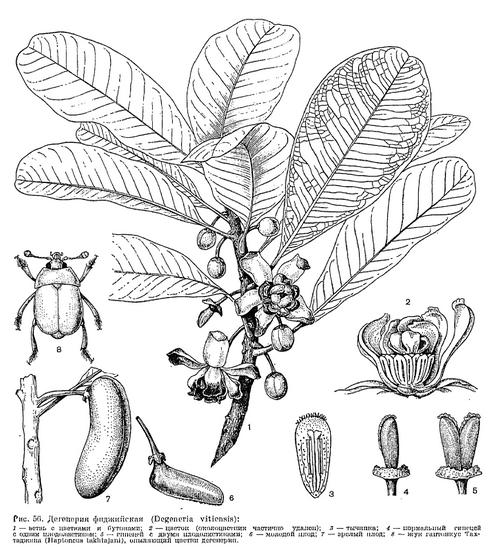
The Degeneriaceae family consists of just one genus, Degeneria, with two currently recognized species, D. vitiensis and D. roseiflora, both found only in the rainforests of Fiji (primarily Viti Levu and Vanua Levu). Their discovery was botanically significant due to their combination of features thought to resemble early flowering plants.
Key characteristics include their tree habit, simple alternate leaves containing aromatic oils, and large, solitary flowers. These flowers are notable for having numerous perianth parts (tepals) not clearly separated into sepals and petals, numerous flattened (laminar) stamens, and, most distinctively, a single carpel that is not fully sealed at the time of flowering. These features provide valuable clues about the morphology of early angiosperms. Phylogenetically, Degeneriaceae is placed within the Magnoliales, an order known for retaining many such ancestral traits.
The restricted distribution and unique features make Degeneriaceae a focus for evolutionary studies and conservation efforts in Fiji.
Quick Facts
- Scientific Name: Degeneriaceae I.W.Bailey & A.C.Sm.
- Common Name: Degeneria Family
- Number of Genera: 1 (Degeneria)
- Number of Species: 2
- Distribution: Endemic to Fiji (Viti Levu, Vanua Levu).
- Evolutionary Group: Angiosperms - Magnoliids - Magnoliales
- Habit: Evergreen trees
Key Characteristics
Growth Form and Habit
Plants are medium to large evergreen trees.
Leaves
Leaves are arranged alternately along the stem. They are simple, with entire (untoothed) margins, typically leathery (coriaceous) in texture, and possess scattered ethereal oil cells making them aromatic when crushed. Leaves lack stipules.
Inflorescence
Flowers are borne solitarily (not in clusters), arising from leaf axils or appearing terminal on short axillary shoots. Flowers are borne on pedicels that have several bracts.
Flowers
Flowers are large, showy, bisexual, and radially symmetrical (actinomorphic). They exhibit several features considered ancestral (primitive) among flowering plants:
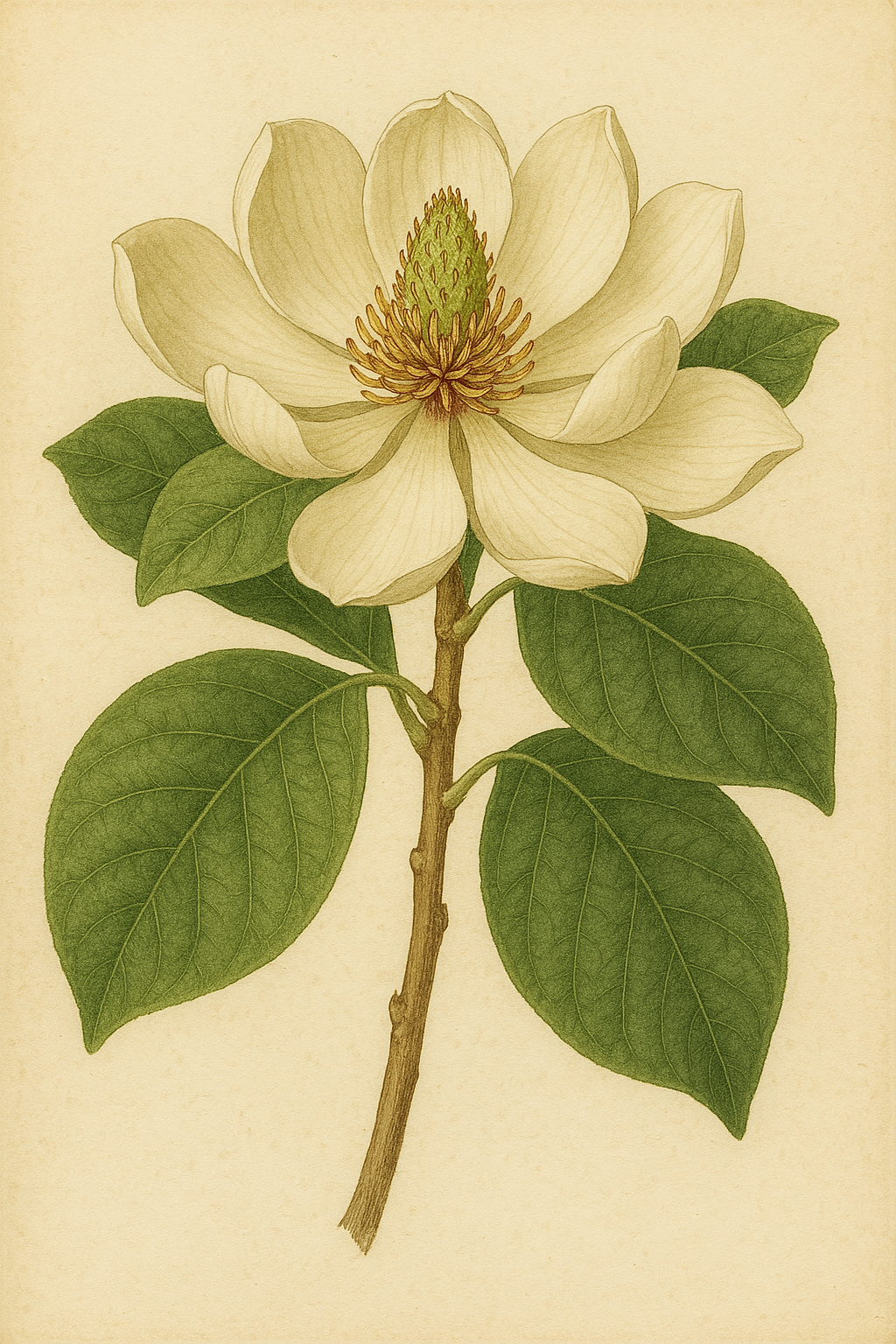
- Perianth: Consists of numerous (12-25+) parts arranged spirally or in indistinct whorls. These parts are not clearly differentiated into distinct sepals and petals and are thus called tepals. They are typically fleshy, cream-colored (D. vitiensis) or pink/rose (D. roseiflora), with the outer ones smaller and grading into the larger inner ones.
- Androecium: Consists of numerous (20-30+) stamens arranged spirally. The stamens are relatively undifferentiated and laminar (flattened and somewhat leaf-like), lacking a distinct filament and anther structure found in most angiosperms. The pollen sacs (microsporangia) are embedded on the inner (adaxial) surface. Sterile stamens (staminodes) are usually present between the functional stamens and the carpel, often secreting nectar.
- Gynoecium: Remarkably consists of a single, superior carpel (unicarpellate condition). This carpel is conduplicate (folded lengthwise) and is characteristically unsealed along its ventral margin at the time of flowering (pollination), although it fuses later during fruit development. The stigma is not localized but runs along the unsealed edges (decurrent stigma). The carpel contains numerous ovules arranged in two rows along the margins (marginal placentation).
Fruits and Seeds
The fruit develops from the single carpel into a large, leathery or somewhat fleshy, indehiscent follicle. It contains numerous, flattened seeds embedded in a pulpy material derived from the seed coat (sarcotesta), which is often reddish or orange. The seed's endosperm is oily and distinctly ruminate (mottled or furrowed due to infoldings of the seed coat).
Chemical Characteristics
Plants contain ethereal oils (contributing to aroma) and various alkaloids.
Field Identification
Identifying Degeneriaceae requires recognizing its tree habit, leaf features, unique floral structure, and restricted Fijian distribution:
Primary Identification Features
- Tree habit, endemic to Fiji: Found only in rainforests on Viti Levu and Vanua Levu.
- Alternate, simple, entire leaves: Leaves are leathery, untoothed, arranged singly.
- Aromatic leaves (when crushed): Due to ethereal oil cells.
- Large, solitary flowers: Flowers borne singly, not in clusters.
- Numerous, undifferentiated tepals: Many fleshy perianth parts (cream or pinkish), not clearly sepals and petals.
- Numerous, laminar stamens: Stamens flattened, not typical filament/anther structure.
- Single carpel: Gynoecium consists of only one carpel (visible in flower or developing fruit).
- Large, leathery follicle fruit: Distinctive fruit type developing from the single carpel.
Secondary Identification Features
- Lack of stipules: No appendages at the base of the petiole.
- Spirally arranged floral parts: Tepals and stamens often appear spirally inserted.
- Unsealed carpel margin (at flowering): A technical feature visible with magnification.
Seasonal Identification Tips
Identification relies heavily on reproductive structures when present:
- Year-round: Evergreen tree habit, leaf arrangement/shape/aroma, and Fijian location are always relevant.
- Flowering Season (Varies): The large, solitary flowers with numerous parts are diagnostic.
- Fruiting Season: The large, leathery follicle is characteristic.
Common Confusion Points
Distinguishing Degeneriaceae from other Fijian trees:
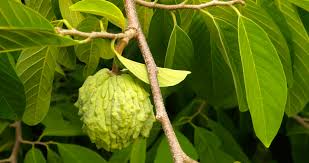
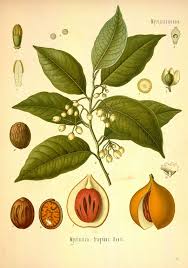
- Magnoliaceae / Annonaceae / Myristicaceae: Other Magnoliales families might occur in the region and share some "primitive" floral traits (e.g., numerous parts), but differ in specifics: Magnoliaceae often have stipules and cone-like fruit aggregates; Annonaceae usually have flowers with parts in whorls of 3 and aggregate fruits; Myristicaceae have unisexual flowers and arillate seeds. Crucially, these families typically have multiple carpels, not the single carpel of Degeneriaceae.
- Other simple-leaved trees: Many unrelated families have simple, alternate leaves. Focus on the unique combination of solitary large flowers, numerous undifferentiated tepals and laminar stamens, single carpel, and follicle fruit specific to Degeneriaceae.
- Focus on the combination: Fiji Tree + Alternate Simple Entire Aromatic Leaves + Solitary Large Flower + Numerous Tepals + Numerous Laminar Stamens + Single Carpel + Follicle Fruit = Degeneriaceae.
Field Guide Quick Reference
Look For:
- Evergreen tree (Fiji endemic)
- Leaves: Alternate, Simple, Entire, Leathery, Aromatic
- No stipules
- Flowers: Large, Solitary
- Perianth: Numerous fleshy Tepals (undifferentiated)
- Stamens: Numerous, Laminar (flattened)
- Gynoecium: Single Carpel, superior
- Fruit: Large, leathery Follicle
Key Variations:
- Flower color (cream vs. pinkish) distinguishes the two species
Notable Examples
The family contains only two species in the single genus Degeneria:

Degeneria vitiensis
(No common name)
The first described species, found primarily on Viti Levu, Fiji. Characterized by its cream-colored tepals and slightly smaller overall size compared to the other species.

Degeneria roseiflora
(No common name)
Found on Vanua Levu and Taveuni, Fiji. Distinguished primarily by its pink or rose-colored tepals. Sometimes considered a subspecies of D. vitiensis by some botanists, but generally accepted as a distinct species.
Phylogeny and Classification
Degeneriaceae belongs to the order Magnoliales, which is one of the orders within the Magnoliid clade. Magnoliids represent an early-diverging lineage of angiosperms, distinct from both monocots and eudicots, and retaining many features considered ancestral ("primitive") among flowering plants.
Within Magnoliales, Degeneriaceae is part of a core group that includes families like Magnoliaceae, Annonaceae, Myristicaceae, Eupomatiaceae, and Himantandraceae. Its exact sister relationship is often debated, but it is frequently placed close to Himantandraceae or Magnoliaceae based on molecular and morphological data. The order Magnoliales as a whole is crucial for understanding the early evolution of floral structures and diversification of flowering plants.
Position in Plant Phylogeny
- Kingdom: Plantae
- Clade: Angiosperms (Flowering plants)
- Clade: Magnoliids
- Order: Magnoliales
- Family: Degeneriaceae
Evolutionary Significance
Degeneriaceae is highly significant in evolutionary botany:
- "Primitive" Floral Traits: Exhibits a collection of features (numerous spirally arranged parts, undifferentiated tepals, laminar stamens, unsealed carpel) considered ancestral within angiosperms, providing clues about early flower morphology.
- Relictual Lineage: Represents a small, ancient lineage likely isolated by geological history (endemism to Fiji).
- Understanding Magnoliids: Helps define the characteristics and relationships within the Magnoliales order and the broader Magnoliid clade, crucial for understanding the base of the angiosperm evolutionary tree.
- Island Biogeography: Its strict endemism makes it relevant for studies on island evolution and conservation.