Lunulariaceae
Crescent-cup Liverwort
Lunulariaceae is a monotypic family (containing only Lunularia cruciata) within the order Marchantiales. This complex thalloid liverwort is instantly recognizable by the distinctive crescent-shaped gemma cups found on its large thallus, facilitating highly effective asexual reproduction. While native to the Mediterranean, it has become a widespread weed in greenhouses and gardens globally.
Overview
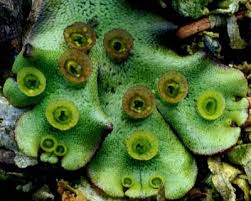
The Lunulariaceae family contains a single genus and species, Lunularia cruciata. This is a relatively large, thalloid liverwort that forms flat, spreading patches, often several centimeters wide. Its most defining characteristic is the presence of prominent, half-moon or crescent-shaped cups on the dorsal surface, which contain small, disc-like asexual propagules called gemmae.
Originally native to the Mediterranean region, Lunularia cruciata has been inadvertently spread by humans and is now found worldwide, particularly as a common weed in greenhouses, plant nurseries, gardens, and on damp, disturbed soil in mild climates. Its success as a colonizer is largely due to its prolific asexual reproduction via gemmae.
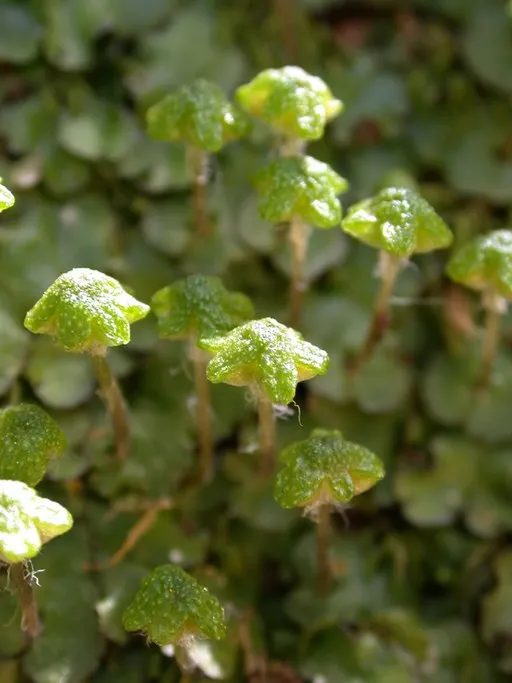
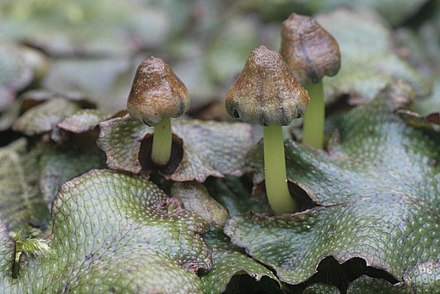
Sexual reproduction in Lunularia is dioicous but occurs much less frequently than asexual reproduction, especially outside its native Mediterranean range. When produced, the female receptacles (archegoniophores) are unique, consisting of a stalk topped by a cluster of radiating tubular structures. The common presence of the crescent-shaped gemma cups makes this liverwort easy to identify, even when sterile.
Quick Facts
- Scientific Name: Lunulariaceae
- Common Name: Crescent-cup Liverwort
- Number of Genera: 1 (Lunularia)
- Number of Species: 1 (Lunularia cruciata)
- Distribution: Native to Mediterranean region; widely introduced and common globally in greenhouses, gardens, disturbed moist soil, especially in temperate climates.
- Evolutionary Group: Bryophytes - Liverworts (Marchantiophyta) - Class Marchantiopsida - Order Marchantiales
Key Characteristics
Growth Form and Habit
Plants are relatively large, thalloid gametophytes, typically 1-2 cm wide and potentially many centimeters long, growing prostrate and branching dichotomously to form extensive flat patches. The thallus is somewhat brittle and often pale to yellowish-green.
Thallus Structure
The thallus shows complex internal differentiation with air chambers and simple air pores, typical of Marchantiales. The dorsal surface is relatively smooth, often slightly shiny, with the boundaries of the underlying air chambers usually indistinct. The air pores are simple, slightly raised, but often inconspicuous. The ventral surface bears rhizoids and two rows of overlapping, hyaline (clear, colorless) ventral scales, each with a distinct appendage. The most prominent feature is the presence of numerous crescent-shaped gemma cups scattered on the dorsal surface, containing lens-shaped gemmae.
Reproductive Structures
Plants are dioicous, but sexual reproduction is infrequent outside the native range. Asexual reproduction via gemmae is dominant. Gemmae are small, multicellular, discoid structures produced within the characteristic crescent-shaped gemma cups; they are dispersed by rain splash. When sexual reproduction occurs, antheridia are borne in sessile dorsal pads. The archegoniophore (female receptacle) is distinctive: it has a long stalk and the head consists of 4(-9) short, thick, tubular involucres radiating outwards, resembling a cross or cluster of tubes, each tube enclosing archegonia and potentially a sporophyte.
Sporophyte and Spores
(Rarely observed). The sporophyte develops within one of the tubular involucres on the archegoniophore head. It consists of a foot, a short seta, and a dark, ovoid capsule. The capsule typically dehisces by splitting into 4 regular valves. Functional elaters with spiral thickenings are present among the spores. Spores are released singly.
Chemical Characteristics
Lunularia produces lunularic acid, a dihydrostilbene derivative that acts as a growth inhibitor, analogous in function to abscisic acid in vascular plants. It is involved in regulating dormancy and response to environmental stress like drought.
Field Identification
Lunularia cruciata is usually very easy to identify due to its unique gemma cups:
Primary Identification Features
- Crescent-shaped gemma cups: The most diagnostic feature; prominent half-moon shaped cups containing green gemmae on the dorsal thallus surface.
- Large, flat thallus: Forms extensive, relatively smooth patches.
- Simple air pores: Present but often inconspicuous (hand lens needed).
- Unique archegoniophore (rare): Stalked structure with radiating tubular involucres.
Secondary Identification Features
- Habitat: Very common in greenhouses, gardens, plant pots, and on damp, disturbed soil, especially in milder climates.
- Hyaline ventral scales: Clear scales visible on the underside (may need to lift thallus).
- Dioicous (though usually found sterile or only with gemma cups).
Seasonal Identification Tips
- Gametophyte with Gemma Cups: Visible year-round in suitable moist habitats. Gemma cups are almost always present.
- Sexual Structures: Archegoniophores and antheridial pads are rare in most introduced populations, typically developing only under specific conditions (often linked to day length/temperature) found more reliably in its native Mediterranean range, usually in spring.
Common Confusion Points
- Marchantia species (Marchantiaceae): Have circular or cup-shaped gemma cups (not crescent-shaped), conspicuous barrel-shaped pores, and different archegoniophore/antheridiophore shapes.
- Conocephalum conicum (Conocephalaceae): Lacks gemma cups, has a strong scent, distinct hexagonal surface pattern, and cone-shaped archegoniophores.
- Other thalloid liverworts: Lack the combination of large size, air chambers/pores, and, most importantly, the crescent-shaped gemma cups.
Field Guide Quick Reference
Look For:
- Large, flat thallus
- Crescent-shaped gemma cups
- Simple pores (often indistinct)
- Hyaline ventral scales
- Habitat: Gardens, greenhouses, disturbed soil
Key Distinctions:
- Crescent gemma cups are unique to Lunularia.
- Distinguished from Marchantia by gemma cup shape and pore type.
- Distinguished from Conocephalum by gemma cups, lack of strong scent/hexagonal pattern.
Notable Examples
The family Lunulariaceae contains only one species:

Lunularia cruciata
Crescent-cup Liverwort
The sole representative of its family. Native to the Mediterranean region but now a cosmopolitan weed, easily recognized by its large thallus bearing distinctive crescent-shaped gemma cups for asexual reproduction. Sexual structures, including a unique archegoniophore with radiating tubes, are rarely produced outside its native range.
Phylogeny and Classification
Lunulariaceae represents another distinct evolutionary lineage within the order Marchantiales (class Marchantiopsida). Although traditionally placed within this order based on its complex thalloid structure, air chambers, pores, and reproductive features, its exact relationships to other families like Marchantiaceae, Aytoniaceae, and Conocephalaceae have been clarified through molecular studies.
It forms its own well-supported clade, characterized morphologically by the unique crescent-shaped gemma cups and the unusual structure of the archegoniophore (when present). Its success as an introduced species highlights the effectiveness of its asexual reproductive strategy. The presence of lunularic acid, a plant hormone-like substance, is also a notable biochemical feature of this lineage.
Position in Plant Phylogeny
- Kingdom: Plantae
- Clade: Embryophytes (Land plants)
- Division: Marchantiophyta (Liverworts)
- Class: Marchantiopsida
- Order: Marchantiales
- Family: Lunulariaceae
Evolutionary Significance
Lunulariaceae is evolutionarily significant due to:
- Highly Effective Asexual Reproduction: The crescent-shaped gemma cup is a specialized and successful mode of propagation.
- Biogeography and Invasion Biology: Its global spread as an introduced species makes it a case study in plant dispersal and colonization.
- Unique Reproductive Morphology: The structure of the archegoniophore (when produced) is distinct among Marchantiales.
- Phytochemistry: The presence and function of lunularic acid provide insights into bryophyte physiology and stress response.