Lepidolaenaceae
Lepidolaena Family
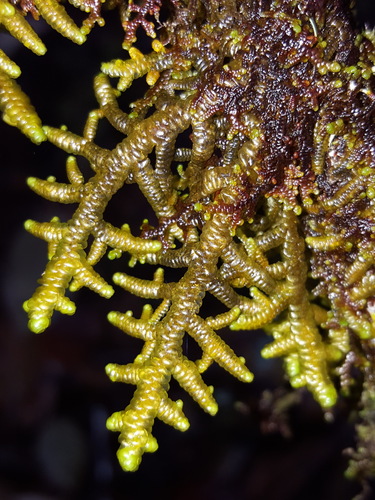
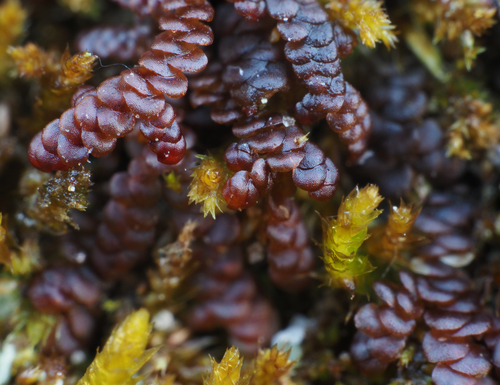
Lepidolaenaceae is a family of robust leafy liverworts endemic to the Southern Hemisphere temperate regions. Belonging to the order Porellales, they are characterized by incubous, complicate-bilobed leaves, large and typically lobed underleaves, and often complex branching patterns, sometimes including specialized branches or potential water sacs.
Overview
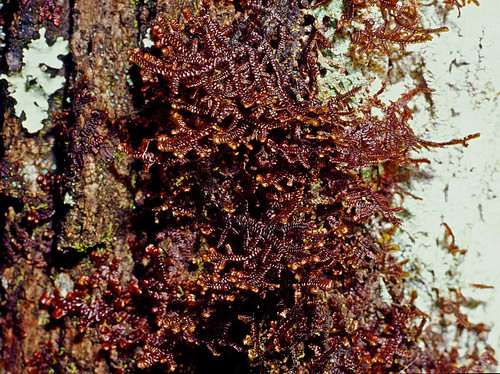
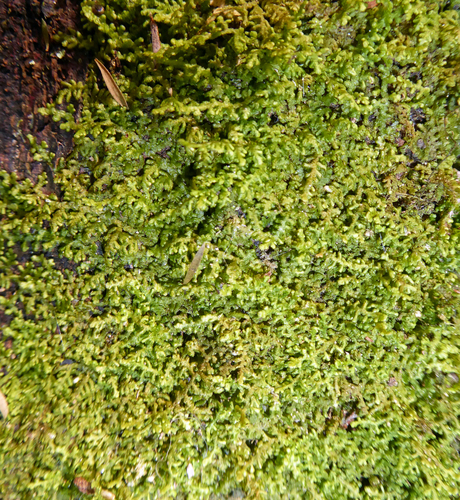
The Lepidolaenaceae family comprises a small group of relatively large and often structurally complex liverworts, restricted entirely to cool, humid temperate rainforests and cloud forests of the Southern Hemisphere, particularly southern South America, New Zealand, Tasmania, and southeastern Australia. The family includes genera like Lepidolaena, Gackstroemia, and Jubulopsis.
These plants typically grow as epiphytes, forming pendent strands or interwoven mats on tree trunks, branches, twigs, or sometimes tree ferns and rocks. They exhibit regular pinnate branching and possess the complicate-bilobed leaves typical of the order Porellales (a large dorsal lobe and a smaller ventral lobule). Unlike Porellaceae (with undivided underleaves) or Radulaceae (with no underleaves), Lepidolaenaceae species have large, conspicuous underleaves that are typically deeply lobed (2-4 lobes). Furthermore, the family is known for morphological complexity, including the potential modification of lobules or underleaf parts into inflated water sacs in some species, and the development of specialized microphyllous (small-leaved) or flagelliform (whip-like) branches.
As a distinct lineage within the Porellales, Lepidolaenaceae showcases unique adaptations and morphological elaborations within this order, and its strict Gondwanan distribution makes it significant for biogeographical studies.
Quick Facts
- Scientific Name: Lepidolaenaceae
- Common Name: Lepidolaena Family
- Number of Genera: 3 (Lepidolaena, Gackstroemia, Jubulopsis)
- Number of Species: Approximately 15-20
- Distribution: Southern Hemisphere temperate (S. South America, NZ, Tasmania, SE Australia)
- Evolutionary Group: Liverworts (Marchantiophyta) - Jungermanniopsida - Porellales - Porellineae
- Key Feature: Incubous complicate-bilobed leaves, large LOBED underleaves, complex branching, Southern Hemisphere.
- Habitat Specificity: Primarily epiphytic in humid temperate forests.
Key Characteristics
Gametophyte Form and Habit
Plants are medium-sized to large, often robust, typically forming pendent strands or interwoven mats adhering to the substrate. Color ranges from green, yellowish-green to brownish or reddish-brown. Stems are prostrate to pendent, usually regularly 1-3 times pinnately branched (Frullania-type lateral branching). Branching systems can be complex, sometimes including specialized microphyllous branches or flagellae.
Leaves and Underleaves
Leaves are arranged incubously and are closely overlapping. They are distinctly complicate-bilobed, divided into a large, ovate to oblong dorsal lobe and a smaller ventral lobule. The lobule shape is variable; it can be flat and lingulate/ovate, or sometimes inflated or saccate, particularly near the base or on specialized branches, potentially forming water sacs. Underleaves are consistently present, large, and conspicuous. Unlike Porellaceae, they are typically deeply divided into 2-4 lobes. Underleaves may also sometimes have saccate structures or modified margins.
Rhizoids
Rhizoids are usually sparse, colorless or brownish, arising in tufts from the base of the underleaves.
Cellular Structure
Leaf cells are typically isodiametric (polygonal). Cell walls are often moderately to strongly thickened, with distinct, sometimes bulging or nodulose trigones. Oil bodies are present, usually granular or segmented.
Asexual Reproduction
Asexual reproduction via gemmae is absent.
Reproductive Structures
Plants are dioicous.
- Antheridia are borne in the axils of saccate bracts on specialized, short, spike-like lateral branches.
- Archegonia are terminal on short lateral branches, surrounded by several pairs of bracts and bracteoles that are often larger and more complexly lobed or divided than vegetative leaves/underleaves.
- A large, prominent perianth is present, typically emergent or exserted. It is usually inflated, ovoid to pyriform or cylindrical, and characteristically plicate (with 3-10 longitudinal folds) towards the contracted mouth, which is often lobed or ciliate. The perianth is generally not strongly dorsiventrally compressed like Porellaceae or Radulaceae. Marsupia are absent.
Sporophytes and Spores
The sporophyte develops within the perianth. The seta is relatively long. The capsule is spherical to ovoid, dark, with a wall composed of multiple layers of cells. Dehiscence occurs via four valves.
Field Identification
Identifying Lepidolaenaceae involves recognizing robust, pinnately branched epiphytes in Southern Hemisphere rainforests, focusing on the combination of complicate-bilobed leaves and large, lobed underleaves.
Primary Identification Features
- Habit: Robust, often pendent epiphytes with regular pinnate branching.
- Leaves: Incubous arrangement; complicate-bilobed with a large dorsal lobe and a smaller ventral lobule (lobule shape variable, sometimes saccate).
- Underleaves: Consistently present, large, and typically deeply divided into 2-4 lobes.
- Habitat & Distribution: Epiphytic (bark, twigs, tree ferns) or epilithic in humid temperate forests of the Southern Hemisphere (S. Am., NZ, Tas, Aus).
- Specialized Structures: May have visible water sacs (modified lobules/underleaves) or microphyllous/flagelliform branches.
Secondary Identification Features
- Color: Often green to brownish or reddish.
- Perianth (if fertile): Large, inflated, plicate (not strongly flattened).
- Gemmae: Absent.
- Cells (Microscopic): Often with distinct trigones.
Seasonal Identification Tips
Lepidolaenaceae gametophytes are perennial:
- Year-Round: The characteristic branching, leaf structure, and large lobed underleaves are visible throughout the year in their humid habitats.
- Reproduction: Perianths on female plants can be conspicuous when developed.
Common Confusion Points
Distinguishing Lepidolaenaceae from other Porellales requires careful attention to underleaf lobing and lobule shape:
- Porellaceae (Porella): Also robust with complicate-bilobed leaves, but underleaves are undivided (entire), and lobules are typically flat.
- Frullaniaceae / Jubulaceae: Have complicate-bilobed leaves, but lobules are typically modified into helmet-shaped sacs, and underleaves are usually bifid (not 2-4 lobed as deeply or complexly).
- Lejeuneaceae: Mostly smaller plants; underleaves are typically bifid, and lobule shape is highly variable but often different.
- Radulaceae (Radula): Completely lacks underleaves.
- Herbertaceae / Lepicoleaceae / Mastigophoraceae: Robust Southern Hemisphere liverworts, but belong to different orders/suborders and lack the typical Porellales complicate-bilobed leaf structure (leaves are deeply divided into simple lobes or segments, or different structure entirely).
Field Guide Quick Reference
Look For:
- Robust, pinnately branched epiphytes
- Leaves incubous, complicate-bilobed (lobe + lobule)
- Underleaves large & LOBED (2-4 lobes)
- Potential water sacs / specialized branches
- Humid temperate forest habitat
- Southern Hemisphere only
Key Distinctions:
- Lobed Underleaves (vs. entire in Porella, absent in Radula, bifid in Frullania/Lejeunea)
- Complicate-bilobed leaves (vs. simply divided in Herbertus/Lepicolea)
- Incubous leaves
- Gemmae absent
- Restricted SH distribution
Notable Examples
The family includes a few distinct genera endemic to the Southern Hemisphere:

Lepidolaena spp. (e.g., L. clavigera, L. taylorii)
(No common name)
The type genus, found in NZ, Tasmania, and SE Australia. Plants are often robust, pinnately branched epiphytes. Leaves complicate-bilobed. Underleaves large and typically 4-lobed. Known for often having clavate (club-shaped) microphyllous branches.

Gackstroemia spp. (e.g., G. weindorferi, G. magellanica)
(No common name)
Found in southern South America, NZ, and Tasmania. Often robust, pendent epiphytes. Similar complicate-bilobed leaves and large, lobed underleaves. Some species possess highly modified water sacs formed from parts of the underleaves or lobules.

Jubulopsis novae-zelandiae
(No common name)
A monotypic genus endemic to New Zealand. Shares features with the other genera but differs in specific details of branching, leaf lobule, and underleaf structure.
Phylogeny and Classification
Lepidolaenaceae is classified within the liverwort division Marchantiophyta, class Jungermanniopsida, order Porellales, and suborder Porellineae. Molecular phylogenetic studies confirm its placement within this suborder, alongside families like Porellaceae, Jubulaceae, Frullaniaceae, and Lejeuneaceae.
It represents a distinct lineage endemic to the Southern Hemisphere temperate zone. Within Porellineae, Lepidolaenaceae is characterized by its combination of complicate-bilobed leaves, large and typically multi-lobed underleaves (unlike the entire underleaves of Porellaceae or bifid underleaves common in Frullaniaceae/Lejeuneaceae), and the frequent development of morphological complexities like specialized branches and potential water-sac structures. Its evolutionary history is deeply tied to the fragmentation of the Gondwanan supercontinent.
Position in Plant Phylogeny
- Kingdom: Plantae
- Clade: Embryophytes (Land Plants)
- Division: Marchantiophyta (Liverworts)
- Class: Jungermanniopsida
- Order: Porellales
- Suborder: Porellineae
- Family: Lepidolaenaceae
Evolutionary Significance
Lepidolaenaceae is significant for:
- Gondwanan Endemism: A prime example of a plant family with a distribution pattern reflecting ancient southern landmass connections.
- Morphological Complexity: Showcases evolutionary elaboration within Porellales, including specialized branches and potential adaptations for water management (sacs).
- Phylogenetic Relationships: Helps resolve the evolutionary history and diversification within the Porellineae suborder.
- Rainforest Biodiversity: An important component of the unique epiphytic bryophyte communities in Southern Hemisphere temperate rainforests.