Jubulaceae
(No widely accepted common name)
Jubulaceae is a small family of leafy liverworts belonging to the order Porellales. It traditionally contains the single genus Jubula, comprising only a few species found primarily in moist, shaded habitats in temperate and tropical regions. These liverworts are characterized by their complex bilobed leaves and distinctive reproductive structures.
Overview
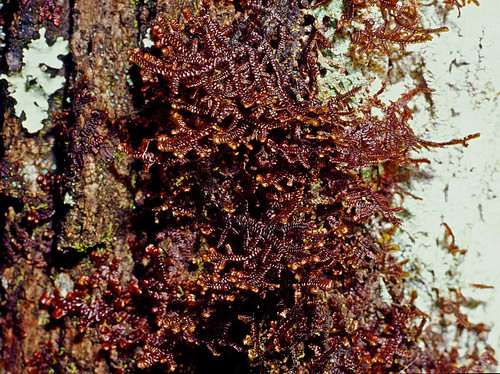
The Jubulaceae family represents a lineage of leafy liverworts within the vast diversity of Bryophytes. Primarily comprising the genus Jubula, these plants are typically small, creeping or pendent epiphytes, growing on tree bark, rocks, or occasionally soil in humid environments. Their intricate morphology, particularly the structure of their leaves and reproductive organs, is key to their classification and identification.
Jubulaceae species are distributed across oceanic temperate zones and tropical mountains, often favouring hyper-oceanic climates with high rainfall and humidity. They play a role in ecosystem dynamics as primary colonizers on certain substrates and contribute to biodiversity in forest understories and riparian zones. Their sensitivity to environmental changes, particularly air pollution and habitat drying, makes them potential bioindicators.
While not economically significant in the way many flowering plant families are, Jubulaceae holds importance for bryologists studying liverwort evolution, morphology, and biogeography. Understanding this family contributes to the broader knowledge of land plant evolution and the diversity within the Marchantiophyta.
Quick Facts
- Scientific Name: Jubulaceae
- Common Name: (None widely established)
- Number of Genera: 1 (Jubula)
- Number of Species: Approximately 3-5
- Distribution: Oceanic temperate regions (Europe, North America, Macaronesia, Asia) and tropical mountains.
- Evolutionary Group: Bryophytes - Marchantiophyta (Liverworts) - Jungermanniopsida - Porellales
Key Characteristics
Gametophyte Form and Habit
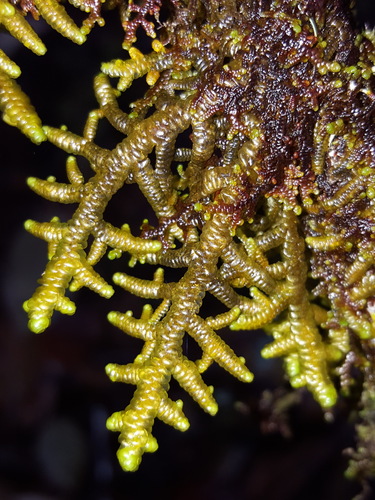
Jubulaceae are leafy liverworts, meaning their dominant photosynthetic generation (gametophyte) consists of a stem with leaf-like appendages. They typically grow as creeping mats or pendent strands, often dark green to brownish-green. Plants are pinnately branched (feather-like branching pattern). Stems possess a cortex of thick-walled cells surrounding a medulla of thinner-walled cells.
Leaves (Phyllids)
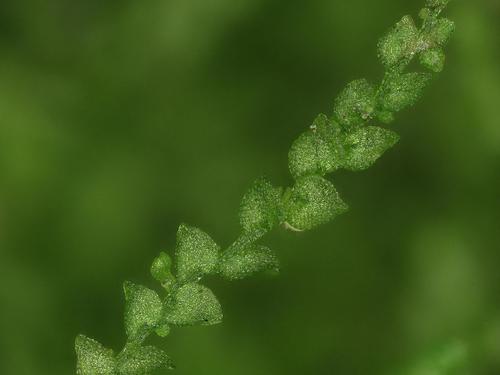
The leaves are arranged in three rows along the stem: two lateral rows of larger leaves and one ventral row of smaller leaves called underleaves (amphigastria). The lateral leaves are distinctive and incubously inserted (the upper margin of a leaf overlaps the lower margin of the leaf above it on the same side of the stem). Each lateral leaf is deeply divided into two parts:
- Dorsal Lobe: The larger, upper part, typically ovate to oblong.
- Ventral Lobule: A smaller, inflated, sac-like or helmet-shaped structure attached to the ventral base of the dorsal lobe. The shape and structure of the lobule are critical identification features.
The underleaves are also typically bilobed (divided into two segments).
Reproductive Structures
Jubulaceae are typically dioicous (male and female reproductive organs are borne on separate plants).
- Antheridia (male organs) are produced in the axils of modified leaves (bracts) on specialized short branches.
- Archegonia (female organs) are clustered at the tip of the main stem or branches and are surrounded by modified leaves (bracts and bracteoles) and a protective structure called the perianth.
- The perianth in Jubula is characteristic: typically inflated, ovate to pyriform (pear-shaped), smooth, and abruptly contracted at the apex into a distinct beak or neck.
Asexual reproduction can occur via fragmentation or potentially through specialized structures, though gemmae (common asexual propagules in other liverworts) are generally absent in this family.
Sporophyte
Following fertilization, a sporophyte (the diploid, spore-producing generation) develops within the archegonium and is protected by the perianth. The sporophyte is dependent on the gametophyte and consists of:
- Foot: Embedded in the gametophyte tissue, absorbing nutrients.
- Seta: A stalk that elongates rapidly at maturity, pushing the capsule out of the perianth.
- Capsule: A typically spherical structure that contains spores and specialized cells called elaters. The capsule wall splits into four valves upon maturity to release the spores. Elaters are hygroscopic (respond to humidity changes) and help disperse the spores.
Spores
The spores are the primary means of long-distance dispersal. They are typically small, unicellular, and haploid. Spore ornamentation (surface patterns) can be taxonomically informative. Upon landing in a suitable environment, a spore germinates to form a protonema, which then develops into a new leafy gametophyte.
Chemical Characteristics
Liverworts, including Jubulaceae, produce a variety of secondary metabolites, often stored in oil bodies within their cells. These compounds can include terpenoids and phenolic compounds, which may play roles in defense against herbivores, pathogens, or UV radiation. The specific chemical profile is less studied than in many flowering plant families but contributes to the plant's biology and ecology.
Field Identification
Identifying Jubulaceae in the field requires close examination, often with a hand lens, focusing on the unique features of these leafy liverworts:
Primary Identification Features
- Leafy Liverwort Habit: Look for small, creeping or pendent plants with distinct stems and leaves (not a flattened thallus).
- Incubous Leaf Insertion: Observe how the lateral leaves overlap – the upper edge of one leaf covers the lower edge of the leaf above it.
- Bilobed Lateral Leaves: Carefully examine a lateral leaf to see the large dorsal lobe and the smaller, often inflated or helmet-shaped ventral lobule.
- Bilobed Underleaves: Check the underside of the stem for the row of smaller, typically two-lobed underleaves.
- Distinct Perianth (if fertile): Look for the characteristic inflated, pear-shaped perianth with a narrowed beak at the tip of female branches.
Secondary Identification Features
- Branching Pattern: Note the typically pinnate (feather-like) branching.
- Habitat: Found in very humid, shaded locations, often on bark, rock faces, or logs near watercourses in temperate rainforests or cloud forests.
- Color: Often dark green, olive-green, or brownish-green.
- Lobule Shape: The specific shape of the ventral lobule (sac-like, helmet-shaped) is key for distinguishing Jubula from related genera (like Frullania).
Seasonal Identification Tips
Liverwort gametophytes are present year-round, but reproductive structures are seasonal:
- Year-Round: Vegetative features (leaf arrangement, lobules, underleaves) are always visible.
- Spring/Summer (Variable): Look for developing perianths on female plants and antheridial branches on male plants. Mature sporophytes with capsules may be present, briefly elongating to release spores before withering.
Common Confusion Points
Jubulaceae can be confused with other leafy liverwort families in the Porellales, especially:
- Frullaniaceae (Frullania): Very similar in appearance (often included in Jubulaceae historically). Frullania typically has helmet-shaped lobules often detached or nearly detached from the lobe, different perianth shapes (often flattened, sometimes with horns or ridges), and often reddish or purplish pigmentation. Jubula lobules are usually more sac-like and broadly attached, and perianths are inflated and smooth with a distinct beak.
- Lejeuneaceae: A very large and diverse family. Many have bilobed leaves and underleaves, but differ in details of lobule structure (often with a distinct tooth/apex), cell structure, oil bodies, and perianth shape (often 5-keeled). Leaf insertion is typically succubous in many, but can be incubous.
- Porellaceae (Porella): Generally larger plants than Jubula, with incubous leaves but the lobule is typically strap-shaped and parallel to the stem, not inflated or helmet-shaped. Underleaves are large and undivided.
Field Guide Quick Reference
Look For:
- Leafy habit, pinnate branching
- Incubous leaf insertion
- Bilobed lateral leaves (lobe + lobule)
- Inflated/sac-like ventral lobule
- Bilobed underleaves
- Inflated, beaked perianth (if fertile)
Key Distinctions:
- vs. Frullania: Lobule shape (sac-like vs. helmet), perianth shape (inflated/smooth vs. flattened/ridged).
- vs. Lejeuneaceae: Details of lobule apex, cell structure, perianth keels.
- vs. Porella: Lobule shape (inflated vs. strap-like), underleaf division (bilobed vs. entire).
Notable Examples
The family Jubulaceae, in its strict sense, primarily includes the genus Jubula.

Jubula hutchinsiae
(Hutchins' Jubula - common name not standard)
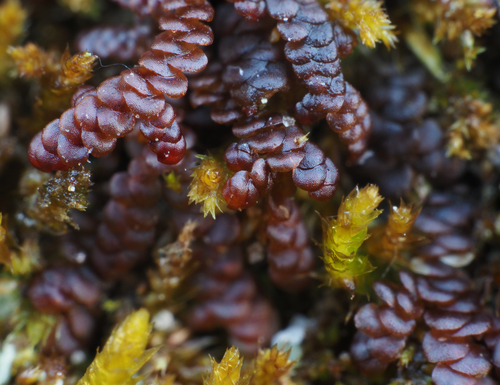
This is the type species for the genus and family. It forms glossy, dark green to brownish patches in very humid, shaded environments, often near waterfalls or streams on rocks or logs. It is characterized by its pinnate branching, incubous leaves with relatively large, inflated ventral lobules, and distinct, smooth, beaked perianths. Distributed in western Europe, Macaronesia, western North America, and parts of Asia.
Phylogeny and Classification
Jubulaceae belongs to the Marchantiophyta (liverworts), one of the earliest diverging lineages of land plants (embryophytes). Within the liverworts, it is placed in the largest class, Jungermanniopsida, and the order Porellales. This order comprises complex leafy liverworts characterized by incubous leaf insertion and often bilobed leaves and underleaves.
Historically, the family Jubulaceae often included the large genus Frullania. However, molecular phylogenetic studies have shown that while closely related, Jubula and Frullania form distinct lineages. Most modern classifications place Frullania in its own family, Frullaniaceae, leaving Jubulaceae as a small, monogeneric family (containing only Jubula). Jubulaceae, Frullaniaceae, Lejeuneaceae, and Porellaceae form the core members of the Porellales.
Position in Plant Phylogeny
- Kingdom: Plantae
- Clade: Embryophyta (Land Plants)
- Division: Marchantiophyta (Liverworts)
- Class: Jungermanniopsida
- Order: Porellales
- Family: Jubulaceae
Evolutionary Significance
The Jubulaceae, as part of the Porellales, represents a highly derived lineage within leafy liverworts. Key evolutionary aspects include:
- Complex Leaf Morphology: The development of bilobed leaves with specialized ventral lobules (potentially for water retention or housing symbiotic organisms) is a significant feature of this order.
- Incubous Insertion: This type of leaf arrangement is characteristic of the Porellales and contrasts with the succubous insertion found in many other leafy liverwort orders.
- Epiphytism: Many members of Porellales, including Jubula, have adapted to an epiphytic lifestyle, colonizing tree bark and contributing to arboreal ecosystems.
- Phylogenetic Position: Studying Jubulaceae helps understand the relationships and evolutionary diversification within the Porellales, a major clade of liverworts.