Hydatellaceae
(No widely accepted common name)
Hydatellaceae is a small, remarkable family of minute, aquatic annual herbs that superficially resemble mosses or small rushes. They possess basal tufts of linear leaves and highly reduced reproductive structures aggregated into dense, head-like units on stalks. Once thought to be monocots, molecular evidence surprisingly places them within the order Nymphaeales, making them close relatives of water lilies and one of the earliest diverging lineages of all flowering plants. They are found in Australia, New Zealand, and India.
Overview
The Hydatellaceae family contains only a single genus, Trithuria (which now includes species formerly placed in Hydatella), with about 10-12 species. These tiny, inconspicuous plants are annual herbs adapted to ephemeral aquatic or semi-aquatic habitats, such as shallow freshwater pools, lake margins, seepages, and wet sandy or peaty soils that dry out seasonally. Their distribution is limited to parts of Australia, New Zealand, and India.
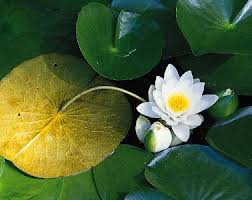
The most significant aspect of Hydatellaceae is its phylogenetic position. For decades, based on their grass-like appearance and reduced features, they were classified within monocots, often near families like Centrolepidaceae or Eriocaulaceae (order Poales). However, groundbreaking molecular studies in the early 21st century revealed their true affinity lies with the Nymphaeales (water lily order), placing them among the most ancient lineages of living angiosperms, alongside Nymphaeaceae, Cabombaceae, and Amborellaceae.
This reclassification highlights the phenomenon of morphological convergence (developing similar forms independently) and underscores the power of molecular data in resolving deep evolutionary relationships. Hydatellaceae are now crucial for understanding the early evolution of flowering plants, particularly adaptations to aquatic life and extreme reduction in floral structures.
Quick Facts
- Scientific Name: Hydatellaceae
- Common Name: (No widely accepted common name)
- Number of Genera: 1 (Trithuria)
- Number of Species: Approximately 10-12
- Distribution: Australia, New Zealand, India.
- Evolutionary Group: Angiosperms - Basal Angiosperms - Order Nymphaeales
Key Characteristics
Growth Form and Habit
Minute (often only a few cm tall), submerged or emergent aquatic annual herbs. Often resemble small tufts of grass, rushes, or mosses. Root system is fibrous.
Leaves
Leaves are basal, forming a small tuft or rosette. They are simple, linear or thread-like (filiform), typically with only a single vascular strand. They lack clear differentiation into sheath, petiole, and blade. Stipules are absent.
Reproductive Units (Inflorescences)
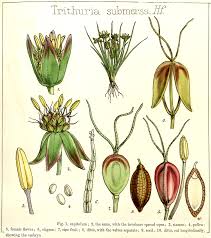
The structures bearing reproductive organs are highly modified and reduced, often termed "reproductive units" or "flowering units" rather than typical inflorescences or flowers. These units are dense, small, head-like clusters borne terminally on slender stalks (scapes) and subtended by an involucre of 2-4 (sometimes more) papery or leaf-like bracts. Units are typically unisexual (containing either male or female structures, with plants being monoecious or dioecious), though sometimes mixed structures occur.
Reproductive Structures (within Units)
Individual "flowers" within the reproductive units are extremely reduced and lack any perianth (sepals or petals).
- Male Structures: Consist solely of a single stamen, comprising a filament (sometimes very short) and an anther with typically 2 or 4 pollen sacs (microsporangia).
- Female Structures: Consist solely of a single carpel (simple pistil) containing a single ovule. The carpel has a superior ovary which tapers into a style, often branched, bearing stigmatic hairs for pollen capture.
- Associated Hairs: Both male and female structures are often interspersed with distinctive multicellular hairs within the reproductive unit.
Fruits and Seeds
The fruit develops from a single carpel and is small, dry, and indehiscent (achene-like) or sometimes dehiscent along one side (follicle-like). It contains a single seed. The seed is characterized by the presence of starchy perisperm (nutritive tissue derived from the maternal nucellus) and lacks true endosperm.
Chemical Characteristics
Detailed chemical studies are limited. They lack the ethereal oil cells found in many other basal angiosperms like Nymphaeaceae.
Field Identification
Identifying Hydatellaceae requires careful observation of tiny aquatic plants in specific habitats and locations, focusing on the unique reproductive units.
Primary Identification Features
- Habit: Tiny (few cm) aquatic annual herb (submerged or emergent).
- Appearance: Resembles moss, small grass, or rush tufts.
- Leaves: Basal tuft of simple, linear/thread-like leaves.
- Reproductive Units: Small, dense, terminal heads on slender scapes, subtended by involucral bracts.
- Flowers: Absent (structures within heads are naked stamens or carpels).
- Habitat: Ephemeral pools, lake margins, wet depressions (often sandy/peaty).
- Distribution: Australia, New Zealand, India only.
Secondary Identification Features
- Unisexual Units: Heads usually contain only stamens or only carpels.
- Fruit: Tiny achene or follicle within persistent bracts.
- Perisperm: Presence of perisperm in seed (microscopic).
Seasonal Identification Tips
- Wet Season: Plants germinate, grow, flower, and fruit rapidly during periods when their ephemeral habitats hold water. This is the best time for observation.
- Dry Season: Plants die back, surviving as seeds in the soil.
Common Confusion Points
Due to their small size and reduced features, Hydatellaceae can be easily overlooked or confused with:
- Centrolepidaceae: Tiny monocots (Poales) in similar habitats (esp. Australia); also have flowers in heads with bracts, but flowers possess glume-like scales, different stamen/carpel structure.
- Eriocaulaceae (Pipewort family): Monocots (Poales) in wet habitats with flowers in button-like heads on scapes, but flowers are unisexual, tiny but possess distinct (though small) sepals and petals, often hairy.
- Juncaginaceae (Arrowgrass family): Monocots (Alismatales) of wet habitats, but flowers have a perianth (tepals) and are usually arranged in spikes or racemes, not dense heads.
- Isoetes (Quillworts): Lycophytes (fern allies), not flowering plants. Have linear leaves in a basal tuft, grow in wet places, but reproduce via spores located in swollen leaf bases, lack flowers/seeds/heads.
- Aquatic Mosses/Liverworts: Non-vascular plants lacking true roots, stems, leaves, flowers, or seeds. Reproduce via spores.
Confirmation often requires microscopic examination of the reproductive units to see the naked stamens/carpels and lack of perianth, combined with the characteristic habit and restricted distribution.
Field Guide Quick Reference
Look For:
- Tiny aquatic/semi-aquatic annual herb
- Moss-like or grass-like tuft
- Basal, linear/thread-like leaves
- Small heads on scapes
- Heads subtended by bracts
- Reproductive parts inside head lack petals/sepals
- Habitat: ephemeral wetlands
- Distribution: Australia/NZ/India
Key Variations:
- Plant size (very small range)
- Scape length
- Bract number/color
- Monoecious vs. Dioecious
Notable Examples
All known species belong to the genus Trithuria.

Trithuria spp.
(No common name)
The sole genus in the family, comprising tiny annual aquatic herbs. Species like T. submersa (Australia, NZ, India) and T. filamentosa (Australia) grow in ephemeral wetlands. They exhibit the characteristic basal tuft of linear leaves and small reproductive heads on scapes containing highly reduced unisexual structures (naked stamens or carpels).
Phylogeny and Classification
The phylogenetic placement of Hydatellaceae represents one of the major recent discoveries in angiosperm systematics. Morphologically, these tiny aquatic plants strongly resemble certain monocot families adapted to similar habitats (like Centrolepidaceae), leading to their long-standing classification within monocots, often in or near the order Poales.
However, molecular phylogenetic studies published starting in 2007 provided compelling evidence that Hydatellaceae are not monocots at all. Instead, they belong to the order Nymphaeales, which includes water lilies (Nymphaeaceae) and watershields (Cabombaceae). Nymphaeales is one of the three earliest diverging lineages of living angiosperms (along with Amborellales and Austrobaileyales), collectively known sometimes as the "ANA grade." Hydatellaceae is robustly placed as the sister group to the clade containing Nymphaeaceae + Cabombaceae.
This surprising placement indicates that the simple, reduced morphology of Hydatellaceae is a result of extreme adaptation to their ephemeral aquatic lifestyle, and their resemblance to certain monocots is purely convergent evolution. They are now understood to be highly modified basal angiosperms.
Position in Plant Phylogeny
- Kingdom: Plantae
- Clade: Angiosperms (Flowering plants)
- Clade: Basal Angiosperms ("ANA Grade")
- Order: Nymphaeales
- Family: Hydatellaceae
Evolutionary Significance
Hydatellaceae holds profound evolutionary significance:
- Basal Angiosperm Lineage: Represents a surviving branch from near the very base of the angiosperm evolutionary tree, providing critical insights into early flowering plant characteristics.
- Phylogenetic Revolution: Its reclassification based on molecular data dramatically altered understanding of angiosperm relationships and highlighted the potential for extreme morphological modification and convergence.
- Evolution of Aquatic Life: Offers a case study in adaptation to ephemeral aquatic habitats and the associated extreme reduction of vegetative and reproductive structures.
- Morphological Plasticity: Demonstrates how highly derived and simplified morphologies can evolve within ancient lineages.
- Biogeography: Its disjunct distribution hints at ancient origins and dispersal patterns across Gondwanan continents.