Herbertaceae
Herbertus / Scissors-leaf Family
Herbertaceae is a distinctive family of leafy liverworts, primarily comprising the genus Herbertus. These robust plants are recognized by their unique structure, with both leaves and underleaves deeply divided into typically three narrow lobes, giving the shoots an almost radially symmetrical appearance. They are found worldwide, particularly in humid montane, alpine, and oceanic regions.
Overview
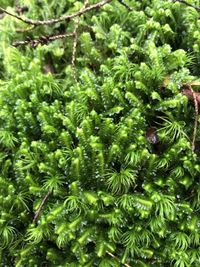
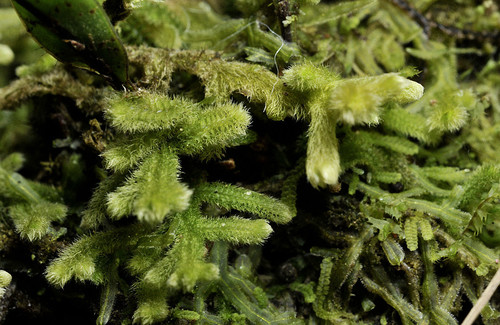
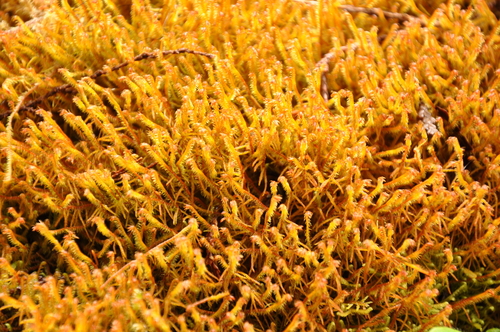
The Herbertaceae family stands out within the Jungermanniales due to its unique morphology. Primarily represented by the genus Herbertus, these liverworts are typically robust and often form large, conspicuous mats or cushions in their preferred habitats. Their most striking feature is the deep division of both leaves and underleaves into usually three (sometimes two) narrow, pointed lobes, often resembling scissors, hence the common name "Scissors-leaf". Because the underleaves are similar in size and shape to the lateral leaves, the shoots appear to have six rows of similar lobes, creating a near-radial symmetry uncommon in leafy liverworts.
Herbertaceae are predominantly found in cool, humid environments, such as montane cloud forests, alpine heathlands, temperate rainforests, and oceanic cliffs. They often grow on rocks, tree trunks, or peaty soil. Their robust nature and often reddish-brown pigmentation make them noticeable elements of the bryophyte flora in these regions.
The family occupies its own suborder, Herbertineae, suggesting a distinct evolutionary lineage within the Jungermanniales. Studying Herbertaceae provides insights into adaptations to high-humidity, often cool environments and the evolution of unique gametophyte architectures among liverworts.
Quick Facts
- Scientific Name: Herbertaceae
- Common Name: Herbertus Family / Scissors-leaf Family
- Number of Genera: 1 (Herbertus) (sometimes includes Triandrophyllum)
- Number of Species: Approximately 20-30 (in Herbertus)
- Distribution: Widespread in humid montane, alpine, and oceanic regions globally
- Evolutionary Group: Liverworts (Marchantiophyta) - Jungermanniopsida - Herbertineae
Key Characteristics
Gametophyte Form and Habit
Plants are medium-sized to large and robust, forming dense mats, cushions, or sometimes pendent strands. Color is typically characteristic, ranging from dark green to olive-green, yellowish-brown, reddish-brown, or purplish-black. Stems are relatively rigid, creeping to ascending or pendent, with branching predominantly lateral (Frullania-type), often appearing somewhat dichotomous.
Leaves and Underleaves
This is the most distinctive feature. Leaves are inserted transversely or slightly succubously. They are deeply divided, often almost to the base, into 2 or, more characteristically, 3 narrow, lanceolate, tapering lobes. Underleaves are virtually identical to the lateral leaves in size, shape, and deep 2-3 lobing. This similarity between leaves and underleaves gives the shoot a characteristic appearance of having 6 rows of similar lobes and results in near-radial symmetry.
Rhizoids
Rhizoids are typically sparse, colorless or brownish, and usually arise from the base of the underleaves.
Cellular Structure
Leaf cells are typically strongly thick-walled, with conspicuous, often large and bulging or knot-like (nodulose) trigones (thickenings at cell corners). The cell lumen (internal space) may appear rounded or star-shaped due to the large trigones. The cuticle (outer surface) is often distinctly papillose (covered in small bumps).
Reproductive Structures
Plants are consistently dioicous (separate male and female plants).
- Antheridia are located in the axils of modified leaves (bracts) that are often slightly smaller and more saccate (pouched) than vegetative leaves, forming intercalary spike-like androecia.
- Archegonia are terminal on leading shoots or long branches, surrounded by several pairs of bracts and bracteoles that are similar to, but often larger than, the vegetative leaves and underleaves.
- A well-developed perianth is present, situated terminally. It is typically long, cylindrical or fusiform (spindle-shaped), often deeply plicate (folded or pleated) towards the narrowed mouth. Marsupia are absent in this family.
Sporophytes and Spores
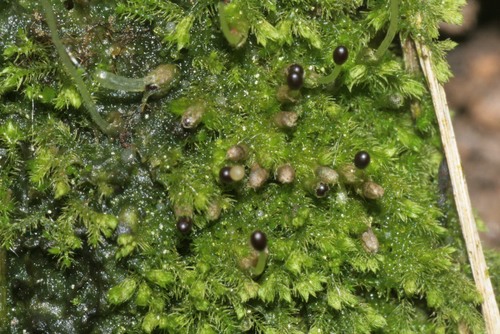
The sporophyte develops within the perianth. It consists of a foot, a relatively massive seta, and an ovoid capsule. The capsule wall is thick (multi-layered). Dehiscence occurs via four valves, releasing spores and elaters.
Field Identification
Identifying Herbertaceae usually involves recognizing their robust habit, characteristic coloration, and unique leaf/underleaf structure in specific humid environments. A hand lens is helpful to confirm lobe details.
Primary Identification Features
- Symmetry: Shoots appear almost radially symmetrical due to large underleaves resembling lateral leaves.
- Leaves and Underleaves: Both deeply divided into 2-3 narrow, tapering lobes ("scissors-leaves"). Look for 6 apparent rows of similar lobes around the stem.
- Habit and Color: Robust plants, often forming large mats/cushions, frequently with reddish-brown or purplish-black hues (though can be green).
- Habitat: Typically found in humid, cool environments: montane/cloud forests, alpine/subalpine zones, oceanic temperate rainforests, on rocks, trees, or peat.
- Cell Walls (Microscopic): Cells are strongly thick-walled with large trigones.
Secondary Identification Features
- Branching Pattern: Often appears somewhat dichotomous (Frullania-type lateral branching).
- Texture: Plants often feel somewhat stiff or wiry due to thick cell walls.
- Perianth: If fertile, look for long, terminal, pleated perianths.
Seasonal Identification Tips
Herbertaceae gametophytes are perennial and identifiable throughout the year:
- Year-Round: The distinctive vegetative morphology (lobe structure, symmetry, color, cell walls) is always present.
- Moisture Levels: Plants may appear more turgid and colors more vibrant when moist.
- Reproductive Structures: Perianths and androecia may be observed at certain times, depending on species and local conditions. Sporophytes are less commonly encountered.
Common Confusion Points
The unique structure of Herbertaceae makes it fairly distinct, but confusion can arise with:
- Trichocoleaceae: Also have finely divided leaves/underleaves, but these are typically ciliate (hair-like) segments, giving a "woolly" appearance, rather than lanceolate lobes. Cells are usually thin-walled.
- Some Lepidoziaceae (e.g., Kurzia): Can have deeply divided leaves/underleaves, but are generally much smaller, more delicate plants, often pale green, and lack the robust habit and thick cell walls of Herbertus.
- Pseudolepicoleaceae: Have divided leaves/underleaves, but differ in symmetry, cell structure, and branching patterns.
- Mastigophoraceae: Robust plants with divided underleaves, but lateral leaves are typically incubous and less deeply divided or differently shaped.
Field Guide Quick Reference
Look For:
- Robust habit, often reddish/brownish
- Apparent radial symmetry (6 rows of lobes)
- Leaves AND underleaves deeply cut into 2-3 narrow lobes
- Thick-walled cells (feel stiff)
- Humid montane/alpine/oceanic habitats
- Long, terminal, pleated perianth (if fertile)
Key Distinctions:
- Deeply lobed leaves AND underleaves (vs. different structures in most others)
- Radial symmetry (vs. dorsiventral)
- Narrow, non-ciliate lobes (vs. Trichocoleaceae)
- Robust size and thick walls (vs. delicate Lepidoziaceae)
- Absence of marsupium
Notable Examples
The family is dominated by the genus Herbertus:

Herbertus aduncus
(No common name)
A widespread species found in oceanic regions of Europe, North America, and elsewhere. Typically forms robust, reddish-brown to dark green mats on rocks or peat in humid areas. Shows the characteristic deeply 2-3 lobed leaves and underleaves.

Herbertus hutchinsiae
Hutchins' Herbertus
Another species of oceanic temperate regions, particularly prominent in the British Isles and Macaronesia. Often found on damp, shaded cliffs and rocks. Similar morphology to H. aduncus, differentiation often relies on subtle cellular or lobe characteristics.

Herbertus subdentatus
(No common name)
A species often found in tropical montane forests (e.g., Andes, Africa, Asia). Demonstrates the family's presence in high-altitude tropical environments, often growing epiphytically or on wet rocks. Exhibits the typical robust habit and 3-lobed leaf/underleaf structure.
Phylogeny and Classification
Herbertaceae occupies a unique position within the liverwort division Marchantiophyta, class Jungermanniopsida, order Jungermanniales. It is placed in its own distinct suborder, Herbertineae. This classification reflects its unique combination of morphological features (especially the radially symmetric shoots with deeply lobed leaves and underleaves, and thick-walled cells) and molecular data, suggesting it represents an early diverging or isolated lineage within the Jungermanniales.
The family primarily contains the genus Herbertus. The genus Triandrophyllum, sometimes included here, shares the feature of large underleaves but differs in leaf lobing and cell structure, and is often placed in its own family, Triandrophyllaceae, also within or near Herbertineae. The distinctiveness of the Herbertineae highlights the diverse evolutionary pathways taken within the leafy liverworts.
Position in Plant Phylogeny
- Kingdom: Plantae
- Clade: Embryophytes (Land Plants)
- Division: Marchantiophyta (Liverworts)
- Class: Jungermanniopsida
- Order: Jungermanniales
- Suborder: Herbertineae
- Family: Herbertaceae
Evolutionary Significance
Herbertaceae is significant for:
- Unique Morphology: The near-radial symmetry achieved through large, leaf-like underleaves and the deeply dissected "scissors-leaves" represent a distinct body plan.
- Phylogenetic Isolation: Its placement in the monotypic (or nearly so) suborder Herbertineae points to an ancient divergence or unique evolutionary trajectory.
- Ecological Specialization: Primarily adapted to cool, high-humidity environments, often dominating bryophyte communities in specific montane and oceanic habitats.
- Cellular Adaptations: The strongly thickened cell walls with large trigones may provide structural support and potentially desiccation resistance.