Trichocoleaceae
Hairywort / Woollywort Family
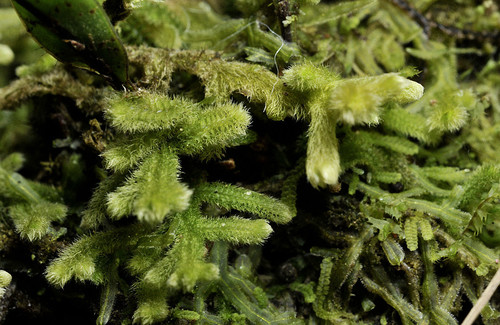
Trichocoleaceae is a distinctive family of leafy liverworts (order Jungermanniales) easily recognized by their 'hairy' or 'woolly' appearance. This texture results from both the lateral leaves and underleaves being deeply dissected into numerous fine, capillary segments or cilia. They typically exhibit pinnate branching and possess a fleshy perigynium instead of a perianth.
Overview
The Trichocoleaceae family is renowned for its unique texture among leafy liverworts. The plants, primarily belonging to the genus Trichocolea (with a few other small genera like Eotrichocolea and Leiomitra), appear strikingly 'hairy', 'woolly', or 'fuzzy'. This appearance is due to the extreme dissection of both the lateral leaves and the underleaves into numerous, very fine, often branched, hair-like segments (cilia), typically composed of single rows of cells. These liverworts are widespread, found from temperate to tropical regions, usually growing in very humid, shaded habitats such as wet forest floors, stream banks, waterfalls, logs, and rocks, where they often form extensive, pale green or whitish mats.
Vegetatively, they often exhibit regular pinnate or bipinnate branching, contributing to their feathery look. Reproductively, they are notable for possessing a perigynium (a fleshy, pouch-like structure derived from stem tissue, similar to that in Calypogeiaceae) which encloses the developing sporophyte, rather than the more common perianth found in many other leafy liverwort families. The perigynium itself is often covered in structures similar to the dissected leaves, enhancing the overall hairy appearance.
Quick Facts
- Scientific Name: Trichocoleaceae Nakai
- Common Name: Hairywort / Woollywort Family
- Number of Genera: Approx. 3 (Mainly Trichocolea, also Eotrichocolea, Leiomitra).
- Number of Species: Approximately 20-30 species.
- Distribution: Widespread in humid temperate and tropical regions globally.
- Evolutionary Group: Bryophytes - Liverworts (Marchantiophyta) - Jungermanniopsida - Jungermanniales (sometimes placed in order Trichocoleales).
Key Characteristics
Note: Trichocoleaceae are leafy liverworts defined by their highly dissected leaves/underleaves creating a hairy appearance, and possession of a perigynium.
Gametophyte (Leafy Shoot) Structure
The dominant phase is the distinctive leafy gametophyte:
- Form: Medium-sized to large plants, forming loose, soft, often extensive mats or wefts. Typically pale green, whitish-green, or yellowish-green.
- Stems: Slender to moderately robust, flexible.
- Leaves & Underleaves (Isophyllous/Subisophyllous): Both lateral leaves and underleaves are present, large, and strikingly similar in structure.
- Structure: Both are deeply dissected almost to the base into numerous, fine, branched or unbranched, capillary segments or cilia, usually composed of single rows of elongated cells. This dense covering of cilia gives the plant its characteristic hairy or woolly texture. A small basal lamina (undivided portion) may be present but is often obscured.
- Insertion: Lateral leaf insertion is typically incubous or transverse.
- Branching: Often regularly pinnate or bipinnate (1-3 pinnate), contributing to a feathery appearance. Branching is typically terminal (Frullania-type).
- Asexual Reproduction: Generally absent or rare; propagation likely occurs via fragmentation.
Reproductive Structures
Species are typically dioicous.
- Antheridia: Male organs are borne in the axils of modified saccate bracts (androecia), usually located on specialized short branches.
- Archegonia: Female organs are terminal on short ventral-intercalary branches. They are enclosed within bracts (which are also dissected and ciliate) and a well-developed perigynium (also known as a shoot calyptra). This is a fleshy, often subterranean or surface-hugging pouch derived from stem tissue, which is frequently covered in cilia or scales similar to the leaves, further enhancing the hairy look. A true perianth is absent.
Sporophyte
The sporophyte develops within the hairy perigynium:
- Foot: Embedded in the base of the perigynium.
- Seta: Distinct, elongating considerably at maturity, raising the capsule.
- Capsule: Ovoid to cylindrical, typically dark. Capsule wall is multistratose.
- Dehiscence: Capsule splits longitudinally into four straight valves upon maturity.
Spores and Elaters
Contained within the capsule.
- Spores: Small, spherical, typically finely papillose or granular.
- Elaters: Present, long and slender with 2 spiral thickenings.
Field Identification
Identifying Trichocoleaceae is usually straightforward due to the unmistakable hairy or woolly appearance of the plants.
Primary Identification Features
- Hairy/Woolly Texture: The entire plant appears fuzzy or hairy due to the deep dissection of both leaves and underleaves into fine cilia.
- Dissected Leaves & Underleaves: Close examination (hand lens may suffice) reveals that the apparent 'hairs' are actually numerous fine segments originating from highly divided leaves and underleaves.
- Isophyllous/Subisophyllous Habit: Lateral leaves and underleaves are large and similar in structure.
- Pinnate Branching (Common): Plants often exhibit regular, feather-like branching.
- Perigynium (if fertile): Sporophytes emerge from a fleshy, often hairy pouch (perigynium) on a short ventral branch, not a typical perianth.
- Habitat: Found in very humid, shaded locations (wet forests, stream banks, waterfalls).
Secondary Identification Features
- Pale Coloration: Often whitish-green or pale yellowish-green.
- Soft Texture: Plants feel soft and 'woolly' to the touch.
Seasonal Identification Tips
- Year-round: The unique vegetative appearance is the primary identification feature and is present year-round in suitable habitats.
- Reproductive Periods: Observing the hairy perigynium can confirm identification, but the vegetative state is usually sufficient.
Common Confusion Points
The hairy appearance makes Trichocoleaceae quite distinct:
- Ptilidium (Ptilidiaceae): Also has ciliate leaves, but the leaves are fundamentally lobed with cilia mainly on the margins, not dissected entirely into cilia. Leaf insertion is incubous, and it has a perianth, not a perigynium.
- Highly Divided Lepidoziaceae (e.g., Kurzia, Telaranea): Leaves/underleaves can be divided into narrow segments, but typically not to the extent seen in Trichocolea, and they lack the overall dense 'hairy' covering. They also have a perianth on a ventral branch, not a perigynium.
- Some Mosses (e.g., Thuidium, some Hookeriaceae): Some feathery mosses might superficially resemble Trichocolea from a distance, but close inspection reveals typical moss leaves (often with a costa) arranged spirally, and completely different sporophyte structures (capsules on setae, often with peristomes).
Key differentiator: The dense, hairy/woolly appearance caused by leaves and underleaves being dissected into numerous fine cilia is unmistakable for Trichocoleaceae.
Field Guide Quick Reference
Look For:
- Hairy / Woolly / Fuzzy appearance
- Leaves & Underleaves deeply dissected into cilia
- Large, similar leaves & underleaves (isophyllous tendency)
- Often regularly pinnately branched
- Pale green / whitish color
- Fleshy, hairy perigynium (if fertile)
- Very humid, shaded habitat
Key Distinctions:
- Appears hairy (unlike most liverworts)
- Leaves/underleaves dissected (not just ciliate margins like Ptilidium)
- Has perigynium (not perianth)
- Clearly liverwort structure (unlike mosses)
Notable Examples
The family is dominated by the genus Trichocolea.

Trichocolea tomentella
(Woollywort / Hairywort)
A widespread and relatively common species found in humid temperate and tropical forests across the globe. Forms extensive, soft, pale whitish-green mats on damp soil, logs, and rocks. Exhibits the characteristic highly dissected leaves/underleaves and often regular pinnate branching.

Trichocolea mollissima
(Soft Hairywort)
Often found in similar habitats, particularly prominent in Australasia and surrounding regions. May be larger and even more 'woolly' than T. tomentella, with very dense ciliation. Taxonomic distinction between species can sometimes be subtle.
Phylogeny and Classification
Trichocoleaceae is a distinctive family whose phylogenetic placement has sometimes been debated. While traditionally included within the large order Jungermanniales, its unique morphology (extreme leaf dissection, perigynium) has led some classifications to place it, along with potentially related families like Herbertaceae and Pseudolepicoleaceae, into a separate order, Trichocoleales. However, many recent molecular studies place it back within Jungermanniales, often near Herbertaceae and Pseudolepicoleaceae, suggesting these families form a related clade characterized by tendencies towards isophylly and leaf division.
The evolution of the highly dissected leaves and the perigynium are key features. The 'hairy' structure dramatically increases the surface area, which may be advantageous for water absorption and retention in their humid microhabitats. The perigynium represents an alternative evolutionary solution for sporophyte protection compared to the more common perianth.
Position in Plant Phylogeny
- Kingdom: Plantae
- Division: Marchantiophyta (Liverworts)
- Class: Jungermanniopsida
- Order: Jungermanniales (or sometimes Trichocoleales)
- Family: Trichocoleaceae
- (Relationships often considered close to Herbertaceae, Pseudolepicoleaceae)
Evolutionary Significance
Trichocoleaceae is significant for:
- Extreme Morphological Specialization: The complete dissection of leaves/underleaves into cilia represents a unique body plan among leafy liverworts.
- Convergent Evolution?: The perigynium structure also occurs in the unrelated Calypogeiaceae, suggesting potential convergent evolution of this protective structure.
- Phylogenetic Relationships: Its placement helps understand the relationships among liverwort lineages with tendencies towards isophylly and leaf division.
- Adaptation to Humid Environments: The 'hairy' structure likely plays a role in water relations in constantly moist habitats.