Helwingiaceae
Helwingia Family
Helwingiaceae is a small, monogeneric family of flowering plants containing only the genus Helwingia, with 3-5 species of deciduous shrubs or small trees native to temperate and subtropical East Asia. The family is exceptionally distinctive due to its epiphyllous inflorescences, where the flowers are borne directly on the upper surface of the leaf midrib. Helwingiaceae belongs to the order Aquifoliales.
Overview
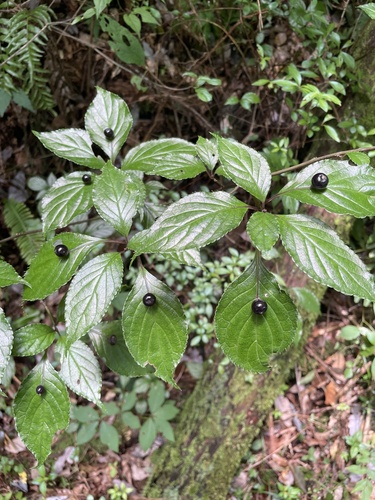
The Helwingiaceae family comprises a single genus, Helwingia, found in forest understories from the Himalayas eastward through China to Japan. These plants are deciduous shrubs or small trees, easily recognized by one of the most unusual features in the plant kingdom: their flowers and subsequent fruits are produced directly on the upper surface of the leaf midrib. This condition, known as epiphylly, results from the developmental fusion of the inflorescence stalk (peduncle) with the leaf petiole and midrib.
Helwingia species are dioecious, meaning male and female flowers occur on separate plants. The flowers themselves are small, greenish, and inconspicuous, lacking petals. Pollination is thought to be by wind or small insects. The fruit is a small, berry-like drupe that ripens to red or black.
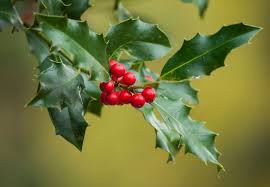
Placed in the order Aquifoliales, Helwingiaceae is related to the holly family (Aquifoliaceae) and the similarly epiphyllous Phyllonomaceae. Its unique morphology makes it a subject of interest for developmental and evolutionary botany.
Quick Facts
- Scientific Name: Helwingiaceae
- Common Name: Helwingia Family
- Number of Genera: 1 (Helwingia)
- Number of Species: Approximately 3-5
- Distribution: Temperate and subtropical East Asia (Himalayas, China, Korea, Japan). Forest understories.
- Evolutionary Group: Angiosperms - Eudicots - Asterids - Campanulids - Aquifoliales
Key Characteristics
Growth Form and Habit
Deciduous shrubs or small trees, typically growing in the understory of forests.
Leaves
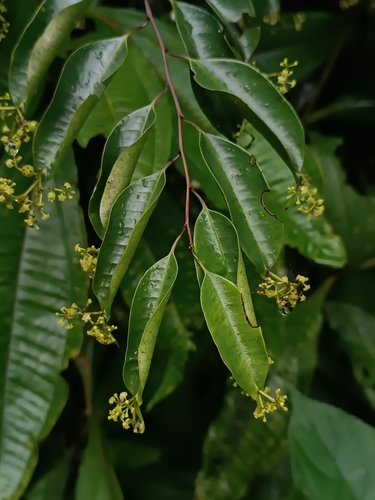
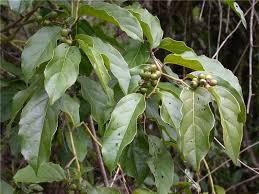
Leaves are simple, alternate, and spirally arranged. The leaf blade is typically ovate with a serrated or crenated margin and pinnate venation. Small, fringed stipules are present at the base of the petiole but often fall off early.
Inflorescences and Flowers
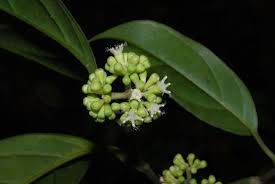
The most distinctive feature is that the inflorescences (small umbels or clusters of flowers) are epiphyllous, appearing to grow directly from the midrib on the upper surface of the leaf blade. This arises from the congenital fusion of the inflorescence axis with the petiole and leaf midrib.
Flowers are small, inconspicuous, actinomorphic (radially symmetrical), and unisexual (plants are dioecious).
- Perianth: Petals are absent. The perianth consists of a single whorl of (3-)4-5 small, greenish, pointed lobes, usually interpreted as sepals.
- Male Flowers: Possess (3-)4-5 stamens alternating with the sepal lobes. A rudimentary pistillode may be present.
- Female Flowers: Lack functional stamens (may have small staminodes). The ovary is inferior or half-inferior, composed of (2-)3-5 fused carpels forming a (2-)3-5-locular ovary. Each locule contains a single pendulous ovule. The style is very short or absent, with (2-)3-5 distinct, recurved stigmas.
Fruits and Seeds
The fruit is a small, globose, berry-like drupe, typically ripening red or black. It is crowned by the persistent sepals and stigmas. The drupe contains (2-)3-5 hard pyrenes (stones), each enclosing a single seed.
Dioecy
Plants are consistently dioecious, with individual plants bearing either only male flowers or only female flowers.
Field Identification
Identifying Helwingiaceae (Helwingia) is exceptionally straightforward if flowers or fruits are present, due to their unique position on the leaf surface.
Primary Identification Features
- Habit: Deciduous shrubs or small trees (East Asia).
- Leaves: Alternate, simple, serrated/crenated margins.
- Inflorescences/Flowers: Borne directly on the upper surface of the leaf midrib (epiphyllous) - this is the key diagnostic feature.
- Flowers: Small, greenish, unisexual (dioecious), petals absent, (3-)4-5 sepals and stamens (male).
- Ovary: Inferior or half-inferior (female).
- Fruit: Small red or black berry-like drupe located on the leaf surface.
Secondary Identification Features
- Small, fringed stipules present (may fall early).
- Found in forest understory habitats.
Seasonal Identification Tips
- Spring/Summer: Look for the small greenish flowers situated on the leaf midribs. Check individual plants to determine sex (male vs female flowers).
- Late Summer/Autumn: Look for the small red or black drupes developing on the leaf midribs of female plants.
- Vegetative State: While less definitive, look for alternate, simple, serrated leaves on shrubs/small trees in East Asian forests. Carefully examine leaf surfaces for scars where previous inflorescences/fruits were attached.
Common Confusion Points
- The epiphyllous position of flowers/fruits is highly unusual and makes confusion with other temperate woody plants unlikely once observed.
- Vegetatively, it resembles other generic deciduous shrubs with alternate, simple, serrated leaves, but the epiphyllous character is unique in its range outside of the related (but geographically separate) Phyllonomaceae.
Field Guide Quick Reference
Look For:
- Deciduous shrub/small tree (E Asia)
- Alternate, simple, serrated leaves
- Flowers/Fruits ON leaf midrib surface
- Small, greenish, unisexual flowers (no petals)
- Small red/black drupe fruit
Key Variations (within Helwingia):
- Number of flower parts (3, 4, or 5)
- Leaf size and shape
- Slight variations in drupe color
Notable Examples
All examples belong to the genus Helwingia.

Helwingia japonica
Japanese Helwingia
A deciduous shrub native to Japan, Korea, Taiwan, and parts of China. It typically grows 1-2 meters tall. Leaves are ovate with serrated margins. Small greenish flowers appear on the leaf midribs in spring, followed by small black drupes on female plants. Several subspecies and varieties are recognized.

Helwingia himalaica
Himalayan Helwingia
Found in the Himalayan region, from Nepal eastward through Bhutan, NE India, Myanmar, to China. Similar to H. japonica but often with slightly larger leaves or differences in flower part numbers. Grows in forest understories at moderate altitudes.

Helwingia chinensis
Chinese Helwingia
Native to central and southern China. Morphologically similar to other species, often distinguished by subtle features of leaf shape, hairiness, or flower/fruit details. Taxonomy within the genus is complex, and species boundaries are sometimes debated.
Phylogeny and Classification
Helwingiaceae is placed within the order Aquifoliales, which belongs to the Campanulids (or Euasterids II) clade within the Asterids. This order is relatively small compared to giants like Asterales or Lamiales.
Within Aquifoliales, Helwingiaceae is most closely related to Phyllonomaceae, another small family (genus Phyllonoma) from Central and South America that remarkably also exhibits epiphyllous inflorescences, suggesting either a shared ancestry for this trait or perhaps parallel evolution within closely related lineages. Helwingiaceae and Phyllonomaceae together form a clade that is related to the other families in the order: Aquifoliaceae (hollies), Cardiopteridaceae, and Stemonuraceae.
Position in Plant Phylogeny
- Kingdom: Plantae
- Clade: Tracheophytes (Vascular Plants)
- Clade: Angiosperms (Flowering Plants)
- Clade: Eudicots
- Clade: Asterids
- Clade: Campanulids (Euasterids II)
- Order: Aquifoliales
- Family: Helwingiaceae
Evolutionary Significance
Helwingiaceae is notable for several evolutionary aspects:
- Epiphyllous Inflorescences: Represents a striking example of morphological specialization where the reproductive structures are borne on leaves. Studying its development provides insights into the plasticity of plant organ fusion and positioning. The occurrence of this rare trait also in the related Phyllonomaceae within the same order is particularly interesting for studying convergent or homologous evolution.
- Aquifoliales Phylogeny: Its phylogenetic position helps resolve relationships within the Aquifoliales order and the broader Campanulid clade.
- Biogeography: Its restriction to East Asia contrasts with the Neotropical distribution of its closest relative (Phyllonomaceae) and the broader distributions of other families in the order, offering clues about historical distributions and diversification.