
Aquifoliaceae
Holly Family
Aquifoliaceae, the holly family, is predominantly composed of a single large genus, Ilex, which contains nearly all of the family's 400-600 species. These plants are typically evergreen or deciduous trees and shrubs, widely recognized for their often glossy, sometimes spiny leaves and colorful berry-like drupes. The family has a near-cosmopolitan distribution, found on all continents except Antarctica, though absent from extreme cold and arid regions.
Overview
The vast majority of species in Aquifoliaceae belong to the genus Ilex. The only other genus sometimes recognized, Nemopanthus (mountain holly), is often included within Ilex based on molecular data (as Ilex mucronata). Hollies are ecologically significant as food sources (fruits for birds) and habitat components. They are perhaps best known culturally as ornamental plants, particularly evergreen species like English Holly (Ilex aquifolium) and American Holly (Ilex opaca), whose glossy leaves and bright red fruits are strongly associated with Christmas and winter decorations.
Beyond ornamentals, some Ilex species have economic importance for producing stimulating beverages. Yerba Mate is brewed from the leaves of Ilex paraguariensis, a major crop in South America. Similarly, Yaupon Holly (Ilex vomitoria) was used by Native Americans in the southeastern US to prepare a caffeinated beverage (the "black drink"), despite its specific epithet suggesting otherwise (the emetic effects were likely due to large quantities consumed or combination with other ingredients).
Most hollies are dioecious, meaning individual plants bear either male or female flowers. This is important horticulturally, as only female plants produce the characteristic fruits, and a male plant must typically be nearby for pollination to occur.
Quick Facts
- Scientific Name: Aquifoliaceae
- Common Name: Holly family
- Number of Genera: 1 (Ilex) - (formerly 2, including Nemopanthus)
- Number of Species: Approximately 400-600 (almost all Ilex)
- Distribution: Near-cosmopolitan; most diverse in tropical mountains of South America and Southeast Asia.
- Evolutionary Group: Eudicots - Asterids (Campanulids)
- Order: Aquifoliales
Key Characteristics
Growth Form and Habit
Members are primarily woody plants, ranging from small shrubs to large trees. They can be evergreen, retaining their leaves year-round, or deciduous, shedding leaves seasonally.
Leaves
Leaves are typically simple and arranged alternately along the stem. Leaf margins show significant variation, ranging from entire (smooth) to serrated, dentate, or famously spiny-toothed (as in English Holly). Leaf texture varies from leathery (common in evergreens) to thinner (common in deciduous species). Stipules, if present, are usually very small and fall off early (caducous).
Inflorescence
Flowers are generally borne in the axils of leaves, often appearing in clusters (cymes or fascicles), but sometimes solitary. Plants are typically dioecious, bearing functionally unisexual flowers on separate male (staminate) and female (pistillate) individuals.
Flowers
Flowers are usually small, inconspicuous, actinomorphic (radially symmetric), and unisexual. Key features include:
- Calyx: Typically 4 (sometimes 5-9) small sepals, slightly fused at the base.
- Corolla: Typically 4 (sometimes 5-9) petals, usually white, greenish, or yellowish, slightly fused at the base and often quickly falling.
- Androecium (Male Flowers): Typically 4 (or as many as petals) stamens, alternating with the petals. A non-functional pistil (pistillode) may be present.
- Gynoecium (Female Flowers): A superior ovary composed of typically 4 (or more) fused carpels, usually with a short or absent style and a capitate or lobed stigma. Non-functional stamens (staminodes) are usually present.
Fruits and Seeds
The fruit is a characteristic fleshy drupe, often brightly colored (red, orange, yellow, black, or white), which is colloquially called a "berry." Each drupe contains multiple (typically 4, but sometimes more) hard nutlets or pyrenes, each derived from a single carpel and containing one seed.
Chemical Characteristics
Aquifoliaceae plants contain various secondary metabolites, including saponins, tannins, and phenolic compounds. Some species, notably those used for beverages like Yerba Mate (I. paraguariensis) and Yaupon (I. vomitoria), contain significant amounts of caffeine and related purine alkaloids (like theobromine). They lack the milky latex found in families like Apocynaceae.
Field Identification
Identifying members of Aquifoliaceae, primarily the genus Ilex, relies on recognizing their woody habit, leaf arrangement and features, and characteristic fruits.
Primary Identification Features
- Woody Habit: Plants are shrubs or trees.
- Alternate, Simple Leaves: Check leaf arrangement; leaves are simple (not compound) and attach alternately on the stem.
- Leaf Margins: Often distinctive – can be spiny, toothed (serrated/dentate), or entire. Many common species are evergreen with leathery leaves.
- Small, 4-Parted Flowers: Flowers are inconspicuous, usually with 4 sepals, 4 petals, and 4 stamens (in male flowers). Usually found in leaf axils.
- Dioecious Nature: Individual plants are typically either male or female. Only female plants bear fruit.
- Drupe Fruit with Multiple Nutlets: Look for fleshy, often brightly colored "berries" (drupes) containing typically 4 hard seeds (nutlets/pyrenes).
Secondary Identification Features
- Evergreen vs. Deciduous: Determine if the plant retains leaves year-round.
- Stipules: Look for tiny, often dark, stipules at the base of the petiole (may fall off quickly).
- Flower Clusters: Flowers often appear in dense clusters in the leaf axils.
- Fruit Color: While often red, fruits can also be black, yellow, orange, or white depending on the species.
Seasonal Identification Tips
- Spring/Summer: Small flowers appear, usually in late spring or early summer. Observe leaf characteristics.
- Fall/Winter: Fruits mature and become conspicuous on female plants, often persisting through winter. This is the easiest time to spot many hollies. Evergreen species retain leaves year-round. Deciduous species show alternate branching patterns.
Common Confusion Points
- Rosaceae (e.g., Cotoneaster, Pyracantha): Some have alternate leaves and red "berries," but flowers are usually 5-parted with numerous stamens, and the fruit is technically a pome (like a tiny apple).
- Ericaceae (e.g., some Vaccinium): Some evergreen species have alternate leaves and red berries, but flowers are typically urn-shaped or bell-shaped, and the fruit is a true berry with many small seeds.
- Rutaceae (e.g., Skimmia): Have alternate, simple, often aromatic leaves and red berries, but flowers often have separate petals, and fruit structure differs.
- Caprifoliaceae (e.g., some Viburnum, Lonicera): Typically have opposite leaves, distinguishing them from the alternate-leaved hollies.
Key checks: confirm alternate leaf arrangement, look for small 4-parted flowers (if present), and check if fruits contain multiple (usually 4) distinct hard nutlets.
Field Guide Quick Reference
Look For:
- Woody shrub or tree
- Alternate, simple leaves
- Margins often spiny or toothed (can be entire)
- Small, 4-parted flowers (usually)
- Plants dioecious (male/female separate)
- Fruit a drupe ("berry") with multiple nutlets (usu. 4)
Key Variations:
- Evergreen or deciduous
- Leaf margin type (spiny, serrate, entire)
- Fruit color (red, black, yellow, etc.)
- Flower parts sometimes 5-9
- Presence of caffeine in some species
Notable Examples
The family is dominated by Ilex, including many familiar ornamental and economically important species.

Ilex aquifolium
English Holly
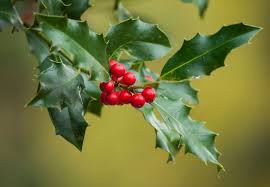
A large evergreen shrub or small tree native to Europe, western Asia, and northwest Africa. Famous for its glossy, dark green leaves with prominent spines (though upper leaves on mature trees can be entire) and bright red drupes on female plants. Widely cultivated and culturally significant, especially during Christmas.

Ilex opaca
American Holly
An evergreen tree native to the eastern and south-central United States. Similar to English Holly but with less glossy, duller green leaves that are typically stiffer, with sharp spines. Produces red drupes. Important ecologically and used ornamentally.

Ilex paraguariensis
Yerba Mate
An evergreen tree native to subtropical South America. Its leaves are harvested, dried, and steeped to produce the stimulating beverage yerba mate, rich in caffeine and theobromine. It has leathery, obovate leaves with serrated margins and produces small reddish drupes.

Ilex vomitoria
Yaupon Holly
An evergreen shrub or small tree native to the southeastern United States. Unique among North American hollies for containing caffeine. Has small, oval, crenate (scalloped) or serrated leaves and produces abundant bright red drupes on female plants. Tolerant of various conditions and popular in landscaping.

Ilex verticillata
Winterberry
A deciduous shrub native to eastern North America, often found in wetlands. Unlike most familiar hollies, it loses its simple, serrated leaves in autumn, leaving dense clusters of bright red drupes along the stems of female plants, providing striking winter interest and food for birds.

Ilex mucronata
Mountain Holly / Catberry
Formerly known as Nemopanthus mucronatus, this deciduous shrub is native to northeastern North America. Found in cool, moist woods and bogs. It has thin, elliptic to obovate leaves with smooth or slightly toothed margins and a distinct bristle tip (mucro). Female plants bear red drupes on long, slender stalks.
Phylogeny and Classification
Aquifoliaceae is placed in its own order, Aquifoliales, within the large Asterid clade, specifically within the Campanulid subgroup (alongside orders like Asterales and Apiales). This placement is strongly supported by molecular data. The order Aquifoliales is relatively small, containing Aquifoliaceae and four other less commonly known families (Cardiopteridaceae, Stemonuraceae, Phyllonomaceae, Helwingiaceae).
Aquifoliaceae itself is dominated by the genus Ilex, which represents an ancient lineage with diversification across the globe. The family's position within the Campanulids suggests a shared ancestry with other major flowering plant groups, but it occupies a distinct branch with its unique combination of characteristics.
Position in Plant Phylogeny
- Kingdom: Plantae
- Clade: Angiosperms (Flowering plants)
- Clade: Eudicots
- Clade: Asterids
- Clade: Campanulids
- Order: Aquifoliales
- Family: Aquifoliaceae
Evolutionary Significance
Aquifoliaceae, primarily through Ilex, represents a successful global radiation of woody plants. Its relatively isolated phylogenetic position in its own order highlights a distinct evolutionary path within the Asterids. Key features contributing to its success include adaptability to diverse climates (from tropical to temperate), effective dispersal via bird-consumed drupes, chemical defenses (saponins, tannins), and reproductive strategies like dioecy. The evergreen habit in many species allows for year-round photosynthesis, particularly advantageous in certain environments.


